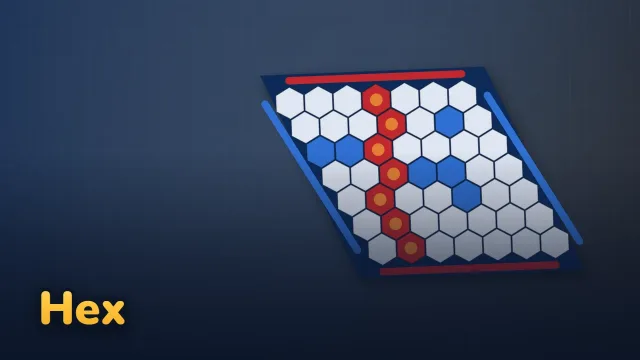
Hex is a two-player connection game played on a rhombus-shaped board made of hexagons. The rule takes a few sentences: players take turns placing stones, and whoever first joins their own two edges with an unbroken chain wins. There are no captures, no sliding stones and no draws, and there is no luck either.
On this page we explain the rules of Hex on CetinsGame exactly as the game applies them. The Mind games collection on our site also has other thinking games such as Reversi, Go, Dots and Boxes, Tower of Hanoi, Chess, Dama and Mangala.
The board and the stones
The board is made of hexagons arranged in a rhombus. In our game you can choose a 7×7, 9×9 or 11×11 board. Two opposite edges are striped red, the other two blue. Each hexagon has at most 6 neighbours; two stones of the same colour that share a side are connected. The corner hexagons touch both a red and a blue edge.
On a phone held upright the board may be turned 90 degrees so it fits larger. That is why the game never says "top" or "left"; it names colours instead: "connect the two red edges".
A move
- Red moves first, then players alternate.
- Each move puts one stone on an empty hexagon. There is no passing.
- Stones are never captured and never move; a stone stays where it is until the end of the game.
- You can place a stone on any empty hexagon; it doesn't have to touch your other stones.
Winning
Red tries to join the two red edges, Blue the two blue edges, with an unbroken chain of stones. The chain doesn't need to be straight; it can bend as much as it likes. Whoever completes their chain first wins at once, even if empty hexagons remain on the board. In the game the winning chain glows gold.
Why are there no draws?
Imagine the board completely full. Either the red stones have joined the two red edges, or the blue stones have built a wall that cuts Red off from one side to the other. That wall is exactly a blue chain joining the two blue edges. Since the only way to stop Red is to win, every game of Hex ends with a winner; this has been proven mathematically. The hexagons matter here: each hexagon shares a full side with its neighbours, so there are no neighbours that touch only at a corner and leave it unclear whether they are connected.
Bridges and edge connections
A bridge is two stones with one hexagon of space between them and two shared empty neighbours. If your opponent plays in one of those two hexagons, you play in the other and your stones are still connected. With a bridge you advance two rows in a single move and stay safely linked.
The same idea works at the edge: a stone one row in from your own edge has two edge hexagons in front of it. If your opponent takes one, you take the other, so that stone already counts as connected to the edge.
The swap rule
Red, who moves first, has a big advantage; a first stone in the centre almost wins on its own. To balance this, Blue may say "Swap" once, right after Red's first stone:
- Red's first stone is removed.
- A blue stone is placed on the hexagon mirrored across the board's diagonal. For example, a stone on row 2, column 5 moves to row 5, column 2. The mirror turns the red edges into the blue edges, so the stone keeps its value: the first stone now belongs to Blue.
- It is Red's turn again.
So Red can place the first stone neither too strongly (Blue will swap) nor too weakly (Blue won't swap and Red falls behind). The swap can only happen right after the first stone, and only once.
Settings in our game
- The swap rule is off on Easy and on for Medium, Hard and Two players. When it is on, a Swap button appears on Blue's turn.
- When the computer is Blue, it swaps if Red's first stone is not on an edge.
- First move option: You, Computer or Take turns. Whoever moves first plays Red.
- The computer plays with exactly the same rules engine you do; there is no luck and no cheating.
Common mistakes
- Thinking stones can be captured: in Hex no stone is ever captured or moved.
- Thinking the chain must be straight: it can bend as much as it likes, as long as it is unbroken.
- Counting two stones that only face each other across a gap as connected: only hexagons sharing a side are connected; two empty hexagons between them make a bridge, not a connection.
- Playing elsewhere when your opponent enters your bridge: if you don't take the other hexagon at once, your link breaks.
- Asking for the swap after Red's second move: the swap is allowed only right after the first stone, and only once.
- Expecting a draw: before the board fills up, someone always joins their two edges.
Frequently asked questions
Who moves first in Hex?
Red does. Against the computer you choose You, Computer or Take turns under First move; whoever moves first plays Red.
Can Hex end in a draw?
No. When the board is full, either Red has joined its edges or the blue stones have formed a chain that cuts Red off, and that chain is Blue's winning chain.
What is a bridge?
Two stones with two shared empty neighbours. If your opponent plays in one of those hexagons, you play in the other and keep your connection.
What is the swap rule?
Right after Red's first stone, Blue may say Swap once. The stone moves to the hexagon mirrored across the diagonal, becomes Blue's, and it is Red's turn again.
Why is there no swap on Easy?
Easy is for beginners, so the swap is off to keep the rules simple in your first games. It is on for Medium, Hard and two-player games.
Which edges are mine?
The two edges striped in your colour. Because the board can turn on an upright screen, the game names colours, not directions: "connect the two red edges".
Who owns the corner hexagons?
Corner hexagons touch both a red and a blue edge, so they count as edge hexagons for both players.
Where can I play Hex?
On CetinsGame, against the computer on three levels and three board sizes, or with two players on one device. The Brain points you win go to the Hex leaderboard.
