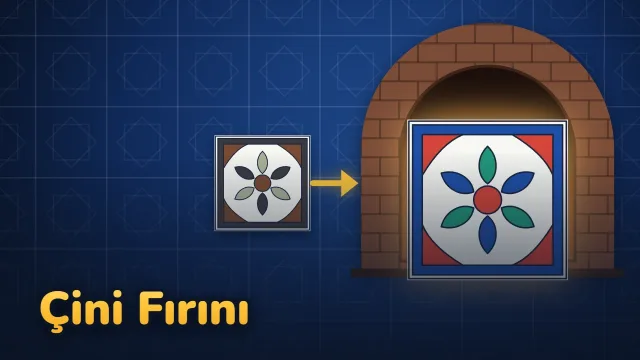
Iznik Kiln is a painting puzzle set in a tile workshop in Iznik. As an apprentice you paint tiles with raw paints and fire them. But raw paints come out of the kiln in very different colours: a grey-black paint turns cobalt blue once fired. The real craft is knowing what the kiln will do. The game has 8 chapters and 36 levels, plus a new "Tile of the day" every day.
Paint, fire, check
- Pick a raw paint jar, then tap areas of the tile.
- Don't touch areas that must stay white; use Erase to clear a mistake.
- Fire: the colours change as they bake. If the result matches the target tile exactly, the level is done.
- Areas that missed are shown striped; try again with Repaint.
The master's notebook
Every paint that comes out of the kiln is written into the master's notebook, with the heat and the colour it became. You discover what each paint does yourself; the notebook never forgets. Under each jar you also see the colours that paint has given so far.
Kiln heat
From the fourth chapter you choose the heat: low, medium, high. Some paints give the same colour at any heat, others turn into very different colours. Too little heat leaves a paint underfired, too much burns it.
Kiln spots and several tiles
In the big kiln two or three tiles fire together. The kiln's mouth fires one step cooler, the fire side one step hotter, the middle at the heat you chose. Put each tile in the right spot: one heat has to work for all of them. The tile tabs show the real heat of each spot.
The journeywoman's hatched areas
Journeywoman Zeynep has already painted some tiles. Hatched areas can't be changed; it's up to you to find the heat at which that paint gives the right colour.
Mixing
In the seventh chapter paints mix: brush a second paint over a painted area and the two mix; the area shows stripes of both colours. Mixes give new colours in the kiln; turquoise, for example, is made this way. Not every mix works: some come out mud brown. Mixes also change with heat and go into the notebook.
The new kiln and the preview glass
In the eighth chapter the mosque's new kiln arrives. Some days it burns one step hotter, some days one step cooler, and it doesn't tell you in advance. The preview glass shows what a painted area will become with these settings, without firing. Look through the glass at a paint whose colour depends on heat and you can read the kiln's mood. The first glass is free.
Stars, the mosque wall and the Tile of the day
- Right on the first firing: 3 stars; second: 2; after that: 1.
- Every perfect tile is hung on the mosque wall; each chapter forms a panel.
- Tile of the day: the same order for everyone each day, with the kiln's hidden mood of the day. Your first result counts: fewer firings, more points. The week's total goes to the leaderboard.
Common mistakes
- Choosing a paint by its raw colour: grey-black comes out blue, brown comes out red.
- Painting an area that should stay white.
- Putting every tile in the middle; the kiln mouth and the fire side fire at different heats.
- Firing the new kiln without reading it first; that's what the preview glass is for.
- In mixing levels, painting over an area to fix it: the paint doesn't change, it mixes. Erase first.
Frequently asked questions
How many levels does Iznik Kiln have?
36 levels in 8 chapters, plus a new Tile of the day every day.
How do I learn what each paint turns into?
By firing, or by looking through the preview glass. Everything you learn goes into the master's notebook.
How are stars given?
Get the tile right on the first firing for 3 stars, on the second for 2, later for 1.
Does the preview glass cost anything?
The first glass in each level is free. If ads are on, the player may choose a short ad for two more.
