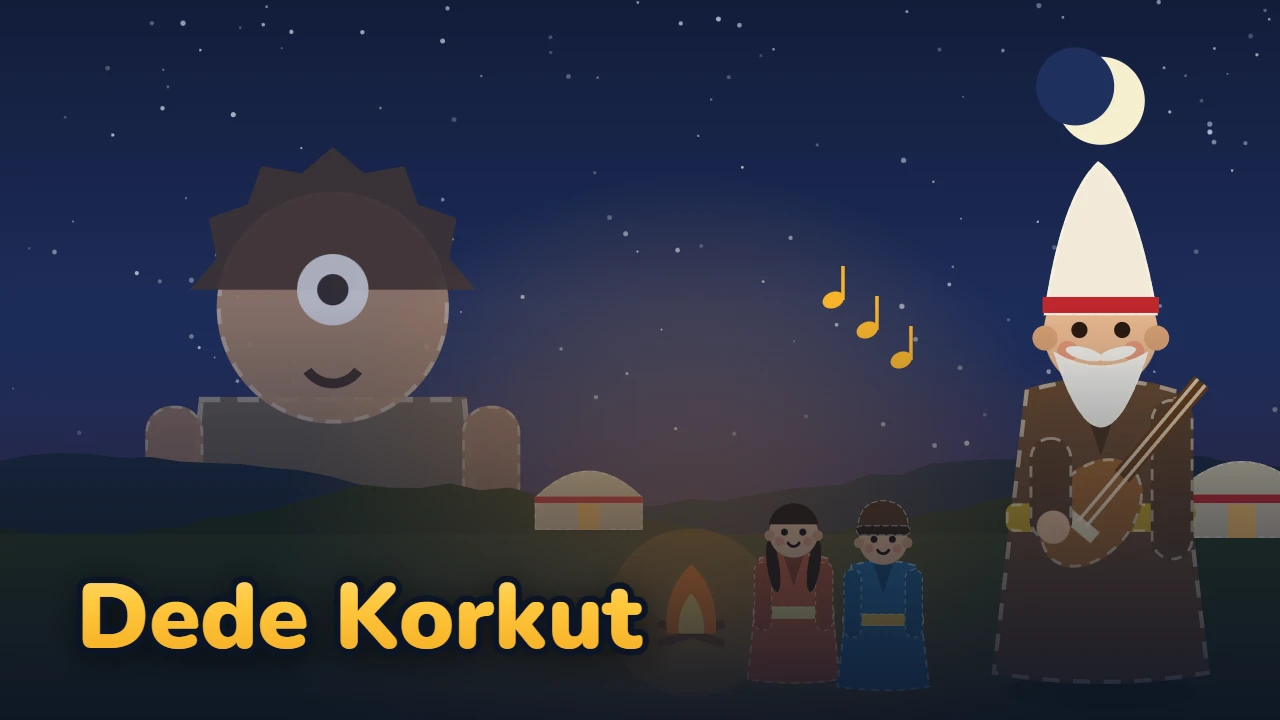
Dede Korkut
Wits, not swords: tell the Oghuz tales step by step.
How to play
Each scene is a small board. Move the hero one square by tapping or swiping in the direction you want, or stay put with Wait. Then everyone on the board makes one move by their own rule: guards walk and look, the bull charges, the lion comes closer, bridges open and close. Red squares are where you would be caught at the end of this step. Visit the ringed spots and reach the glowing goal. If you are caught, the game doesn't end: you go one step back. Find the shortest way (the bard's path) for 3 stars.
How to play Dede Korkut: Tales of the Oghuz - a detailed guide
Dede Korkut: Tales of the Oghuz turns the Dede Korkut stories into a step-by-step board puzzle. There are 12 tales, each with 4 scenes: 48 puzzles in all. In every scene you guide a hero across a small grid to the goal. No luck, no timer: you take one step, then everyone else on the board makes one move according to their own fixed rule. So every scene is really a question of timing: when to walk and when to wait? In these stories wits win, not swords. Nobody is killed; enemies are dodged, tricked or tired out.
Goal and the turn rule
The glowing spot on the board is your goal. In some scenes it is locked: first you must visit every ringed spot (someone to rescue, a key, or the water and the wolf Kazan asks for directions), tire out the bull, or lure the lion into its cage. Once the condition is met, the goal unlocks.
Every turn has two parts. First you move the hero one square or choose Wait. Then guards take one step along their patrol, pursuers come one step closer and bulls charge. Everyone's next move is known in advance, and the same moves always give the same result.
Controls
| What you want | Touch | Keyboard |
|---|---|---|
| Walk one square | Tap in the direction you want, or swipe | Arrow keys or W A S D |
| Stay put | Wait button, or tap the hero | Space, Enter or full stop |
| Take back the last step | Undo | Z or Backspace |
| Start the scene again | Restart | R |
| Hint | Hint | H |
| Break | Menu | Esc |
The What is what? button explains everything on the current board with a picture and one sentence. When something new appears for the first time, this explanation opens by itself. Undo is unlimited.
Red squares, orange squares and getting caught
Before each step the game paints the danger on the board. Red square: if you end this step there, you are caught. Orange squares appear only in disguise scenes: walk onto one and you are spotted, but if you are already there and stand still, you are safe.
Getting caught does not end the game. After a short warning the step is taken back and you keep thinking from where you were. There are no lives, no energy and no timer. If there is nowhere left to move, the game tells you, and you need to undo a few steps and try another way.
The tales and their tricks
Each tale adds a new rule to the board:
- Boğaç Han: when the bull sees you in the same row or column it shouts '!' and charges straight on the next step. Make it crash into posts; after enough crashes it kneels and the gate opens.
- Kazan's Camp: patrolling guards and guards who turn on the spot. A guard sees 2 squares in the direction he faces; inside a bush nobody can see you.
- Bamsı Beyrek and Kazan Set Free: disguise. Don't walk while they look at you; Wait.
- Burla Hatun: the galloping horse doesn't stop until it reaches an obstacle, a ringed spot or the goal.
- Deli Dumrul: bridges open and close; the Dark Rider comes closer every second step.
- Kan Turalı: a bull, a lion and a bull camel. Lead the lion into the cage and the door shuts.
- Yigenek: a castle, keys and a castle dog that disguises don't fool.
- Basat and Tepegöz: the blind giant feels the four squares beside him. Take the ram's fleece and next to the sheep you pass for a sheep.
- Emren: the enemy rider comes closer every second step.
- Seğrek: torches burn at night and guards see 3 squares away.
- The Oghuz Unite: find the scattered beys one by one, with all your tricks together.
Bard's path, stars and Epic points
Every scene has a Bard's path: the number of steps in its shortest solution. Waiting counts as a step; steps you undo don't count.
- 3 stars: within 2 steps of the Bard's path.
- 2 stars: up to the Bard's path + 6 + one third of the Bard's path.
- 1 star: just finish the scene.
A scene is worth up to 300 points; each step over the Bard's path costs 10, a hint costs 50, and the score never drops below 100. With a hint you can get at most 2 stars. Your best score in each scene is added up into your Epic points, up to 14,400, which go to the leaderboard.
Hints, progress and the story
A Hint draws the next 3 steps on the board as golden footprints. One hint per tale is free; after that you can watch a short ad if you want one. If you are in a position with no way out, the hint isn't used up; you are told to undo first.
Finishing a scene opens the next scene of the same tale. Finishing the first scene of a tale also opens the first scene of the next one, so you can leave a tale you're stuck on and come back later. The Tales screen shows your stars for each tale. Dede Korkut opens every tale with illustrated panels, continues the story before the fourth scene and tells its ending; after the 12th tale comes the finale.
Tips
- Check the red squares before you walk: the game already shows what will be dangerous after your next step.
- Waiting isn't a weakness. In many scenes, one well-timed wait is part of the shortest path.
- Guard patrols repeat. Watch one round, then pick your moment to pass.
- When the bull shouts '!', step out of its line at once, and make sure a post stands at the end of that line.
- On horseback the horse won't stop: plan where you'll end up and use ringed spots as stopping points.
- Leave pursuers on the far side of walls; the longer their path, the later they catch up.
- Missed the Bard's path? Hit Restart. Now that you know the way, the second try is much shorter.
The Dede Korkut stories: the bard of the Oghuz and his twelve tales
Dede Korkut is the wise bard of the Oghuz Turks' epic tales, who travels among the tribes and plays the kopuz. The manuscripts known as the Book of Dede Korkut tell stories such as Boğaç Han, Bamsı Beyrek, Deli Dumrul and Basat and Tepegöz; by tradition, Dede Korkut comes at the end of each tale to sing it and give it a name. In 2018 this heritage was inscribed on UNESCO's list of intangible cultural heritage in a joint nomination by Azerbaijan, Kazakhstan and Türkiye. The game's storytelling is our own short retelling for children; instead of battles, wits, courage and loyalty come first.
- Source
- The Book of Dede Korkut, epic tales of the Oghuz Turks
- Known manuscripts
- Dresden (introduction and 12 tales), Vatican (6 tales)
- Storyteller
- Dede Korkut: bard and sage
- The bard's instrument
- Kopuz, a stringed instrument
- UNESCO
- 2018, joint file of Azerbaijan, Kazakhstan and Türkiye
- In the game
- Our own short retelling for children; no battles or blood
The Book of Dede Korkut
The Book of Dede Korkut (Kitab-ı Dedem Korkud in Turkish) is the written form of epic tales the Oghuz Turks passed down from generation to generation. Told aloud for a long time, they survive in two known old manuscripts: the one in Dresden holds an introduction and 12 tales, the one in the Vatican holds 6. Prose and verse are woven together. Each tale is called a boy, and they speak of the courage of the Oghuz beys, family bonds, keeping one's word and loyalty.
Who is Dede Korkut?
In the stories Dede Korkut is both bard and sage. By tradition he is the one the Oghuz turn to for advice in hard times, who gives young heroes their names and counsels the beys. At the end of the tales he arrives with his kopuz and sings the story to its close. The kopuz is a stringed instrument Turkic bards have carried for centuries, and it is seen as the bard's emblem. Dede Korkut's name is still honoured today in Türkiye, Azerbaijan and Kazakhstan, where he is known as Korkyt Ata.
Heroes and stories
The same beys appear again and again: Salur Kazan, the bey of beys, his wife Burla Hatun, their son Uruz, Bamsı Beyrek who strives to reach Banu Çiçek, promised to him since the cradle, and Basat, raised by lions. Boğaç earning his name by defeating a bull, Bamsı Beyrek slipping into a wedding disguised as a bard, and Basat facing the one-eyed giant Tepegöz are among the best-known episodes. The likeness between the Tepegöz story and Polyphemus in Homer is often pointed out.
In the game
The game's 12 tales follow the order of the 12 stories in the Dresden manuscript. But the storytelling in the game is our own short retelling for children, not a translation. No battles, blood or deaths are shown: in the original, the animals in Kan Turalı's trials are killed, while in the game they tire out and kneel or end up in a cage. The figure of death in Deli Dumrul's tale is drawn as the Dark Rider. If you're curious about the real stories, we recommend reading the text itself.
Today
In 2018 the "Heritage of Dede Qorqud/Korkyt Ata/Dede Korkut, epic culture, folk tales and music" was inscribed on UNESCO's Representative List of the Intangible Cultural Heritage of Humanity, after a joint nomination by Azerbaijan, Kazakhstan and Türkiye. The stories keep being retold in school books, on stage, in cartoons and in TV series.
How Dede Korkut was made
The game started from one line: wits, not swords. In the Dede Korkut stories, courage is often shown through cunning, patience and loyalty; Bamsı Beyrek disguises himself as a bard, Basat wraps himself in a ram's fleece, Boğaç tires out a bull. So instead of twelve separate mini-games, the game rests on a single rule: on a small grid the hero takes one step, then everyone else makes one move according to their own fixed rule. Each tale adds a new trick drawn from its own story: a bull that tires itself out against posts, a bard's disguise, bridges that open and close, a blind giant feeling around with his hands.
The most important design decision was about violence. In similar step-by-step puzzles the enemy is usually eliminated; here nobody is killed. Enemies are dodged, tricked or tired out. Animals that die in the original text kneel or end up in a cage in the game. Religious motifs were left out; death in Deli Dumrul's tale became the Dark Rider. The stories were rewritten as short retellings for children, and the game says plainly that they are not a translation.
Not punishing the player was also deliberate. There are no lives, no timer and no luck; squares that will be dangerous after the next step are shown in red, getting caught only takes back one step, and undo is unlimited. The challenge lies less in finishing a scene than in finding the shortest way: the shortest solution, called the "Bard's path", is the measure for stars. Before release it was checked that all 48 scenes can be solved and how many steps each shortest path takes.
The art has a felt-and-appliqué look and is drawn in code, without yarn or thread motifs. The music, a kopuz-like melody in the Uşşak makam, is synthesised in code, and the sound effects are original too. The game is playable in seven languages; heroes keep their Turkish spelling everywhere, and in Russian they are written in Cyrillic so they are easy to read.
Frequently asked questions
What do the red and orange squares mean?
A red square is where you'll be caught if you end this step there. Orange squares appear only in disguise scenes: walk onto one and you're spotted, but if you're standing on it and stay still, you're safe.
What happens when I'm caught? Do I replay the scene?
No. When you're caught, the last step is taken back and you carry on from there. There are no lives or timer, and you can undo as much as you like or Restart.
What is the Bard's path?
The Bard's path is the number of steps in the scene's shortest solution. Finish within 2 steps of it for 3 stars. Undone steps don't count, but Wait does count as a step.
How do I tire out the bull?
When the bull sees you in the same row or column it shouts '!' and charges straight that way on the next step. Stand with a post behind you and step aside when you see the '!'. After enough crashes into posts, the bull kneels and the gate opens.
Why can't I walk in the bard's disguise?
You can, but if a guard is looking at you while you walk, the disguise fails. Choose Wait on a watched square and you're taken for a bard playing the kopuz. The castle dog isn't fooled by disguises, though: it smells you.
How do I hide from Tepegöz?
Tepegöz is blind and feels the four squares next to him with his hand. Once you've taken the ram's fleece, stand right next to a sheep and he'll think you're a sheep too.
How many hints are there and how do they work?
One hint per tale is free; after that you can watch a short ad if you want another. A hint shows the next 3 steps as golden footprints, but you can get at most 2 stars in that scene.
I'm stuck in a tale. Can I move on to the next one?
Yes. Finishing the first scene of a tale opens the first scene of the next. You can return to the remaining scenes later from the Tales screen.
How are Epic points calculated?
Each scene gives up to 300 points; every step over the Bard's path costs 10 and a hint costs 50, with at least 100 left. Your best scores from all scenes add up to your Epic points, at most 14,400.
Are the stories in the game the same as in The Book of Dede Korkut?
The tales follow the order of the 12 stories in the book, but the telling is a short retelling for children. No battles or blood are shown; enemies are dodged, tricked or tired out.
Is Dede Korkut free?
Yes. No download or account needed; it plays right in your browser. Watching an ad for a hint is always your choice.
Will I lose my progress?
Your progress is saved automatically on this device. Sign in and it moves to your account, so you can continue on any device.
Can I play on my phone?
Yes. The game opens full screen on phones; tap the X in the corner to exit. On iPhone use "Add to Home Screen" to play it like an app.
Can I play Dede Korkut offline?
Yes. A game you have opened once is stored on your phone or computer and opens without internet. Leaderboards and cloud saves need a connection.
Which languages are available?
Turkish, English, Spanish, Portuguese, German, French and Russian.
Comments
Sign in to write a comment.
No comments yet. Be the first.
