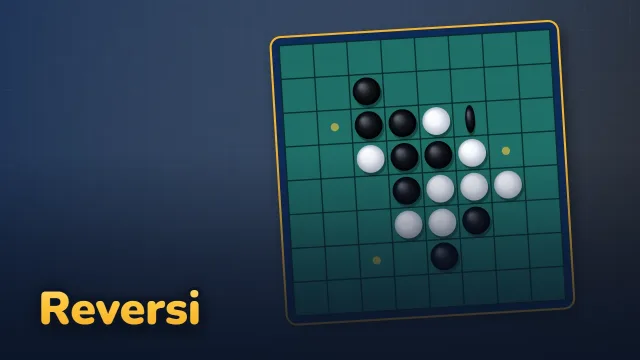
Reversi is a trapping game for two players on an 8×8 board. Each disc is black on one side and white on the other; when you trap your opponent's discs between two of your own, they are turned over to your colour. The rules take a few minutes to learn, but because discs change hands again and again, playing well takes a lot of practice.
This page explains the rules of Reversi on CetinsGame exactly as the game applies them. They are the same rules played in tournaments today. The six-step Learn section in the game teaches the same rules by letting you try them on the board.
The board and the discs
The board has 8×8, 64 squares in total. At the start there are 2 black and 2 white discs placed diagonally on the four centre squares: top left and bottom right are white, top right and bottom left are black. The other 60 squares are empty. Black moves first, then the players take turns. Once a disc is on the board it never moves and is never removed; it only changes colour.
A move: trap and flip
- Place a disc of your colour on an empty square.
- Every opposing disc lying in an unbroken straight line (horizontal, vertical or diagonal) between your new disc and another of your discs is flipped.
- You can't place a disc where it flips nothing. A legal move must flip at least one opposing disc.
- Only the discs trapped by the new disc are flipped; the flipped discs themselves don't start a new flip.
Example: if a row reads empty, white, white, white, black from left to right, Black plays on the empty square at the left and all three white discs turn black. If the row were empty, white, empty, white, black, a black disc on the leftmost square would flip nothing in that row, because there is a gap. And if the row empty, white, white ends at the edge of the board, there is no flip either: there is no black disc at the other end of the white ones.
Flipping in several directions
From each square you look in eight directions: two horizontal, two vertical and four diagonal. A move flips discs in every direction where it makes a trap, and all these flips happen at once. That is why a single disc can change the look of the board in an instant.
The starting position: Black has four options on the first move, and each flips exactly one white disc. The four moves are mirror images of each other, so the choice doesn't change the course of the game. The real differences begin on the second and third moves.
Passing
- A player who has no legal move on their turn passes, and the turn goes to the opponent. Our game does this automatically and shows a short message.
- A player who has a legal move may not pass; they must play one, even if they don't like any of them.
- After passing, a player may find a move again once the opponent has played; the game simply goes on. A player can pass several times in a row.
The end of the game and the count
- The game ends when neither player can move. Usually this happens when the board is full, but it can also end with empty squares left if neither side can flip anything. The game also ends if one colour disappears from the board completely.
- The player with more discs on the board wins. If the counts are equal, for example 32 each, the game is a draw.
- Since every move fills one empty square, a game lasts at most 60 moves.
In some tournaments, if a game ends with empty squares, those squares are added to the winner's count. Our game shows the result using only the discs on the board; who wins and who loses is the same either way.
Corners, edges and basic strategy
- A disc in a corner can never be flipped, because no line can trap it from both sides. Corners are the most valuable squares on the board.
- Playing early on the square diagonally next to a corner can hand that corner to your opponent. The two edge squares next to a corner are risky in a similar way.
- Edge discs can only be flipped along the edge; a chain of edge discs starting from a corner often lasts until the end.
- Early and in the middle of the game, collecting many discs usually hurts. The side with few discs but many possible moves can force the opponent onto bad squares.
The computer opponent
There is no luck in the game; the computer calculates its moves with exactly the same rules engine you use. Easy is for beginners and often plays at random. Medium knows the value of corners and looks a few moves ahead. Hard calculates deeply and, once 12 empty squares are left, solves the rest of the game exactly. You can choose who moves first, You, Computer or Take turns, and two people can also play on the same screen.
Common mistakes
- Trying to play on a square that flips nothing: a legal move must flip at least one opposing disc.
- Thinking you have trapped a row with a gap in it: the trapped discs must form an unbroken line.
- Forgetting the diagonals: flips happen in the four diagonal directions as well as horizontally and vertically.
- Wanting to pass when you have a move: a player with a legal move must play.
- Flipping as many discs as possible on every move early on: it leaves your opponent lots of options.
- Playing diagonally next to an empty corner: your opponent will often take that corner.
Frequently asked questions
How many discs are there in Reversi?
The board has 64 squares. The game starts with 4 discs in the centre and one disc is added each move, so a full board holds 64 discs.
Who moves first in Reversi?
Black moves first. In our game you can choose whether you or the computer starts, or let it alternate every game; whoever starts plays Black.
In how many directions does a move flip?
In every direction where it makes a trap. A disc looks in up to eight directions: two horizontal, two vertical and four diagonal.
What happens if I have no move?
A player with no legal move passes and the turn goes to the opponent. If neither player has a move, the game ends.
Can Reversi end in a draw?
Yes. If both colours have the same number of discs at the end, the game is a draw.
Can a corner disc be flipped?
No. No line can trap a corner disc from both sides, so a corner stays with whoever takes it until the end.
Can the game end before the board is full?
Yes. If neither player can find a legal move, or one colour has no discs left, the game ends even with empty squares.
Where can I play Reversi?
On CetinsGame you can play against the computer at three levels or with two players on one screen. Your brain points go to Reversi's own leaderboard, and the game has eight badges to earn.
