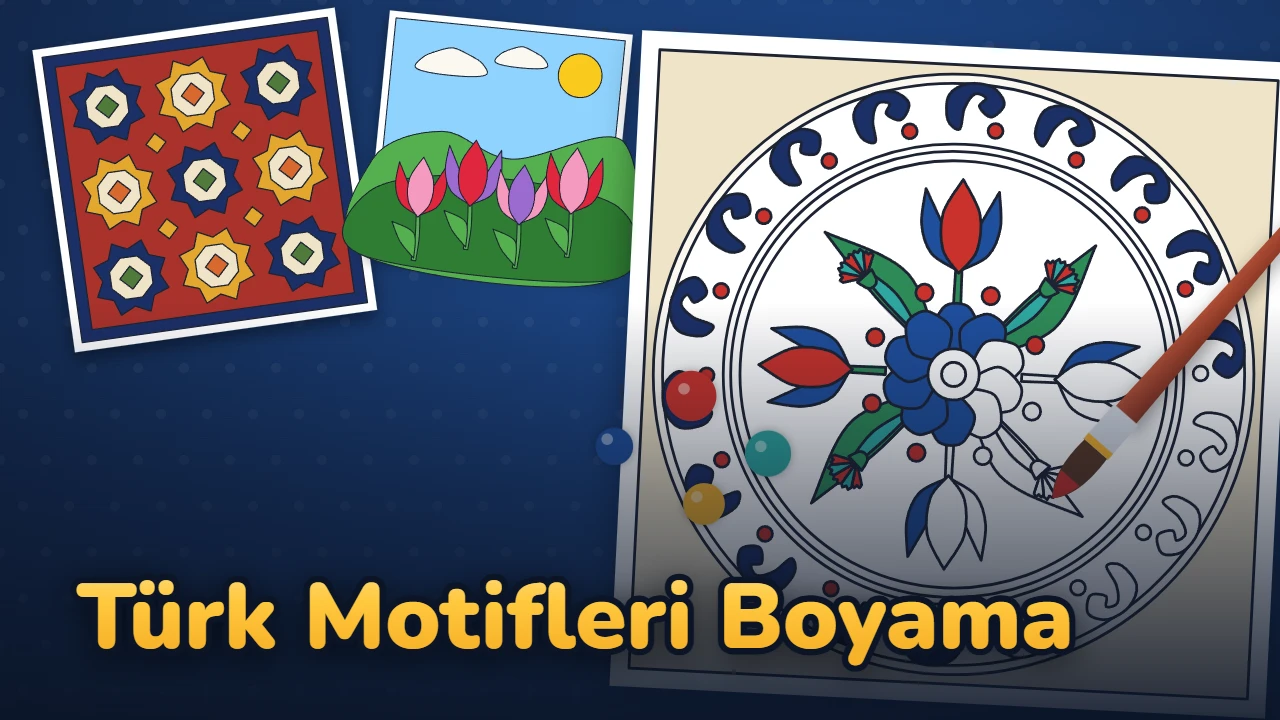
Turkish Patterns Coloring Book
Tap to color tiles, kilims, ebru marbling and shadow puppets.
How to play
Pick a color and tap the area you want to paint: it fills with that color at once. The lines always stay on top, so the color never goes outside the lines. In Free coloring you choose the color, the palette and the fill style; once half of the page is colored, the Done button becomes available. In Color by number every area has a number, and each number is one of the page's traditional colors; the page finishes by itself when the last area is colored. After every page a short culture card tells you about the motif, and your finished picture goes into the Album.
How to play Turkish Patterns Coloring Book: a guide for kids and parents
Turkish Patterns Coloring Book is a coloring book full of Turkish motifs: tiles, kilims, ebru marbling, evil eye beads and the shadow puppets of Karagöz. Tap a color, then tap an area, and the area fills with that color. There is no losing, no timer and no score race; every page is finished at the child's own pace.
The book also has a little story: Deniz finds faded pattern books in Grandpa's attic, Grandpa asks Deniz to bring their colors back, and Colorful Bird helps. When every page is finished, the whole neighborhood comes to Deniz's show.
How to color
Pick a color, then tap the area you want to paint. The lines always stay on top, so the color never goes outside the lines, and even small fingers make a neat picture.
- Undo and Redo are unlimited.
- Pinch with two fingers or use the mouse wheel to zoom in up to 8x; when zoomed in, drag to move around. Dragging never paints.
- Fit brings the whole page back onto the screen.
- Find (the magnifier) zooms to the smallest area that is still empty.
On a keyboard, Ctrl+Z undoes and Ctrl+Y redoes; + and - zoom in and out, and 0 fits the page.
Free coloring
In Free coloring you paint each area any color you like. There are six palettes: Iznik, Kilim, Ebru, Spring, Night and All, which offers all 54 colors. Next to the color you pick one of five fills: Plain color, Ebru waves that ripple like paint on water, golden Gold leaf, Tile dots and cheerful Polka dots. The Eraser removes the color from an area. Once half of the page is colored, the Done button becomes available.
Color by number
In Color by number every area has a number, and each number is one of the page's own traditional colors. Tap an area with a different number and nothing is painted; the area just shakes and shows its number. When every area is colored, the page finishes by itself and the motif appears in its traditional colors. This mode has its own page with a detailed guide.
Books, difficulty and seals
The 30 pages are divided into six books. Every page is open from the start; nothing is locked.
| Book | Pages | Examples |
|---|---|---|
| Tiles | 5 | Tulip Rosette, Iznik Plate |
| Kilim | 5 | Eye Motif, Hands on Hips |
| Ebru marbling | 5 | Stone Marbling, Hatip Marbling |
| Garden | 6 | Evil Eye Tree, Street Fountain |
| Istanbul and the roads | 5 | Maiden's Tower, Camel Caravan |
| Karagöz | 4 | Hacivat, Shadow Theater Screen |
Difficulty depends on the number and size of the areas: Easy pages (8) have a few big areas, Master pages (5) are full of small pieces, and Medium pages (17) are in between. Pages have about 15 to 127 areas. Finishing a page earns a seal for that mode; since each page can be finished in both modes, there are 60 seals in all. Finished pages are kept in the Album.
Culture cards, Save picture and Share
At the end of every page a short culture card tells you about the motif in a few sentences. Save picture downloads the colored page to the device as a 1600×1600 PNG picture, and Share lets you share it. Both sit behind a parent gate: the screen says Show a grown-up, and the button has to be pressed and held for 3 seconds to continue. That way a small child cannot send a picture by accident.
For parents
We made this game with young children in mind. On top of our site's general principles:
- No leaderboard and no competition. No points, no timer, no comparing with others.
- No rewarded ads at all. An interstitial ad appears only after a finished page, at most once every 3 finished pages and at least 2 minutes apart. Ads never appear while coloring.
- No chat, no purchases and no external links.
- No account needed. Progress is saved on the device, and also in the cloud if you sign in.
- The music and sound effects are original and made in code; each can be turned off separately.
We suggest it for ages 3 to 10, with the Easy pages for the youngest. Coloring helps with fine motor skills, recognizing colors and the numbers 1 to 10. The culture cards are nice to read together with your child.
Tips
- For the youngest, start with Easy pages: Tulip Rosette, Eye Motif and Evil Eye Bead have a few big areas.
- If a tiny area is hard to hit, zoom in with two fingers first; dragging never paints, so you can move around freely.
- If Done stays unavailable, press Find to see the small piece that is still empty.
- Try the same page again with the Night or Spring palette for a whole new picture.
- Use Gold leaf and Ebru waves on big areas; the pattern shows best on a wide space.
Turkish motifs: tulips, kilims, ebru, the evil eye and shadow play
Tulips, carnations and rumi curls are among the most common motifs on Ottoman tiles, fabrics and book art. Kilims are woven with geometric motifs such as the eye, elibelinde, the ram's horn and the star, and by tradition each one has a meaning. Ebru is the art of sprinkling paint onto thickened water, and Karagöz is a shadow play performed behind a lit screen. The 30 pages of this coloring book grew out of these traditions.
- Finest age of Iznik tiles
- 16th century
- Famous Iznik colors
- Cobalt blue, turquoise, coral red
- Homeland of the tulip
- Central Asia
- Kilim
- A flat-woven rug with no pile
- Ebru on the UNESCO list
- 2014
- Karagöz on the UNESCO list
- 2009
Flowers on tiles: tulip, carnation and rumi
The tulip is the best-loved flower of Ottoman decoration; because of this love, the early 18th century is called the Tulip Era. Tulips first grew wild in Central Asia and reached Europe from Ottoman lands in the 16th century. Next to the tulip, the carnation is one of the flowers most often painted on Iznik tiles; the long, curving leaves beside it are called saz leaves. Rumi is a curling, forked ornament that looks like a wing or a leaf; its name is said to come from Rum, an old name for Anatolia. Iznik tiles reached their finest age in the 16th century.
The language of kilims
A kilim is a flat-woven rug with no pile. By tradition, each of its geometric motifs carries a meaning:
- The eye: protection from unkind looks.
- Elibelinde: a woman with her hands on her hips, standing for motherhood and plenty.
- The ram's horn: strength and courage.
- The star: an eight-pointed star carries a wish for happiness.
- The water path: one of the zigzags along the borders; water is the source of life and plenty.
Ebru: a picture on water
Ebru is the art of sprinkling paint onto thickened water; when paper is laid on the water, the pattern moves onto it. Its most basic form is battal: the colors are lifted onto paper without any combing, and because it looks like a pile of stones it is also called stone marbling. In wave marbling the colors are combed back and forth into waves. In hatip marbling, drops inside each other are pulled from four sides into stars and hearts; the style is said to be named after a master. Turkish ebru was added to UNESCO's list of Intangible Cultural Heritage in 2014.
The evil eye bead
The evil eye bead, or nazar, is a dark blue glass bead with an eye in the middle. It is shaped from hot glass at a furnace: the glassmaker adds white, light blue and black rings on top of the dark blue glass. By tradition it protects against envious looks. In some gardens, beads are hung on the branches of trees.
Karagöz and Hacivat
Karagöz is a shadow play performed behind a lit screen. The figures are cut from leather and painted; when light shines through the leather, they appear in color. Karagöz is a cheerful, outspoken man of the people, while his friend Hacivat speaks in a fancy, bookish way. Legend says the two were real people who lived in Bursa. Karagöz was added to UNESCO's list of Intangible Cultural Heritage in 2009. Deniz, Grandpa and Colorful Bird, on the other hand, are fictional characters written for this book.
How was Turkish Patterns Coloring Book made?
Coloring games are among the most searched children's games, but most of their pages look alike: animals, cars, cartoon heroes. We wanted children to discover something while they color. That's why all 30 pages come from Turkish motifs: the tulips and carnations of Iznik tiles, the eye and ram's horn motifs of kilims, ebru marbling patterns, the evil eye bead, the Maiden's Tower, a caravanserai gate and the Karagöz shadow screen.
Our first decision was that the paint must never go outside the lines. For a small child, the most frustrating thing is color slipping over the line. In the game, every page is drawn area by area and the lines always stay on top of the colors; wherever a finger lands, only that area fills. Every page was drawn in code, shape by shape. Then each page went through a computer test: no area gets lost, every area's number falls inside it, and even the smallest area is easy to color once you zoom in.
In Color by number, we didn't give the numbers random colors. The numbers on each page are the traditional colors of that motif: when the Iznik plate is finished, cobalt blue, turquoise and coral red appear, and the kilim pages come together in madder red and navy. A child who taps the wrong number gets no penalty; the area only wiggles and shows its own number. For Free coloring, we added fills such as Ebru waves, Gold leaf and Tile dots next to the usual plain colors, so the result looks like a real work of art.
Every page ends with a short culture card. On the cards we only used well-known facts, and for legends and customs we said "according to tradition" or "as the story goes". Child safety decisions were clear from the start: no leaderboard and no competition, no rewarded ads at all, and interstitial ads only when a page is finished, at most once every three pages. To save or share a picture, a grown-up has to hold the button for three seconds.
In the story, Deniz finds faded pattern books in Grandpa's attic and brings their colors back; when every page is finished, Deniz opens an exhibition for the whole neighborhood. The music is a calm tune close to the Uşşak makam; the music, sounds and visuals were all made in code. The game was released as version 1.0 on 14 October 2026 and can be played in seven languages.
Frequently asked questions
What age is Turkish Patterns Coloring Book for?
We suggest ages 3 to 10. The youngest can start with the Easy pages, which have a few big areas; older children usually enjoy the detailed Master pages and Color by number more.
Can my child share a picture by accident?
No. Save picture and Share sit behind a parent gate: the button has to be pressed and held for 3 seconds to continue. The game also has no chat and no external links.
Does the color go outside the lines?
No. Every tap fills one area, and the lines always stay on top. That is why even small children whose hands are still unsteady end up with a neat picture.
What does color by number teach a child?
Recognizing numerals, matching each number with a color and tapping a small area with care. There is no penalty for a wrong number: the area just shows its own number, and the child tries again to find the right color.
Why are the colors always the same in Color by number?
Because every page has its own traditional palette. When the numbers are done, the motif appears in its real colors, like the Iznik plate in cobalt blue, turquoise and coral red. A child who wants to pick their own colors can open Free coloring.
Can I print the picture we colored?
There is no print button. First use Save picture to download the page as a 1600×1600 PNG picture, then print that picture from your own device. Saving requires pressing and holding the button for 3 seconds.
Do ads interrupt my child's coloring?
No. This game has no rewarded ads at all. An interstitial ad can appear only after a finished page, at most once every 3 finished pages and at least 2 minutes apart, and never while coloring.
Why can't I press the Done button?
In Free coloring, the Done button becomes available once half of the page is colored. Keep coloring a little more, and use the Find button to see where empty areas are left.
What are seals, and how many are there?
You get a seal for a mode when you finish a page in it. Each of the 30 pages can be finished separately in Free coloring and in Color by number, so there are 60 seals in total.
Is Turkish Patterns Coloring Book free?
Yes. No download or account needed; it plays right in your browser. Watching an ad for a hint is always your choice.
Will I lose my progress?
Your progress is saved automatically on this device. Sign in and it moves to your account, so you can continue on any device.
Can I play on my phone?
Yes. The game opens full screen on phones; tap the X in the corner to exit. On iPhone use "Add to Home Screen" to play it like an app.
Can I play Turkish Patterns Coloring Book offline?
Yes. A game you have opened once is stored on your phone or computer and opens without internet. Leaderboards and cloud saves need a connection.
Which languages are available?
Turkish, English, Spanish, Portuguese, German, French and Russian.
Comments
Sign in to write a comment.
No comments yet. Be the first.
