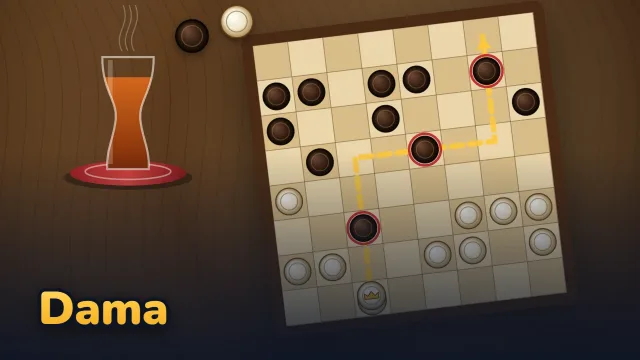
Dama is one of the most played board games in Türkiye, in coffeehouses, parks and homes. Turkish draughts is played orthogonally, not diagonally: men move forward and sideways, and a king (dama) moves any distance in a straight line and captures from afar. That makes it quite a different game from international draughts and English draughts (checkers).
On this page we explain the rules of Dama on CetinsGame exactly as the game applies them. The rules follow Turkish draughts sources; only one rule (the long-game limit) is specific to our game, and we say so.
Board and pieces
Dama is played by two players on an 8×8 board. Each player has 16 men, placed on their 2nd and 3rd rows; the back row starts empty. White moves first, then the players alternate.
A traditional Turkish board may be a single colour: since the game is played along straight lines, square colours do not matter.
How a man moves
A man moves one square forward or one square sideways (left or right) to an empty square. It never moves backward or diagonally.
Capturing: compulsory, and the most pieces
A man jumps over an enemy piece directly in front of it or beside it and lands on the empty square right behind; the jumped piece is captured. A man does not capture backward. Two pieces standing one behind the other cannot be jumped.
- Capturing is compulsory. If a capture is available, no other move is allowed.
- If you can capture again from your landing square, you keep capturing in the same move (multiple capture).
- If there are several routes, you must play the one that captures the most pieces. Kings and men count the same. Among equal routes, you choose.
Captured pieces are removed at once
This is the rule that sets Turkish draughts apart from international draughts: in a multiple capture, each captured piece leaves the board immediately after it is jumped. The chain may continue through squares that have just become empty. The same piece cannot be captured twice, because it is already off the board.
Crowning and how a king moves
A man that reaches the opponent's back row becomes a king (shown in our game as two stacked pieces with a gold crown). A king moves any number of empty squares in a straight line in four directions (forward, backward, left, right); it never moves diagonally and never jumps over pieces when moving.
A king captures from a distance: along a line, even with empty squares in between, it jumps a single enemy piece and lands on any empty square beyond it. The maximum-capture rule applies here too: if the capture can continue, only landing squares that continue it are allowed. During a multiple capture a king may not turn back the way it came (no 180° turn); it may turn left or right.
If a man reaches the back row during a capture and can keep capturing sideways from there, it continues as a man; it is crowned if it ends the move on the back row.
Winning and draws
You win by capturing all of your opponent's pieces or by leaving your opponent with no legal move on their turn. A player who resigns loses.
The game is drawn when:
- The same position (same pieces, same player to move) occurs three times.
- Only one king against one king is left.
- Both sides agree (in our game you can offer the computer a draw).
- Our game's rule: 25 moves each pass with no capture and no man moving forward. This CetinsGame rule stops kings from circling forever.
What's in CetinsGame Dama?
- Quick Game: against the computer at Easy, Medium or Hard; play White, Black or random.
- Daily Puzzle: the same "win in 2 or 3 moves" position for everyone each day, 3 tries and a daily streak.
- Two Players: with a friend on the same device.
- When capturing is compulsory, the pieces that must capture glow and each stop of the chain is shown; undo and a "What would the master play?" hint.
Quick strategy tips
- Keep your men side by side and one behind the other: two pieces in a row cannot be captured.
- Look for chains where you give up one piece to capture several; combinations are very strong in Turkish draughts.
- The first to crown often wins: keep your path to the back row open and block your opponent's.
- Trade pieces when you are ahead; your advantage grows as the board empties.
Common mistakes
- Trying to move another piece while a capture is available: capturing is compulsory.
- Choosing a route that captures one piece when another route captures more; the larger capture is compulsory.
- Trying to move a man backward or diagonally: men only move forward and sideways.
- Removing captured pieces at the end of the move: in Turkish draughts each captured piece leaves at once.
- Forgetting that a king captures from afar and leaving a piece unprotected on its line.
- Trying to turn a king back the way it came during a capture: a 180° turn is not allowed.
Frequently asked questions
How is Turkish draughts different from regular draughts?
In Turkish draughts pieces move straight (forward and sideways) instead of diagonally, each player has 16 men, kings move any distance in a straight line, and captured pieces are removed at once. International and English draughts are played on the diagonals.
Is capturing compulsory?
Yes. If a capture is available, no other move is allowed; if there are several routes, the one capturing the most pieces must be played.
Does a king count more than a man?
Not when counting captures: under the maximum-capture rule a king and a man each count as one.
Can a man capture backward?
No. A man captures forward and sideways only. A king can capture in all four directions.
Can a king turn back during a capture?
No. Between two captures a king may not reverse direction; it may turn left or right.
When is the game a draw?
When the same position occurs three times, when one king faces one king, or by agreement. In our game the game is also drawn after 25 moves each with no capture and no man moving forward.
