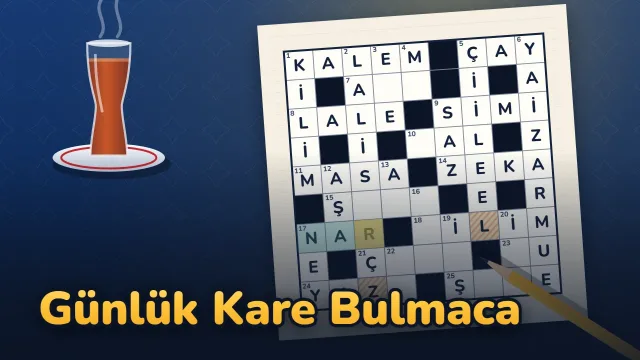
Daily Crossword is the classic newspaper crossword with black squares, renewed every day. White squares hold letters, black squares separate the words, every word starts in a numbered square, and the clues sit in two lists: Across and Down. The puzzle is finished when every white square holds the right letter.
This page explains how to solve a crossword, what Across and Down mean, how a crossword differs from an arrow word, which short words come up often, how the daily secret word works, how the score is calculated and which solving tips really help.
How do you solve a crossword?
Read a clue, find the answer and write it into the grid starting from the square with that clue's number. The answer is as long as the run of white squares from the numbered square to the next black square or the edge of the grid. Every letter is shared by two words: when you fill in an Across word, you also get one letter of each Down word that crosses it.
Here is how typing works in the game:
- Tap a square to select its word. Tap the same square again to switch direction (from Across to Down or back).
- Type with the game's own on-screen keyboard, which has the letters your puzzle language needs. Your phone's keyboard does not open and never covers the grid.
- As you type, the cursor moves along the word and skips filled squares; at the end of the word it jumps to the next empty word. Delete first clears the square, and if it is already empty it steps back.
- The clue bar under the grid shows the selected clue. Use the arrows on either side to go to the previous or next clue; tap the bar to see every clue.
- On a computer you can type on your physical keyboard: the arrow keys move between squares, Tab goes to the next clue (Shift + Tab to the previous one) and Space switches direction.
- On the 13×13 puzzle, phones get a Zoom the grid button.
What do Across and Down mean?
They tell you which way to write the answer. The answer to an Across clue starts in the numbered square and runs to the right, horizontally. The answer to a Down clue starts in the numbered square and runs downwards, vertically.
The same number can appear in both lists: that square starts both an Across word and a Down word. If the clue bar says "4 Across", you write from square 4 to the right; if it says "4 Down", you write from the same square downwards. The highlighted word shows the current direction, and one more tap on the same square switches it.
Crossword vs arrow word: what is the difference?
Both are solved through crossing words; the difference is where the clues are.
| Crossword | Arrow word | |
|---|---|---|
| Clues | Outside the grid, in two numbered lists: Across and Down | Inside the grid, in boxes with arrows that point the way |
| Black squares | Empty, they only separate words | Often used as clue boxes |
| Numbers | In the square where each word starts | Usually none |
| Clue length | Can be a full sentence | Short enough to fit in a box |
In short, in an arrow word you read the clue inside the grid right next to the answer; in a crossword you find the number in the list and read the clue there. In Turkish these are called çengel bulmaca and kare bulmaca. Daily Crossword is the second kind.
Short words that often appear in crosswords
Daily Crossword follows the Turkish newspaper style, where two-letter words are allowed, so knowing short words speeds you up a lot. Short words you will often meet:
- Musical notes: do, re, mi, fa, sol, la. If a clue says "a musical note" or "the first note of the scale", the answer is one of these.
- Two-letter words: everyday words such as at, in, on, up or go in English.
- Three-letter words: common words rich in vowels, such as age, ear, era or ice.
These are only examples, not the answer to any particular day. Our clues are written in plain everyday language instead of stock crossword fillers, so you can work out the short words from the clue itself.
What is the secret word?
In every puzzle some squares are shaded. Read in order, their letters spell the day's secret word: a word from Turkish culture, such as a province, a dish, a craft or a musical instrument. It is our version of the keyword hidden in shaded squares in many Turkish newspaper puzzles.
You can guess the secret word before you finish: tap the secret word boxes next to the grid, type your guess and press Try. A correct guess earns +200 points. A wrong guess costs nothing; as you solve the puzzle, the shaded letters fill in and the word becomes clearer. When the puzzle is done you get a short culture note about the secret word.
When does the daily crossword change?
A new puzzle arrives every day at midnight Turkey time, and everyone solves the same puzzle that day. Puzzles are numbered: 14 October 2026 is #1, and the number goes up by one each day. A countdown in the game shows how long until the next puzzle.
- Monday to Friday: 9×9, made for a short break.
- Saturday and Sunday: 13×13, the weekend puzzle.
- Difficulty rises from Monday to Sunday: early in the week the clues are easier and the words more common, and Sunday is the hardest.
Days you missed stay in the Archive and can all be played; archive puzzles do not count toward your streak and give half points. The game is available in 7 languages, and each language has its own puzzle built from its own words, not a translation. You can change it under Puzzle language in the How to play window.
How is the score calculated?
The base score is 1000 on 9×9 and 2000 on 13×13. After a time threshold the score starts to drop: past 4 minutes on 9×9 and 12 minutes on 13×13, every minute takes away 4% of the base score, up to 50% in total. Then the helps you used are subtracted:
| Help | What it does | Cost |
|---|---|---|
| Check | Marks wrong letters in the selected word | -20 points |
| Letter (reveal letter) | Fills in the right letter in the selected square | -50 points; 3 free a day, then by watching an optional rewarded ad |
| Word (reveal word) | Fills in the whole selected word | -150 points; by watching an optional rewarded ad |
| Solve (show the solution) | Reveals every answer | The day counts as unsolved and your streak breaks |
If Show wrong letters instantly is on in the settings, the score is halved. Guessing the secret word early adds +200. The minimum score is 100, and archive puzzles give half. Example: you finish a 9×9 puzzle in 7 minutes with one Check. You are 3 minutes past the threshold, so time takes away 12%: 880. Minus 20 for the Check: 860 points.
Your streak is the number of days in a row you solved the daily puzzle. Points from the week are added up for This week's best; the week starts on Monday. How everyone did shows how many players finished that day and how many solved it with no help. Statistics keep your average and best times separately for 9×9 and 13×13.
Crossword solving tips
- Start with what you are sure of. Skim all the clues and fill in the short words you know right away. Notes and two-letter words make a good start.
- Use the crossing letters. Every word you write gives letters to the words that cross it. Coming back to a hard clue once a few letters are in often gives the answer away.
- Count the squares. The number of squares is the number of letters; if your idea does not fit, think of a synonym.
- Mind the form of the clue. If the clue is plural or a verb, the answer usually is too.
- Work out from corners and edges. Finishing one area and moving to the next is easier than scattering letters around the grid.
- Keep the secret word in mind. Once a few shaded squares are filled, try to guess it; a correct guess earns points and confirms those letters.
- Save the helps for last. Check costs only 20 points; try it to find a wrong letter before revealing a whole word.
Common mistakes
- Mixing up the direction: the same number can be in both lists. Check whether the clue bar says Across or Down, and tap the same square again if the direction is wrong.
- Writing a long word you are unsure of first: one wrong long word misleads every word that crosses it. Start with short words you are sure of.
- Thinking the puzzle is done when the grid is full: if every square is filled but the puzzle has not ended, some letters are wrong. Use Check on the word you suspect.
- Thinking free letters cost nothing: the first 3 letters of the day come without an ad, but every revealed letter still takes 50 points.
- Expecting the archive to save your streak: archive puzzles do not count toward your streak. Solve the daily puzzle on the day.
- Forgetting the secret word: a correct guess before you finish earns +200 points, and a wrong guess costs nothing.
- Forgetting the puzzle language: each language has its own puzzle, so make sure Puzzle language is set to the language you want to solve in.
Frequently asked questions
Is a crossword the same as a kare bulmaca?
Yes. In Turkey the crossword with black squares and numbered clue lists is called kare bulmaca, while the kind with clues in arrowed boxes inside the grid is called çengel bulmaca.
Can the puzzle have two-letter words?
Yes. In the Turkish newspaper style, two-letter words and musical notes (do, re, mi...) are allowed, and weekend puzzles have short words too.
Does the game tell me when a letter is wrong?
Not by itself. Press Check to test the selected word (-20 points), or turn on Show wrong letters instantly in the settings; then the score is halved.
If I miss a day, does my streak break?
Yes, the streak counts the days in a row you solved the daily puzzle. You can play a missed day from the archive, but archive puzzles do not count toward the streak.
Do shared results show the answers?
No. A shared result shows the puzzle number, size, your time, how many helps you used and your streak; no letters or answers.
Where do the clues come from?
The clues are written for the game. Each language has its own words and its own clues; the Turkish puzzle follows the spelling of the Turkish Language Association (TDK).
