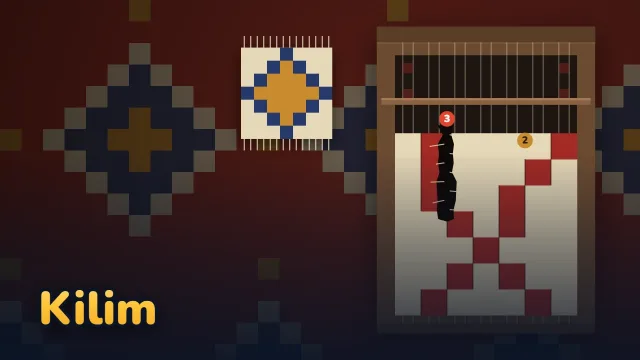
Kilim is a puzzle game born from Anatolian weaving. On the loom you weave the kilim from the bottom up, row by row, and try to make each kilim look like the Target drawing in the corner.
One rule changes everything: if the vertical boundary between two different colours stays in the same place for too many rows, the fabric splits there. That is why the target drawing usually cannot be woven exactly; the craft is to weave the kilim that looks most like it without tearing. This page explains the rule, the counters, the stars, the chapters and the meaning of the 24 motifs.
How to play Kilim
- Look at the Target drawing. Below it you see the motif's name and its Motif meaning.
- The row with the golden frame on the loom is the row you are weaving now. Pick a colour from the palette and tap the cells in that row.
- The small triangle in the corner of each cell shows that cell's colour in the target. The faint squares above show the rest of the drawing.
- When the row is ready, press Beat the weft: the beater comes down, the row is locked and you move up one row. The new row starts with the colours of the row below.
- When the last row is woven, the kilim is finished. The game compares every cell with the target and gives you the Similarity percentage and your stars.
Once a row is locked you cannot change it, so it pays to check the counters before you beat.
Controls
- Tap a cell to paint it with the selected colour. Drag your finger along the row to paint many cells at once.
- Palette: the colours used in the kilim. Each chapter uses 2 to 4 colours.
- Beat the weft: locks the row.
- How do I solve it?: shows the best painting for that row (see below).
- On a computer, keys 1, 2, 3 and 4 pick a colour; Space or Enter beats the weft.
- The question mark button shows the rule again with picture examples; the gear button opens sound, music and language settings.
The boundary rule and the counters
When two neighbouring cells have different colours, there is a boundary between them. If the next row also has a boundary in the same place, its counter goes up by one; if the boundary closes or moves, the counter resets. The rule is shown on screen: with Boundary max 2 rows a boundary may stay in the same place for at most 2 rows, and on the third row the fabric splits.
- Yellow counter: the boundary has reached its limit. You may beat this row, but on the next row you must break that boundary.
- Red counter: if you beat the row like this, the kilim tears. Paint one of the two cells next to the boundary in the other's colour.
Example: the target has a straight red line 5 rows tall. You weave the first two rows exactly; on the third row the counters turn red. You cut the line for one row there and then carry on. The kilim looks almost the same as the target and does not tear. Moving the boundary one cell left or right also resets the counter; stepping the edges like a staircase is the basic language of kilims.
Tearing and mending
If the rule is broken, the fabric splits and the The kilim tore screen opens. It tells you exactly which two cells had a boundary in the same place for how many rows. You have two choices:
- Mend the tear: brings back the last row and makes the cells you need to fix glow.
- Start over: starts the kilim from the beginning.
Mending is free and unlimited; it does not need an ad.
Chapters and stars
The game has 5 chapters of 8 kilims each, 40 kilims in total. Finishing a kilim unlocks the next one.
| Chapter | Colours | Rule | What is new |
|---|---|---|---|
| 1. The Courtyard | 2 | max 2 rows | Basic weaving, two colours |
| 2. The Plateau | 3 | max 2 rows | A third colour, more boundaries |
| 3. The Repair | 2-3 | max 2 rows | The bottom rows are already woven, some counters start full |
| 4. Fine Wool | 2 | max 1 row | A boundary cannot stay in place even for two rows |
| 5. The Dowry | 2-4 | max 2 rows | Four colours; the last kilim is the big Dowry kilim |
Every kilim finished without tearing earns stars. At the end you see Similarity and Best without tearing; the second is the highest similarity that kilim can reach without tearing.
| Result | Stars |
|---|---|
| You reached the Best without tearing percentage | 3 stars |
| At least 85% as many cells as the best result match the target | 2 stars |
| The kilim was finished without tearing | 1 star |
The percentage needed for 3 stars is shown from the start next to For 3 stars. If you weave a kilim again and get the same or more stars, your new kilim replaces the old one.
24 motifs and their meanings
Every kilim weaves an Anatolian motif. Its name and meaning are shown on the game screen. These meanings are traditional interpretations that vary from region to region:
| Motif | Meaning |
|---|---|
| Straight line | A kilim can’t hold a vertical line; weavers break or shift it. |
| Eye | Protects against the evil eye. |
| Ram’s horn | Strength, heroism and fertility. |
| Hands on hips | Motherhood and fertility. |
| Star | Happiness and good fortune. |
| Amulet | Protection from evil. |
| Water path | The continuity of life. |
| Wolf’s track | Guards the flock from wolves. |
| Abundance | Plenty for the home. |
| Hook | Catches the evil eye. |
| Dowry chest | A dowry and a happy home. |
| Tree of life | Immortality and family line. |
| Burdock | Its thorns keep the evil eye away. |
| Hair band | The wish to marry. |
| Earring | A wish for marriage. |
| Snake | Protection and fertility. |
| Scorpion | Protects from scorpions and evil. |
| Fetter | Unity and togetherness. |
| Bird | Happiness and love. |
| Crane | Love and longing. |
| Tribal seal | The signature of the clan. |
| Comb | Marriage and new life. |
| Arrow | Journeys and fate. |
| Dowry kilim | Plenty and love for a new home. |
How do I solve it? and My home
When you are stuck, press How do I solve it?. The game works out the painting for that row that does not tear and gives the highest similarity all the way to the end of the kilim, and makes the cells you need to change glow. The button then becomes Paint it for me; press it and the row is painted for you. Help is unlimited and does not lower your stars.
Your finished kilims are laid out on the My home screen, each one exactly as you wove it, with its stars. At the start and end of each chapter, short scenes tell the story of Grandma and the older sister's dowry.
Tips for Kilim
- Check the counters before you beat: if there is a yellow counter, break that boundary on the next row.
- Do not copy long vertical lines exactly; cutting one row or moving one cell is usually best.
- Moving a boundary usually costs fewer cells than closing it.
- Read the percentage needed for 3 stars first; sometimes giving up one cell saves the whole kilim.
- In the Repair chapter the counters of the ready rows start full; check which boundaries are yellow on the first row.
- In the Fine Wool chapter every boundary must move on every row; think of the motifs as diagonal lines.
Common mistakes
- Trying to copy the target exactly: the kilims are designed so that an exact copy tears the fabric.
- Ignoring a yellow counter: if that boundary is not broken on the next row, the kilim tears.
- Forgetting that a new row starts with the colours of the row below: beating without changing anything makes boundaries longer.
- Spending many cells to close a boundary: moving it by one cell is often enough.
- Missing the full counters of the ready rows in the Repair chapter.
- Starting over after a tear: Mend the tear only takes back the last row and shows what to fix.
Frequently asked questions
Why does the fabric tear in Kilim?
If the vertical boundary between two different colours stays in the same place for more rows than the rule allows, the fabric splits there. This is a simplified version of the slit technique in real kilims: a long vertical slit weakens the fabric, which is why weavers build their patterns in steps.
Why can't I weave the target drawing exactly?
The kilims are designed that way on purpose: copying the target exactly makes a boundary too long. Every kilim was measured with a solver; none of them can be woven as an exact copy of the target. The craft is finding the closest kilim that does not tear.
What do I need for 3 stars?
Your similarity must reach the Best without tearing percentage shown for that kilim. The percentage is shown on the game screen from the start.
Can I save a torn kilim?
Yes. Mend the tear brings back the last row and makes the cells you need to fix glow. Mending is free and unlimited.
Does the How do I solve it? button lower my stars?
No. Help is unlimited and does not affect your stars. Pressed a second time it becomes Paint it for me and paints the row for you.
How many chapters and kilims are there?
There are 40 kilims in 5 chapters: The Courtyard, The Plateau, The Repair, Fine Wool, The Dowry. The kilims use 24 Anatolian motifs.
Will I lose my progress?
No. Your stars and the kilims you wove are saved on your device. If you sign in with an account, your progress moves to your account.
Do I have to watch ads?
No. Mending and help need no ads. A short ad may appear between kilims, at least 2 minutes apart; no ad appears while you weave.
