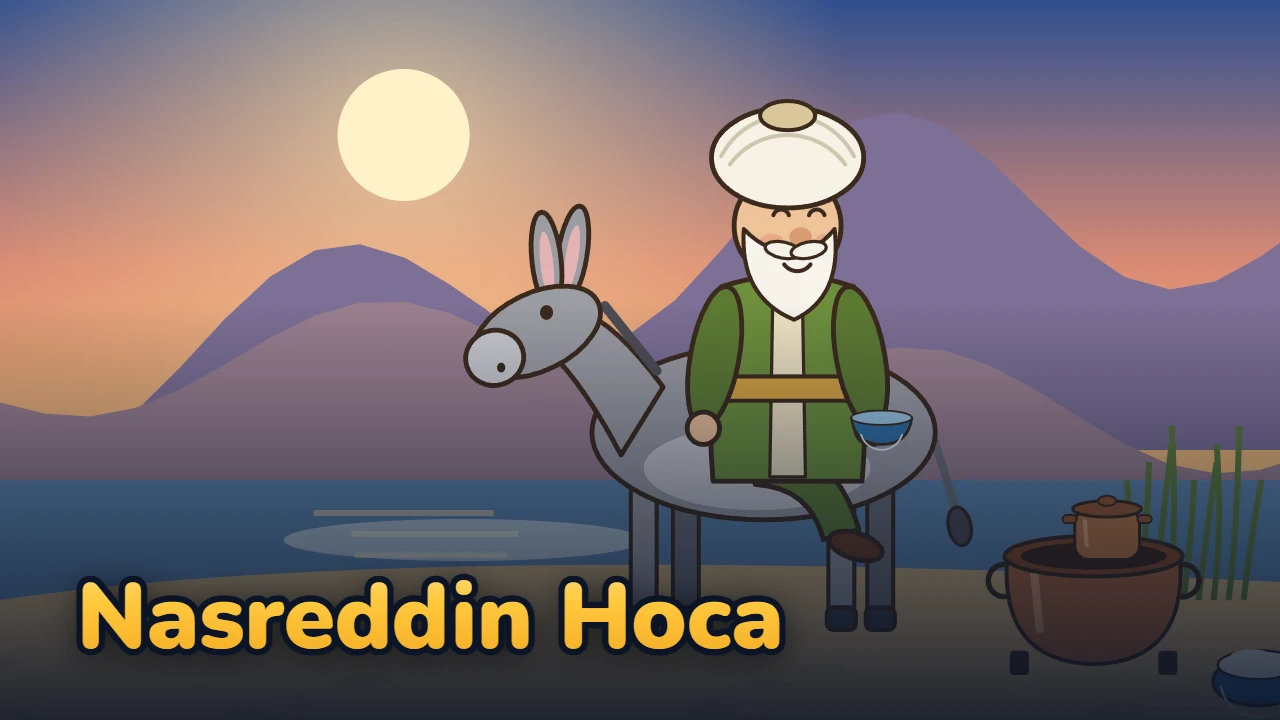
Nasreddin Hodja
Think backwards! Solve the tale like the Hodja.
How to play
Every level is a Nasreddin Hodja tale. A one-line problem appears at the top. Tap an item in the scene to put it in your saddlebag, then select it there and tap a person, a place or another item, or drag it onto them. The ordinary solution everyone would choose is not wrong, but it is no tale: the Hodja says "Think backwards!" and it counts as a miss. If you get stuck, Boz the donkey gives a hint in three steps. Finish with no hint and at most 2 misses for 3 stars. Solve the tale and a short illustrated retelling ends with the Hodja's punchline.
How to play Nasreddin Hodja: a complete guide
Nasreddin Hodja is a puzzle game that turns the best-known Hodja tales into picture scenes. Every level is a tale: a one-line problem appears at the top, and the scene is full of people and things. Your job is not to find the solution everyone would think of, but the unexpected one only the Hodja would come up with. There are 20 tales spread over 5 quarters of Akşehir, and the story is told by the Hodja's donkey, Boz. No timer, no lives, no losing; if you get stuck, Boz pricks up his ears.
The goal
Each tale starts with a problem: the neighbour wants his cauldron back, the moon seems to have fallen into the well, nobody at the wedding even looks at you. You pick up things from the scene and give them to the right person, the right place or another item. Correct steps change the scene; after the last step the tale is solved.
Then a short illustrated retelling shows how it ends, followed by the Hodja's famous punchline. Every tale you solve goes into the Book of Tales.
How to play: the saddlebag
Your only tool is the Hodja's Saddlebag. It sits at the bottom of the screen, and everything you pick up lines up there.
| What you want to do | Touch / mouse | Keyboard |
|---|---|---|
| Put an item in the saddlebag | Tap the item in the scene | - |
| Use an item | Select it in the saddlebag, then tap a person, place or item; or drag and drop it | - |
| Combine two items | Select one item in the saddlebag, then tap the other or drag onto it | - |
| Drop the selection | Tap the selected item again or an empty spot in the scene | Esc |
| Hint | Hint button | H |
| Break | Menu button | Esc |
Tap a person with empty hands and they talk. What they say often gives away what the problem is and what everyone expects; listening costs nothing.
The ordinary solution: think backwards!
This is the heart of the game. Every scene has an ordinary solution: the sensible, honest thing anyone would do. Handing the cauldron back as it is, paying for the smell, eating the soup with a spoon without putting on the fur coat. If you try it, it is not wrong, and the other person reacts normally; but it is no tale. The Hodja raises an eyebrow and says "That works, but it's no tale! Think backwards."
Both the ordinary solution and meaningless combinations (giving the ladle to the neighbour, for example) count as a miss. There is no penalty and the tale does not end; it only affects your stars. After four misses the hint button starts to glow.
Boz's hints
When you are stuck, Boz the donkey helps. One hint covers up to three steps of help for the current move; each press takes you one step further:
- Item: Boz tells you which item will be useful, or points at the one in your saddlebag.
- Target: he shows who or what that item is for.
- Move: Boz makes the move for you.
You start with 3 hints. Finishing all four tales of a quarter gives +1, and finishing them all with 3 stars gives another +1. If you run out, you may choose to watch a short ad for 1 hint; it is entirely up to you, and if you would rather not, just think backwards a little longer.
Stars and Hodja points
At the end of a tale you see your stars, points, misses and hints used.
| Stars | Condition | Points |
|---|---|---|
| 3 stars (A true Hodja!) | No hint and at most 2 misses | 100 |
| 2 stars (Nicely thought!) | At most 1 hint and at most 5 misses | 70 |
| 1 star (Tale complete!) | Finish the tale | 40 |
If you used no hint at all, you get +20. Your best result for each tale is kept; their total is your Hodja points, which go to the leaderboard. You can replay any tale to raise its stars and points.
The quarters of Akşehir
The 20 tales are split into 5 quarters of four tales each. Solve 3 tales in a quarter and the next one opens, so you can leave a tricky tale for later.
- The Hodja's Street: The pot gave birth, Don't tire the donkey, The moon fell in the well, You watch the door.
- Lakeside and Orchards: Yogurt for the lake, The walnut and the melon, Cooked by candlelight, Slippers up the tree.
- Bazaar and Square: Who pays, plays the whistle, The price of a smell, Eat, my coat, eat!, The centre of the world.
- Neighbours: The house is too small, The soup of the soup of the hare, If this is the cat, where is the meat?, Riding backwards.
- Timur's Camp: Nine donkeys, The elephant, Figs or beets?, Teaching a donkey to read.
At the start of each quarter Boz tells the story in short picture scenes. In the last quarter, as legend has it, Timur's army arrives in Akşehir and the Hodja tells his neighbours, "Let me have a word with Timur."
The Book of Tales
The Book of Tales in the main menu collects the illustrated endings of the tales you have solved. Tap a tale and its retelling and the Hodja's punchline play again; the ones you have not solved yet stay locked. Collect all twenty and you have a short picture book of Nasreddin Hodja.
Tips
- First think about what everyone would do, then try the exact opposite. The ordinary solution is often the mirror image of the right one.
- Tap people with empty hands. The neighbour, the judge or the cook tells you what they want, and the answer is often hidden in that sentence.
- Not every item in the scene is useful; some are red herrings. If an item has failed twice, move on to another.
- Remember you can combine two items in the saddlebag. In some tales one item only works together with another.
- If you know the tale, remember its ending: the Hodja's last line gives away the steps that lead there.
- For 3 stars you need no hints and at most 2 misses. There is no timer, so take a good look at the scene first.
- Save your hints for when you are really stuck. One hint opens all three steps for that move, so pressing the button again does not use up a new one.
Nasreddin Hodja: the laughing sage from Akşehir
According to tradition, Nasreddin Hodja was a folk sage who lived in Anatolia in the 13th century and spent most of his life in Akşehir, where his tomb stands. Sources disagree on his birthplace and dates. His tales have been passed on by word of mouth for centuries and are known from the Balkans to Central Asia. The tales with Timur are legend: Timur came to Anatolia in 1402, about a century after the Hodja. The tales belong to everyone; the short retellings in the game and Boz the narrating donkey are the game's own.
- Home town
- Akşehir (according to tradition)
- Era
- 13th century (according to tradition; dates vary between sources)
- Tomb
- Akşehir
- Another name
- Molla Nasreddin
- Timur tales
- Legend; Timur came to Anatolia in 1402
- Best-known image
- The Hodja riding his donkey backwards
Who was the Hodja?
According to tradition, Nasreddin Hodja was a folk sage who lived in Anatolia in the 13th century and spent most of his life in Akşehir, a town in today's Konya province in Türkiye. Sources disagree about where he was born and when he lived, so it would be wrong to give exact dates. Hodja (Turkish hoca) means a learned man or teacher. Little is known for certain about him, but a great deal is told: what keeps the Hodja alive are the tales passed from mouth to mouth for centuries.
A tradition of tales
The Hodja's tales were told by word of mouth for centuries before they reached books. Along the way, many new stories were attached to his name, so nobody can say which tales really go back to him. In the tales the Hodja sometimes seems very wise and sometimes naive, and he often laughs at himself. He follows a strange but consistent logic: if a pot can give birth, it can also die.
These tales are known across a huge area, from the Balkans to the Caucasus and Central Asia. In some places he goes by other names, such as Molla Nasreddin. The picture of the Hodja riding his donkey backwards is one of the shared symbols of this whole region.
The Timur tales: legend
Some of the best-loved Hodja tales feature Timur: the elephant, the figs, teaching a donkey to read. But these are not historical events. Timur came to Anatolia in 1402, about a century after the time tradition gives the Hodja. In these tales people brought a mighty ruler face to face with a quick-witted sage, showing the power of wit and laughter against a feared force. The game presents them the same way, "as legend has it".
Akşehir today
The Hodja's tomb is in Akşehir and is one of the town's best-known sights. Every year Akşehir holds a festival in his name, and there are statues of the Hodja in the town. UNESCO also commemorated 1996 as the year of Nasreddin Hodja. Today his tales live on in schoolbooks, cartoons and everyday speech: lines like "Eat, my coat, eat!" or "Who pays, plays the whistle" are used in Turkish almost like proverbs.
In the game
The tales are shared folk heritage; the short retellings in the game are the game's own. Turning each tale into a puzzle, we kept the plot and the Hodja's final line and added small details for the scene, such as which items are lying around. Boz the narrator and the names of the quarters are fiction; the quarters are not real neighbourhoods of Akşehir but kinds of places: a street, a lakeside, a bazaar. The tales were chosen to suit all ages and to keep their meaning in translation; religious themes and tales that mock anyone were left out.
How Nasreddin Hodja was made
Most Nasreddin Hodja tales are solved not with a word but with an action: putting a small pot next to the cauldron, carrying the door on your back, jingling a purse. The game grew out of that observation and became a scene puzzle. No words to type, no letters to guess; all the player reads is the problem of the scene and the Hodja's line at the end. The reward for solving the puzzle is the tale itself: every solved scene ends with a short illustrated retelling.
The most important design decision was the "ordinary solution". The honest answer everyone thinks of first is not treated as wrong; the other person reacts normally, but the Hodja says "That works, but it's no tale! Think backwards." So even the first miss gets a laugh and teaches the rule on its own. Interface tricks such as turning the screen or dragging buttons were left out on purpose; all the logic lives inside the scene. When a player gets stuck, Boz, the Hodja's donkey, helps in three steps, and an ad only appears when hints run out and the player asks for one.
The tales were chosen by clear rules: the solution has to be an action, the punchline has to survive translation, and the tale has to suit all ages. Tales based on wordplay, tales with religious elements and tales that mock anyone or hurt an animal were left out. Because the Timur tales are not historical, they are told "as legend has it", and the credits say so too. The quarters are not given invented names of real Akşehir neighbourhoods; they are kinds of places, such as a street, a lakeside and a bazaar. So that no one gets stuck for good, solving three tales in a quarter is enough to open the next.
Every possible state of every tale is checked by a solver: each tale can be solved, no order of moves leads to a dead end, and each scene has an ordinary solution. The art is drawn with code, and the music was synthesized with code in the Hicaz makam. The game is playable in seven languages.
Frequently asked questions
What is the "ordinary solution" in Nasreddin Hodja?
The sensible thing anyone would do, like handing the cauldron back as it is or paying up. It is not wrong, but it is no tale: the Hodja says "Think backwards!" and it counts as a miss.
Does the ordinary solution cost me stars?
Yes, it counts as a miss, just like a wrong combination. For 3 stars you can have at most 2 misses, for 2 stars at most 5. There is no other penalty and the tale does not end.
How much does one hint help?
One hint opens three steps for the current move: first it shows the item, then the target, and finally Boz makes the move for you. Pressing the button again on the same move does not use up another hint.
I'm out of hints. What can I do?
Finishing a quarter gives you 1 hint, and finishing all its tales with 3 stars gives 1 more. You can also choose to watch a short ad for 1 hint; it is never required.
Why won't the next quarter open?
Each quarter has four tales. Solve 3 of them and the next quarter opens. You can leave a tale you are stuck on for later and carry on with the others.
How are Hodja points calculated?
Each tale gives 100 points for 3 stars, 70 for 2 and 40 for 1, plus 20 if you used no hint. Your best score for each tale is added up and goes to the leaderboard.
Can I replay a tale?
Yes. Use the Again button on the result screen or pick the tale on the map. Your best stars and points are kept, so a weaker result never overwrites a better one.
What is the Book of Tales?
It collects the illustrated endings of the tales you have solved. Open it from the main menu and tap a tale to watch its retelling and the Hodja's punchline again.
Did Nasreddin Hodja really meet Timur?
No, those tales are legend. Timur came to Anatolia in 1402, about a century after the period in which the Hodja is believed to have lived. The game tells them "as legend has it".
Are the tales the same as the versions I know?
The plot and the Hodja's last line are kept. The retellings are shortened and shaped into puzzles, and the items in the scene and a few small details were added for the game.
Is Nasreddin Hodja free?
Yes. No download or account needed; it plays right in your browser. Watching an ad for a hint is always your choice.
Will I lose my progress?
Your progress is saved automatically on this device. Sign in and it moves to your account, so you can continue on any device.
Can I play on my phone?
Yes. The game opens full screen on phones; tap the X in the corner to exit. On iPhone use "Add to Home Screen" to play it like an app.
Can I play Nasreddin Hodja offline?
Yes. A game you have opened once is stored on your phone or computer and opens without internet. Leaderboards and cloud saves need a connection.
Which languages are available?
Turkish, English, Spanish, Portuguese, German, French and Russian.
Comments
Sign in to write a comment.
No comments yet. Be the first.
