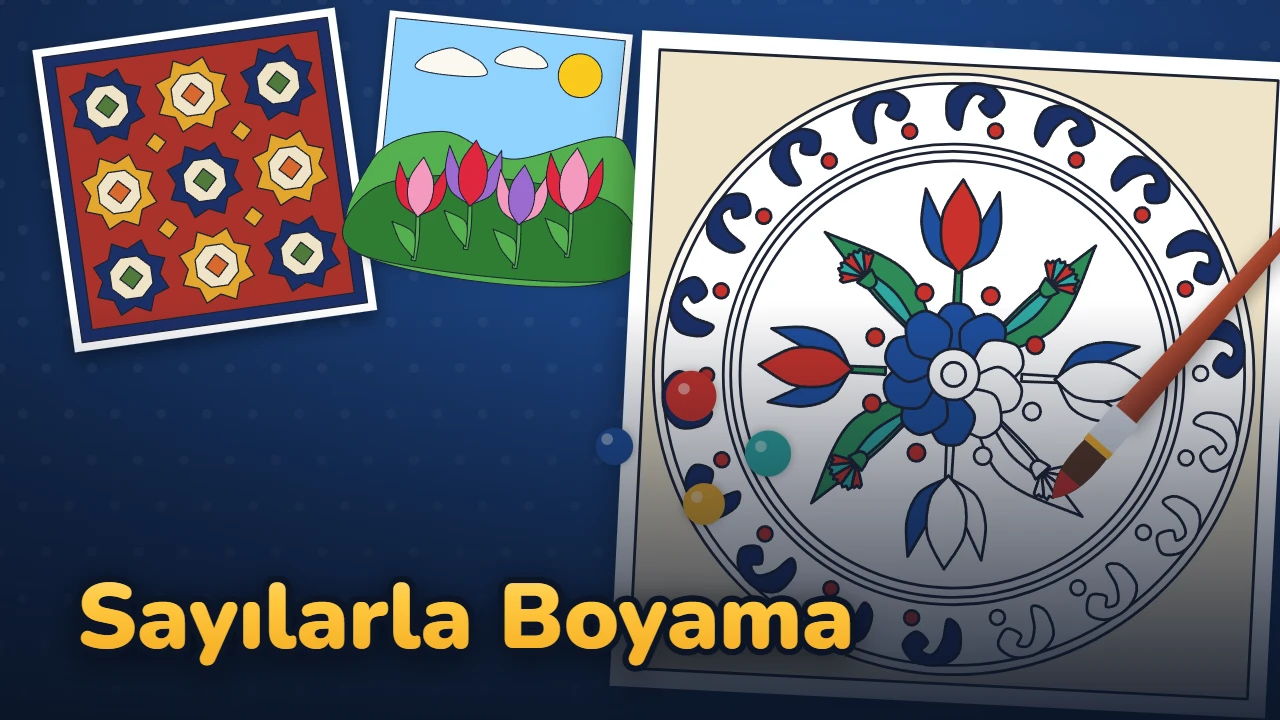
Color by Number: Turkish Patterns
Find the number, paint the right color and bring out the motif's true colors.
How to play
In Color by number, every area on the page has a number. Choose a number and its areas are marked with stripes. Tap the striped areas and they fill with that number's color. If you tap an area with a different number, nothing is painted: the area just gives a little shake and shows its own number, with no penalty. When every area of a number is done, the next number is selected for you. Once the last area is colored, the page finishes by itself and the motif appears in its traditional colors: the Iznik plate turns cobalt blue, turquoise and coral red.
How to play Color by Number: a guide to coloring Turkish patterns by number
Color by Number: Turkish Patterns is the numbered mode of Turkish Patterns Coloring Book. Every area on the page has a number, and every number has a color. As you paint the numbers with the right colors, a tile, kilim, ebru or Karagöz motif slowly appears. When the last area is colored, the picture is complete in the motif's traditional colors.
This guide explains how to choose numbers, what happens after a wrong tap, how to find small areas and which pages are good to start with.
The goal
Paint every area on the page in the color of its number. Each number is a color from that page's own traditional palette, so you do not choose the colors: the numbers lead you to the motif's real ones. There is no losing, no timer and no score. The page finishes by itself when the last area is colored; there is no extra button to press.
Choose a number, paint the areas
- Choose one of the numbers. All the areas with that number are marked with stripes on the page, so you can see at once where to paint.
- Tap a striped area: it fills with the number's color.
- When the last area of that number is painted, the next number is selected automatically, and you can keep coloring without stopping.
You can change the order yourself too: just tap another number. Undo and Redo are unlimited in this mode as well.
If you tap the wrong number
If you tap an area with a different number from the chosen one, nothing is painted. The area just gives a little shake and shows its own number. There is no penalty and no lost points. That matters for young children: a wrong tap never spoils the picture, it only reminds them of the right number.
Finding small areas
- Find (the magnifier) zooms to the smallest area that is still empty. Near the end of a page, this is how you spot tiny forgotten pieces.
- Pinch with two fingers or use the mouse wheel to zoom in up to 8x. When zoomed in, drag to move around the page; dragging never paints.
- Fit shows the whole page again.
- On a keyboard, +, - and 0 zoom in, zoom out and fit; Ctrl+Z and Ctrl+Y undo and redo.
Which page to start with?
All 30 pages are open from the start. Difficulty depends on the number and size of the areas; pages have about 15 to 127 areas.
- Easy (8 pages): Tulip Rosette, Eye Motif, Wave Marbling, Stone Marbling, Daisy Marbling, Tulip Garden, Evil Eye Bead, Butterfly and Carnations. A few big areas, ideal for a first try.
- Medium (17 pages): more detailed pages such as Maiden's Tower, Hacivat and Hands on Hips.
- Master (5 pages): Iznik Plate, Tile Panel, Water Path Kilim, Caravanserai Gate, Shadow Theater Screen. Lots of small pieces that call for patience.
Every finished page earns a color by number seal and goes into the Album. Finish the same page in Free coloring too and you get a second seal.
Coloring together with your child
Played together with a grown-up, color by number can become a small lesson. Read the number aloud together, say the name of the color, count how many areas are left. When the page is done, read the short culture card together; it tells where the motif comes from. There are no rewarded ads in this mode either; an interstitial ad appears only after a finished page, at most once every 3 pages. Save picture and Share require holding a button for 3 seconds.
Tips
- For a first page, pick Evil Eye Bead or Tulip Rosette: few areas, big spaces.
- Paint the big striped areas of a number first, then the small ones, so you do not skip any.
- If the page looks done but does not finish, press Find; it takes you to the smallest empty area.
- On Master pages, zoom in and start from one corner, then work your way around.
- With a little brother or sister, you read the number and they paint: it is more fun together.
- After finishing a page, color the same motif in Free coloring with your own colors and compare the two pictures in the Album.
Traditional colors: the palettes behind the numbers
Color by number is all about recognizing a numeral and matching it to a color. For a young child that means learning numbers and colors at the same time, and aiming a fingertip at a small area. The ending is a reward of its own: when the numbers are done, the page does not come out in random colors but in the motif's traditional ones. Easy pages have a few large areas for little hands, while Master pages are full of fine detail for patient colorists.
- Colors of the Iznik plate
- Cobalt blue, turquoise, coral red
- Pattern on the plate's rim
- Wave and rock
- Hexagonal tiles
- Fit together without gaps, like a honeycomb
- Ground of most ebru
- Battal (stone marbling)
- Rings of the evil eye bead
- White, light blue and black on dark blue
- Shadow play figures
- Cut from leather and painted
The three colors of Iznik
Tiles and pottery made in the town of Iznik reached their finest age in the 16th century. Their famous colors are cobalt blue, turquoise and a raised coral red. When you finish the Iznik Plate page by numbers, exactly these three colors appear. The curly pattern around the plate's rim is called wave and rock. Next to the tulip, the carnation is one of the flowers most often painted on Iznik tiles; the long, curving leaves beside it are called saz leaves.
Patterns that repeat
In Turkish decoration, big patterns often grow from one small piece repeated. Walls are sometimes covered with hundreds of small tiles; hexagonal tiles fit together without any gaps, just like a honeycomb. When the same flower repeats on every tile, a big pattern appears. Kilims work the same way: a single eight-pointed star, repeated again and again, can decorate a whole kilim, and the zigzag stripes along the edges wrap it like a frame. That is why the same number comes back in many areas in color by number.
The ground and flowers of ebru
Most ebru styles start from a battal ground: the colors are sprinkled on the water and lifted onto paper without any combing. In flower marbling, every petal begins as a single drop of paint; the master pulls the drop with a fine wire until it becomes a petal. Daisies, tulips, carnations and roses are common ebru flowers. The colors of the Ebru marbling book come from this ground and these flowers.
Colors from glass and leather
An evil eye bead is shaped from hot glass at a furnace; the glassmaker adds white, light blue and black rings on top of dark blue glass, and the rings in the middle look like an eye. In the Karagöz shadow play, color comes from light: the figures are cut from leather and painted, and when the light behind the screen shines through the leather, they appear in color. The decorative picture that stands on the screen before the play begins is called the opening picture.
Frequently asked questions
What age is color by number for?
The game as a whole is suggested for ages 3 to 10. Color by number suits children who are starting to recognize numerals especially well; the youngest can begin with Easy pages and a grown-up's help.
What happens if my child taps the wrong number?
Nothing is painted and there is no penalty. The area just gives a little shake and shows its own number, and the child picks that number and tries again. Since the picture is never spoiled, a wrong tap teaches instead of upsetting.
What do the striped areas mean?
The stripes show every area of the chosen number on the page. That way the child sees where to paint that color without hunting for each area. When the number changes, the stripes move to the areas of the new number.
Is there no Done button in this mode?
There is no need for one. When the last area is painted the right color, the page finishes by itself, the motif appears in its traditional colors and a short culture card opens.
Can we choose the colors ourselves?
Not in this mode, because every number is a color from the page's traditional palette. If you want to pick your own colors, open Free coloring in the same game; it has six palettes and five fill styles.
We cannot find the last area. What can we do?
Press the Find button (the magnifier). The game zooms to the smallest area that is still empty; on Master pages these pieces can be very small. After painting it, use Fit to see the whole page again.
Is there any point in coloring the same page twice?
Yes. Finishing a page separately in Color by number and in Free coloring earns two different seals, and there are 60 seals across the 30 pages. Seeing both pictures side by side in the Album also gets children thinking about color choices.
Can we keep and print the finished picture?
Finished pages stay in the Album. With Save picture you can download a 1600×1600 PNG picture and print it from your own device. Saving requires pressing and holding the button for 3 seconds.
Why does an ad sometimes appear after a page?
Ads are our site's only income. In this game an interstitial ad appears only after a finished page, at most once every 3 finished pages and at least 2 minutes apart. No ads appear while coloring, and there are no rewarded ads at all.
Is Color by Number: Turkish Patterns free?
Yes. No download or account needed; it plays right in your browser. Watching an ad for a hint is always your choice.
Will I lose my progress?
Your progress is saved automatically on this device. Sign in and it moves to your account, so you can continue on any device.
Can I play on my phone?
Yes. The game opens full screen on phones; tap the X in the corner to exit. On iPhone use "Add to Home Screen" to play it like an app.
Can I play Color by Number: Turkish Patterns offline?
Yes. A game you have opened once is stored on your phone or computer and opens without internet. Leaderboards and cloud saves need a connection.
Which languages are available?
Turkish, English, Spanish, Portuguese, German, French and Russian.
Comments
Sign in to write a comment.
No comments yet. Be the first.
