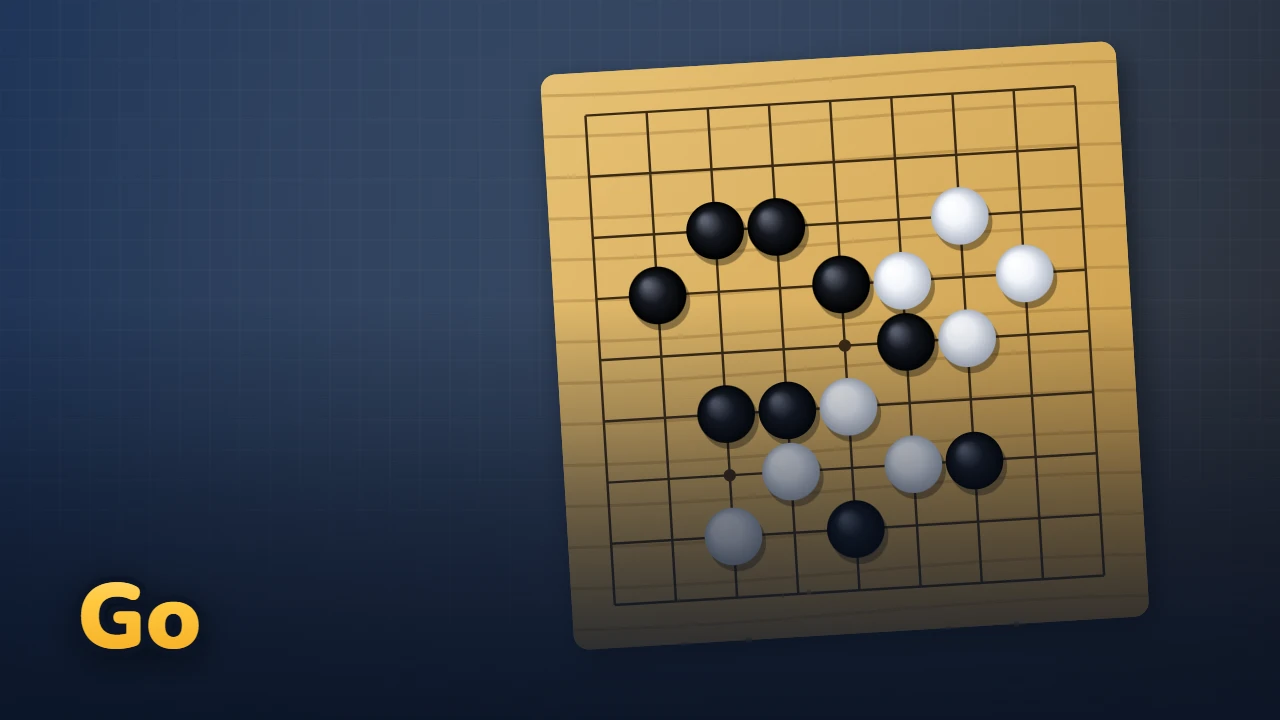
Go
Surround territory with your stones and capture groups with no liberties left.
How to play
Black and White take turns placing one stone on an empty point where the lines of the board cross; Black starts and stones never move. The empty points next to a group are its liberties: fill the last liberty of an opposing group and you remove it from the board. When there is nothing valuable left to play, press Pass; two passes in a row end the game. Your living stones plus the empty points surrounded only by your stones are counted, White gets 7.5 komi, and the larger area wins.
How to play Go: a guide to 9×9 Go against the computer
Go is a territory game in which two players take turns placing black and white stones on the points where the lines of the board cross. The rules fit in a few sentences; mastering the game takes years. On CetinsGame you can play Go on a 9×9 board under Chinese rules (area scoring), against the computer at three levels or with a friend on the same screen. Your Brain points go to Go's own leaderboard. The Mind games collection on the site has other mind games too, such as Reversi, Hex, Dots and Boxes, Tower of Hanoi, chess, Dama and Mangala.
The goal
To own more area than your opponent when the game ends. Your area is your living stones on the board plus the empty points surrounded only by your stones. Capturing is not a goal in itself; captured stones matter because they shrink your opponent's area and grow yours. Black moves first, so White receives 7.5 points of komi; thanks to the half point, Go never ends in a draw.
How to play
Placing a stone: on your turn, tap an empty intersection. Your stone goes there and never moves again; a small ring marks the last stone played.
Capturing: the empty points next to a stone, or next to a group of stones connected along the lines, are its liberties. Fill the last liberty of an opposing group and all its stones leave the board. A group with only one liberty left is in atari.
Forbidden points: you can't play where your stone would have no liberties (suicide), unless that move captures opposing stones. A move that returns the board to a position seen before is also forbidden (ko). If you tap a forbidden point, no stone is placed and the game tells you why.
Passing and the end: when there is nothing valuable left to play, press Pass. When both players pass in a row, the game ends and the count begins.
Counting and dead stones
When the game ends, the computer suggests which groups are dead: stones stranded inside the opponent's area with no chance of escape are shown faded, areas are marked with small squares and the live count appears at the top of the screen. If you disagree, tap a group to switch it between dead and alive, then press Accept the count. Against the computer, if your marking differs from the computer's, it does not accept the count and the game goes on: under area scoring, playing inside your own area costs no points, so you settle the disputed stones by playing. You can also press Keep playing to leave the count and return to the game yourself. In a two-player game you mark the dead groups together and accept once you both agree.
Learn, levels and two players
- Learn: a 6-step tutorial teaches the rules with small positions on a 7×7 board: liberties and capturing, capturing a group, suicide, ko, two eyes and counting. In the first four steps you make the move yourself; the last two are shown on the board.
- Against the computer: Easy thinks very briefly and suits first games. Medium decides by playing thousands of trial games. Hard is the strongest level, yet it cannot beat a strong club player. Medium and Hard may resign when they see the game is lost. You choose who makes the first move: You, Computer or Take turns; whoever starts plays Black.
- Two players: take turns on the same screen; there are no interstitial ads in this mode or in Learn.
Points and helpers
Beating the computer earns 15, 35 or 70 Brain points depending on the level; a loss never takes points away. After a lost game you can start a rematch: win it and the points are doubled. What would a master play? shows on the board the move the Hard level would choose right now; you have 3 per game, the first is free and the rest are unlocked with a rewarded ad. Sometimes the master suggests passing. Undo takes back your last move and the computer's reply; it is unlimited, but a game where it was used gives no points. Resign in the pause menu ends the game. Your points go only to Go's own leaderboard. The Badges button on the game screen shows eight badges: Learned, Easy, Medium, Hard, Three in a row, Master hunter, With a friend and Wide territory. The statistics keep your wins by level, your longest winning streak and your biggest point margin.
Strategy
On a 9×9 board every stone counts. Early on, corners and edges are the easiest places to make territory, because the edge of the board works as a ready-made wall. On a small board stones near the centre are strong too: a centre stone influences all four directions and helps split your opponent's groups.
Keep your groups connected; a cut-off, weak group becomes your opponent's target. Every group wants two eyes: a group with two separate empty points inside can never be captured. Before trying to rescue a stone in atari, check whether it can really escape; adding stones to a stone that can't be saved only makes the loss bigger. Pass once the borders are settled, but don't pass early while you are behind.
Tips
- In the opening, play near the corners and the centre; a stone on the outermost line early on gains little area.
- Count the escape route of a stone in atari: if it would be in atari again while running, let it go.
- Give your groups two eyes; a group with one eye can be captured in the end.
- If your stone was taken in a ko, first play a threat your opponent must answer, then retake the ko.
- Moves that separate two of your opponent's groups are often the strongest moves.
- Before the count, make sure there are no gaps in your own area; playing inside your area costs no points.
- Don't pass while you are behind: if the computer is ahead when you pass, it passes too and the game ends.
- When you are stuck, use What would a master play? to see the Hard level's move and think about why.
Go: one of the oldest board games still played
Go was born in China and is one of the oldest board games still played today; it has been taught in Japan and Korea for centuries, with professional players and schools. Tournaments use a 19×19 board, while 9×9 is the common small board for beginners. Our game uses Chinese rules (area scoring). The Mind games collection on the site has other mind games too, such as Reversi, Hex, Dots and Boxes, Tower of Hanoi, chess, Dama and Mangala.
- Origin
- China
- Earliest written mention
- A Chinese history book written around the 4th century BC; the event it describes dates from 548 BC
- Board
- 19×19 in tournaments; 9×9 in our game, 7×7 in the tutorial
- Rules
- Chinese rules: area scoring, 7.5 komi for White
- End of the game
- Two passes in a row; the larger area wins, no draws
- Scoring
- Its own Brain points leaderboard, 8 badges
A game born in China
Go was born in China and is one of the oldest board games still played today. Its earliest known written mention is in a Chinese history book written around the 4th century BC; the event the book describes took place in 548 BC. So by then the game was already known well enough to be mentioned in passing. Exactly when and how it first appeared is not known.
Japan, Korea and the terms
Go has been taught in Japan and Korea for centuries, and both countries have professional players and schools. Most Go terms used in Western languages come from Japanese. We use three of them on this page: atari, a group with only one liberty left that can be captured on the next move; ko, the rule that stops the same position from repeating forever; and komi, the extra points given to the second player to balance the advantage of moving first.
Big board, small board
In tournaments Go is played on a 19×19 board with 361 points, and one game can last for hours. The 9×9 board is the common small board for beginners: 81 points, short games, but the same rules. Basic patterns such as capturing, making eyes and drawing borders show up much faster on a small board. That is why our game uses 9×9, while the tutorial shows the rules with small 7×7 positions.
Chinese rules and area scoring
Go rules rest on the same foundation everywhere, but there are two common ways to count the end of the game. Area scoring (Chinese rules) counts living stones on the board plus surrounded empty points. The other common method counts only surrounded empty points plus captured prisoners. In most games the two methods give the same or a very close result. Our game chose area scoring: it is easy to explain, and settling disputed stones by playing does not change the score.
Go and artificial intelligence
For a long time Go was known as the game where computers could not beat the masters; the number of possible moves is so large that classic search methods were not enough. In 2016 an artificial intelligence beat one of the world's best players for the first time. The computer opponent in our game is far more modest: on Medium and Hard it plays thousands of trial games for each move and picks the one that wins most often. Hard is a tough opponent for beginners, but it cannot beat a strong club player.
How Go was made
Go is one of the classic games played in Turkish schools in the Mind and Intelligence Games course. We built these games with a classroom in mind: a teacher opens the game on the smart board, explains it in a few minutes, and the students carry on at home or on a phone. At first we put five games into a single package; because each has its own rules, rhythm and way people look for it, we later turned them into separate games. Each one has its own page, its own leaderboard and its own badges.
Go is one of the oldest board games in the world and one of the deepest. For schools we chose the 9×9 board: a game ends in fifteen to twenty minutes, yet every idea of Go, liberties, captures, two eyes and territory, lives on this small board too. Scoring follows Chinese rules: stones on the board and surrounded empty points both count, and White, who plays second, receives 7.5 points of komi. These are the easiest rules for a beginner to grasp.
Writing a strong computer player is far harder for Go than for chess, so we used a method that plays thousands of random games and favours the most promising moves. The superko rule, which forbids repeating a position, is applied in full. The most confusing moment for newcomers is counting at the end: which stones are dead and which are alive? The game estimates the dead stones and shows them, and the player corrects them with a tap and confirms. We tuned the levels with bot games: Medium beats Easy in about 5 games out of 6, and Hard beats Medium in close to 9 out of 10.
Every game has a 6-step Learn mode that you try on the board itself: the rules are learned by tapping, not by reading. Two players can also play on the same screen, so two students can face each other on one tablet in class. Learn mode and two-player games never show ads. The board, pieces and sounds were all made with code; the game is playable in seven languages, and every fact on the history card was checked against its source. Go was released as version 1.0 on 14 October 2026.
Frequently asked questions
What is atari in Go?
A stone or group with only one liberty left: if the opponent fills that last liberty on the next move, the group is captured. You save a group in atari by connecting it or gaining liberties; if it can't be saved, letting it go is usually best.
Why can't I play on some points?
There are two possible reasons: if your stone would have no liberties, the move is suicide and is forbidden unless it captures; or the move would return the board to a position seen before (ko). The game tells you the reason when you tap a forbidden point.
My stone was taken in a ko. What should I do?
You can't take back right away. First play somewhere else, a move your opponent has to answer. If they answer it, the position has changed and you may retake the ko.
Why is komi 7.5 points?
Black has the advantage of moving first, and the points added to White balance it. With area scoring on a 9×9 board, 7 points is a common value, and the extra half point removes any chance of a draw.
Which stones count as dead at the end?
Stones stranded inside the opponent's area that can't make two eyes and have no chance of escaping. The computer suggests the dead groups and shows them faded; if you disagree, tap a group to change it.
What happens if the computer doesn't accept the count?
The game continues from where it stopped, and you settle the disputed stones by playing. Under area scoring, playing inside your own area costs no points, so playing it out doesn't change the result unfairly.
Do my prisoners earn points?
Not separately under area scoring. But captured stones reduce your opponent's stones on the board, and the emptied points often become part of your area, so capturing scores indirectly.
When should I pass?
When the borders are settled and no move can grow your area or shrink your opponent's. Passing early is risky: if the computer is ahead when you pass, it passes too and the game ends.
Can the Hard level be beaten?
Yes. Hard is a tough opponent for beginners and intermediate players, but it cannot beat a strong club player. Start with Easy and Medium; as you learn to give your groups two eyes, you will beat Hard too.
What badges are there in Go?
There are eight: Learned (finish the tutorial), Easy, Medium and Hard (beat that level), Three in a row (beat the computer 3 times in a row), Master hunter (beat Hard 5 times), With a friend (finish 5 games on the same screen) and Wide territory (beat the computer by 20 points).
Is Go free?
Yes. No download or account needed; it plays right in your browser. Watching an ad for a hint is always your choice.
Will I lose my progress?
Your progress is saved automatically on this device. Sign in and it moves to your account, so you can continue on any device.
Can I play on my phone?
Yes. The game opens full screen on phones; tap the X in the corner to exit. On iPhone use "Add to Home Screen" to play it like an app.
Can I play Go offline?
Yes. A game you have opened once is stored on your phone or computer and opens without internet. Leaderboards and cloud saves need a connection.
Which languages are available?
Turkish, English, Spanish, Portuguese, German, French and Russian.
Comments
Sign in to write a comment.
No comments yet. Be the first.
