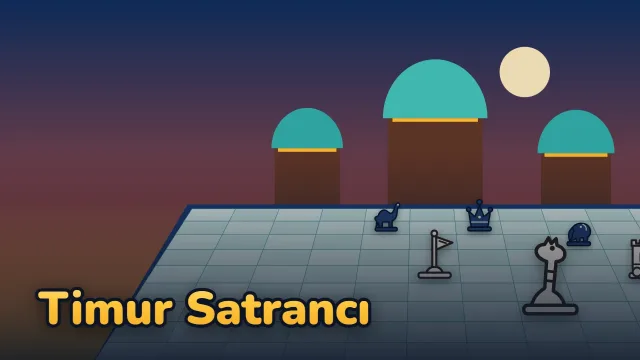
Tamerlane chess is the great chess said to have been played at Timur's court in the 14th century. The board has 11 files and 10 ranks, with a citadel on each side. Each side starts with 17 pieces and 11 pawns; there are pieces not found in classic chess, such as the giraffe, the camel, the war engine and the picket.
The rule set used in this game: the setup given by H. J. R. Murray in A History of Chess (1913), the most common one today. The sources differ in small ways; where they leave gaps, the interpretation used by CetinsGame's Tamerlane Chess is stated separately on this page.
Board and setup
The files are lettered a to k, the ranks numbered 1 to 10. White's citadel is to the right of rank 2, Black's to the left of rank 9. White moves first.
| Rank | White's pieces (a to k) |
|---|---|
| 1 | Elephant, empty, Camel, empty, War Engine, empty, War Engine, empty, Camel, empty, Elephant |
| 2 | Rook, Knight, Picket, Giraffe, General, King, Vizier, Giraffe, Picket, Knight, Rook |
| 3 | Pawn of pawns and the pawns of the War Engine, Camel, Elephant, General, King, Vizier, Giraffe, Picket, Knight and Rook |
Black's setup is the same turned 180 degrees: the black King is on f9, the black Vizier on e9.
How do the pieces move?
| Piece | Movement |
|---|---|
| King | One square in any direction |
| General | One square diagonally |
| Vizier | One square straight |
| Rook | Straight, any number of squares; does not jump |
| Knight | Leaps in an L shape: two straight, one to the side |
| Elephant | Leaps exactly two squares diagonally |
| Camel | Leaps three straight, one to the side |
| War Engine | Leaps exactly two squares straight |
| Picket | Diagonally, at least two squares; does not jump |
| Giraffe | One square diagonally, then at least three squares straight on in the same direction; does not jump |
The leaping pieces (Knight, Elephant, Camel, War Engine) pass over any pieces in between. If there is a piece on the diagonal square right next to the Picket, it cannot move in that direction. The Giraffe's diagonal square must be empty, and its straight path must not be blocked.
Pawns and promotion
Every piece has its own pawn. A pawn moves one square forward (also on its first move) and captures diagonally forward. There is no castling and no en passant.
A pawn that reaches the last rank promotes to its own piece: the pawn of the rook becomes a Rook, the pawn of the giraffe a Giraffe, even if that piece is still on the board. The pawn of the king becomes a Prince. The pawn of pawns has a rule of its own.
The pawn of pawns
This is the rule described most confusingly in the sources. This game's interpretation:
- The first time it reaches the last rank, it stays there, cannot be captured and makes no normal moves.
- Later, if its owner wishes, it is placed on an empty square from which it attacks two enemy pieces at once, and from there it continues as a normal pawn.
- The second time it reaches the last rank, it goes to the starting square of the pawn of the king (f3 for White, f8 for Black); if that square is occupied, it waits on the last rank until it is free.
- The third time, it becomes an Adventitious King.
King, Prince, Adventitious King and king swap
The goal is to checkmate the opponent's king. The Prince and the Adventitious King also count as kings. A side with several kings may leave them in check, and one of them can be captured. When only one king is left, the normal rule applies: that king may not be left in check.
King swap (this game's interpretation): once during the game, when your King is in check or you have no move at all, you can trade the places of your King and one of your own pieces (except a pawn). This counts as a move, and your king may not be left in check at the end of it.
Citadels
These are two squares that stick out on each side of the board. Only the highest-ranking king (the King; otherwise the Prince; otherwise the Adventitious King) may enter the opponent's citadel, and the moment it does, the game is drawn. This is a great rescue for the side that is about to lose. Only an Adventitious King may enter its own citadel; it cannot be captured there, and the enemy king cannot enter that citadel. No other piece may enter a citadel.
The end of the game
- Checkmate: the side whose only king is in check and that has no move at all loses.
- Stalemate wins too: the side that is to move and has no move at all loses, even if its king is not in check.
- A bare king is not a win: the opponent being left with only a king does not end the game.
- Citadel: if a king enters the opponent's citadel, the game is drawn.
- Extra draw rules (not historical, in this game): the game is drawn if the same position occurs three times, if no piece is captured and no pawn is moved for 100 moves, or if only kings are left on both sides.
Sources and differences
The rule set is the setup given by Murray; most sources on chess history also give this setup as the "common setup". The main points on which the sources differ: whether entering the citadel ends the game at once or a draw has to be declared, the second and third promotion of the pawn of pawns, which pieces the king swap can be made with, and, in some manuscripts, different positions for the elephant, camel and war engine. Some manuscripts also place pieces whose movement is unknown, such as a lion or a bull, on the empty squares of the back rank; they are not in this game.
Common mistakes
- Thinking the Vizier is like the queen in classic chess: in Tamerlane chess the Vizier moves only one square straight.
- Thinking stalemate is a draw: in this game the side with no move left loses.
- Not noticing the enemy king approaching your citadel: if it gets in, the game you have won ends in a draw.
- Trying to move the Picket to the diagonal square right next to it: it must move at least two squares.
- Thinking the Elephant moves along long diagonals: in this game the Elephant leaps exactly two squares.
Frequently asked questions
What is the biggest difference between Tamerlane chess and classic chess?
The board (11×10 with two citadels), the pieces (giraffe, camel, war engine, picket, a vizier that moves only one square) and two rules: stalemate wins, and if a king escapes into the opponent's citadel, the game is drawn.
Is this game really Timur's?
It is known that the game was played at Timur's court and that it is described in a manuscript attributed to Ali ash-Shatranji, the court's chess master. That it was Timur's own invention, however, is a legend.
Why can't pawns move two squares on their first move?
The two-square advance and en passant are rules added in medieval Europe that did not exist in the old chess of the Islamic world. In Tamerlane chess a pawn always moves one square.
How do you win if there are several kings?
You first have to capture the extra kings. When only one king is left, you win the game by checkmating or stalemating it.
What happens when the Adventitious King enters its own citadel?
The Adventitious King cannot be captured there, and the enemy king cannot enter that citadel; so the opponent cannot get a draw through that citadel.
Why are there threefold repetition and 100-move rules?
They are not in the historical rules. CetinsGame added these draw rules so that a game against the computer cannot go on forever.
