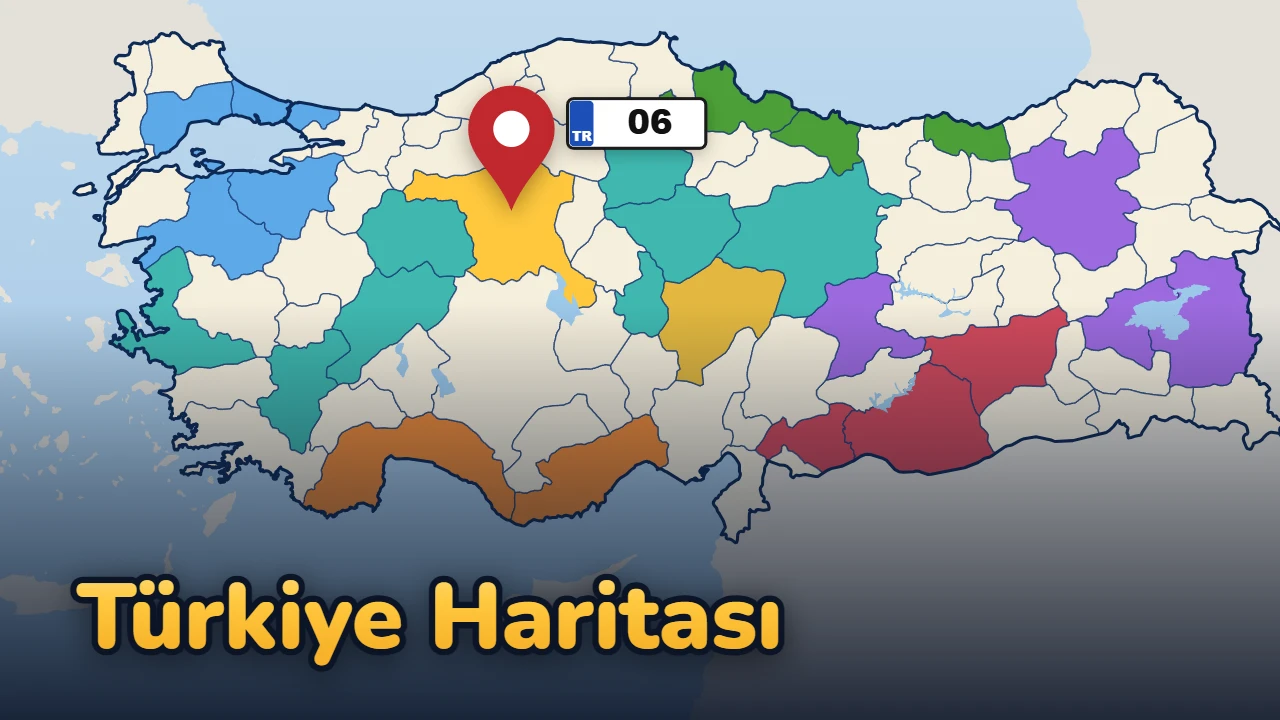
Türkiye Map Quiz
How fast can you find all 81 provinces? Provinces, plates, regions and neighbours.
How to play
A province name appears at the top: "Find: Kırşehir". Tap that province on the map. If you are right, it fills with turquoise and you score; if not, the name of the province you tapped is shown and you try again. You have 3 tries per question; after the third miss the right province is shown and the next question comes up. A first-try answer earns 100 points plus a speed bonus of up to 50: the full bonus within 3 seconds, nothing at 10 seconds. A second try earns 50, a third 25. In Licence Plates, Regions and Neighbours the question changes but the rule stays the same. On phones a magnifier opens when you tap among small provinces.
How to play Türkiye Map Quiz: a complete guide
Türkiye Map Quiz is a free geography game where you find the 81 provinces of Turkey on a map. The map is already on screen when the game opens, with a one-line question on top: "Find: Kırşehir". You tap, the province lights up turquoise or red, and the next question follows straight away. At the end of a round the map becomes a report card: the provinces you found stay turquoise, the ones you missed stay gold.
This guide explains the basic rule, the six modes (Provinces, Licence Plates, Regions, Neighbours, Learn and Map of the Day), how points are counted, the magnifier that makes small provinces easy to hit on a phone, and the 81-card album. At the end you will find a few ways to learn the provinces faster.
Goal and basic rule
The goal is to find the province you are asked for as quickly as possible and with as few mistakes as possible. Every mode uses the same loop:
- A question appears on top: a province name, a plate code, or a province highlighted on the map.
- You tap the province on the map (in Regions you tap a region button, and when typing a plate you use the number keys).
- Right: the province fills in and points fly up. Wrong: the province you tapped flashes red and its name appears: "That's Nevşehir".
- You have 3 tries per question. After the third miss the right province flashes gold, no points are given and it is marked as missed.
You cannot lose: a round always runs to the end. Time only affects your score; the game never ends because the clock runs out. Province names are not written on the map, because this is a quiz; when the round is over, Show names reveals them all so you can study the map like a report card.
Modes
| Mode | Question | Round |
|---|---|---|
| Provinces | "Find: Kilis", then tap the province on the map | Full round of 81, quick round of 20, or one region |
| Licence Plates | Find the province from its plate ("Find: 38"), or type the two-digit plate of the highlighted province | 81 or 20 provinces |
| Regions | Which region is the highlighted province in? Choose one of 7 region buttons | 81 or 20 provinces |
| Neighbours | Tap every province that shares a land border with the highlighted one | 15 provinces |
| Learn | Provinces rules without timer or score, with hints | All of Türkiye or one region |
| Map of the Day | Provinces rules, the same questions for everyone | 10 provinces |
In Licence Plates, if you type a wrong plate the game tells you which province it belongs to, so even a wrong answer teaches you something. In Regions every province you get right is painted in its region's colour, and by the end of the round the map has become a 7-colour map of the regions. In Neighbours, tapping a province that is not a neighbour counts as a mistake; after 3 mistakes the remaining neighbours are shown.
Points and leaderboards
In Provinces, Licence Plates and Regions each question is scored like this:
- First try: 100 points plus a speed bonus. Find it within 3 seconds for +50; after that the bonus shrinks and reaches zero at 10 seconds.
- Second try: 50 points.
- Third try: 25 points.
- Missed: 0 points.
The highest possible score in a full round of 81 provinces is 81 × 150 = 12,150. In Neighbours each neighbour you find is worth 20 points, and finding all neighbours of a province without a single mistake adds 40 more.
The results screen shows your score, accuracy (the share of provinces found on the first try), your time and the provinces you missed. Full rounds and the Neighbours round go to the leaderboard, and the Map of the Day has its own board. Quick rounds, region rounds and Learn mode do not go to the leaderboard; they are kept as your best score on your device. That way the leaderboard only compares rounds where everyone answered the same set of questions.
Map, zoom and magnifier
You can zoom with two fingers or the mouse wheel and move the map by dragging. The +, - and Fit map buttons in the corner do the same, and on a keyboard +, - and 0 work too.
On a phone, small provinces such as Yalova, Kilis, Bartın, Düzce or Kırıkkale can be smaller than your fingertip. So if several provinces lie around the point you tapped and one of them is very small on screen, the answer is not taken right away: a round magnifier opens above your finger and asks "Which one? Tap it". With large provinces it never appears. If you turn your phone sideways the map gets bigger; the game reminds you of this in the first questions.
You can also play with a keyboard: digits 0-9, Backspace and Enter when typing a plate, and keys 1-7 to pick the regions in order in Regions mode.
Learn mode and the Card Album
Learn mode is for first-timers: there is no timer and no score. Press and hold a spot on the map to see the name of that province. If you get stuck, Hint helps in two steps: the first hint lights up the province's region, the second zooms the map to the province and makes it blink. Each Learn session gives you 3 free hints; when they run out you can choose to watch a short ad for 3 more. Scored modes have no hints, to keep the leaderboard fair.
The first time you find a province, its culture card unlocks. The card shows the province's outline, plate code, region, neighbours, a well-known food or product and a sight worth seeing, such as Kütahya tiles or Hattusa. Cards are collected in the Card Album ("34 / 81 cards unlocked"). In scored rounds cards never interrupt play and arrive as "New cards" at the end; in Learn mode they open right after each correct answer.
Map of the Day
The Map of the Day changes every day at midnight Turkey time, and everyone gets the same 10 provinces that day. The list always includes at least one province from each region and at least one small province. The rules are the same as in Provinces; the top score is 1,500.
Your score for the day comes from your first game. You can play again afterwards, but your leaderboard score does not change. When you finish, you see how many mistakes the day's players made. It also works well for a whole class solving the same 10 provinces and comparing results.
For teachers and students
The game was also designed as a classroom tool. The 20-province quick round and region rounds give short exercises that fit into one lesson, such as only the Aegean provinces or only the Black Sea provinces. Regions mode practises the 7 regions, and Neighbours mode practises reading the map. Every mode can be played without logging in, and the map stays large and readable on a projector. Regions follow the common province-region list used in Turkish school books.
Tips
- Study one region on its own first: a region round has fewer provinces, so their places stick quickly.
- Start with the coastal provinces; they are easy to spot, and the inland ones sit between them.
- Tell similar names apart: Kırşehir, Kırıkkale and Kırklareli are three different provinces, and Kırklareli is far away in Thrace.
- Read the list of provinces you missed at the end of a round and watch out for them in the next one.
- Use the alphabet to learn plates: 01 to 67 follow the alphabetical order of the old province names.
- On a phone, zoom in or turn the phone sideways for small provinces; if the magnifier opens, take your time.
- Aim for accuracy before speed: a first-try answer is worth more than the speed bonus.
The provinces of Türkiye: from plate codes to regions
Türkiye is divided into 81 provinces; the newest, Düzce, was created in 1999. Plate codes 01 to 67 follow the alphabetical order of the 67 provinces of that time, and provinces founded later were numbered in order of creation, from 68 Aksaray to 81 Düzce. The provinces are grouped into 7 geographical regions defined at the First Geography Congress in Ankara in 1941. The map data comes from Natural Earth, which is in the public domain; the culture cards are based on the Turkish geographical indication register, UNESCO and the Ministry of Culture and Tourism.
- Number of provinces
- 81
- Newest province
- Düzce, 1999 (plate 81)
- Plates 01-67
- Alphabetical order of the 67 provinces of that time
- Geographical regions
- 7; First Geography Congress, Ankara, 1941
- Largest and smallest province
- Konya and Yalova (by area)
- Most neighbours
- Konya, Erzurum, Erzincan: 9 each
81 provinces
For administration, Türkiye is divided into provinces (il). Each province is headed by a governor and is split into districts. Today there are 81 provinces. The newest is Düzce, which became a province in 1999 and got plate code 81. Some provinces changed their names over time: Maraş became Kahramanmaraş in 1973, Urfa became Şanlıurfa in 1984, İçel became Mersin in 2002 and Afyon became Afyonkarahisar in 2005. In the game, province names keep their official Turkish spelling in every language.
The story of the plate codes
The first two digits of a Turkish licence plate are the province code. Codes 01 to 67 were given in the alphabetical order of the 67 provinces of that time. That is why 03 Afyon, 33 İçel, 46 Maraş and 63 Urfa sit in the alphabet under their old names; the names changed, the plates did not. Provinces created later were numbered in order of creation, from 68 Aksaray to 81 Düzce. The same numbers are used in the international province codes (ISO 3166-2:TR; Ankara is TR-06).
Seven geographical regions
Türkiye's 7 geographical regions were defined at the First Geography Congress, held in Ankara in 1941: Marmara, Aegean (Ege), Mediterranean (Akdeniz), Central Anatolia (İç Anadolu), Black Sea (Karadeniz), Eastern Anatolia (Doğu Anadolu) and Southeastern Anatolia (Güneydoğu Anadolu). Region borders do not follow province borders, so the land of some provinces stretches into two regions. Schools teach each province with a single region, and the game uses this common list. The largest region by area is Eastern Anatolia, the smallest is Southeastern Anatolia, and the region with the most provinces is the Black Sea region with 18.
In the game: 81 culture cards
Each province's card in the game names a food or product and a building or natural sight: Malatya apricots, Rize tea, the fairy chimneys of Cappadocia, the houses of Safranbolu and many more. This information comes from the geographical indication register of the Turkish Patent and Trademark Office, the UNESCO World Heritage List and the Ministry of Culture and Tourism. Figures that change every year, such as population, were left out. The map itself is drawn from Natural Earth data, which is in the public domain; neighbouring countries appear as unnamed grey land.
How Türkiye Map Quiz was made
Türkiye Map Quiz grew out of one of the games students and teachers search for most: finding the province you are asked for on the map. The goal was a game you understand within ten seconds. So there is no menu, tutorial or story at the start; the screen shows the map and a single line at the top: "Find: Kırşehir". You tap, and the province turns turquoise or red.
The hardest part was the map itself. The borders of the 81 provinces come from Natural Earth, which is in the public domain and free for any use. Sources whose licence requires share-alike or forbids commercial use were deliberately left out. Neighbouring countries are drawn as plain grey land with no names or borders, so the map is only about Türkiye. Neighbouring provinces were not typed in by hand: they were calculated from the borders themselves and checked one by one against other sources. Konya, Erzurum and Erzincan came out with nine neighbours each, Kilis with just one.
On a phone, Türkiye is about the size of a palm, and Yalova or Kilis are smaller than a fingertip. That is why the game has a magnifier: when a tap lands on the border between several small provinces, a circle magnified three times opens above your finger and you choose the province there. Counting a near miss as correct would have been easier, but it would also give the answer away. The magnifier only appears for truly ambiguous taps; tap the middle of a province and the answer counts straight away.
Scoring rewards knowing over guessing: 100 points on the first try plus up to 50 for speed, 50 on the second try, 25 on the third. After the third miss the right province lights up in gold, and at the end of the round the map becomes a report card. For classrooms there are short rounds of 20 provinces and single-region rounds; Learn mode has no timer and no score.
Every province has a culture card: its plate code, region, neighbours, a well-known food and a place to see. The facts were chosen from sources such as the Turkish geographical indication register, UNESCO lists and the Ministry of Culture and Tourism; numbers that change every year, like population, were deliberately left out. The game launched on 14 October 2026, is played in seven languages, and shows province names in their official Turkish form in every language.
Frequently asked questions
How many provinces does Türkiye have?
81. The newest is Düzce, which became a province in 1999 and carries plate code 81. A full round in the game asks for all 81.
Why is Mersin's plate code 33?
When the codes were given, the province was called İçel, and 33 was its place in the alphabet between Isparta and İstanbul. It was renamed Mersin in 2002, but the code stayed. The same goes for Kahramanmaraş (46), Şanlıurfa (63) and Afyonkarahisar (03).
What counts as a neighbouring province?
Two provinces are neighbours if they share a land border. Borders across the sea do not count: İstanbul and Yalova are not neighbours because the sea lies between them. Provinces that touch at a single point are not neighbours either.
Which province has the most neighbours?
Konya, Erzurum and Erzincan, with 9 neighbours each. Kilis has only one neighbouring province: Gaziantep.
Which region does a province belong to if its land spans two regions?
Region borders do not follow province borders, so some provinces stretch into two regions. The game uses the common list from Turkish school books and puts each province in one region.
How do I tap small provinces on a phone?
Zoom in with two fingers or turn your phone sideways. If several small provinces lie where you tap, a magnifier opens and you pick the province there.
Are there hints in scored modes?
No. To keep the leaderboard fair, hints are only available in Learn mode. Each Learn session has 3 free hints, and you can choose to watch a short ad for 3 more.
Do quick rounds go to the leaderboard?
No. The leaderboards take the full 81-province rounds of Provinces, Licence Plates and Regions, the Neighbours round and the Map of the Day. Quick rounds, region rounds and Learn mode are saved as your best score on your device.
Why are province names in Turkish in every language?
The official names of the provinces are Turkish, and that is how you see them on maps, road signs and plates. So the game shows them with their official Turkish spelling in every language.
Is Türkiye Map Quiz free?
Yes. No download or account needed; it plays right in your browser. Watching an ad for a hint is always your choice.
Will I lose my progress?
Your progress is saved automatically on this device. Sign in and it moves to your account, so you can continue on any device.
Can I play on my phone?
Yes. The game opens full screen on phones; tap the X in the corner to exit. On iPhone use "Add to Home Screen" to play it like an app.
Can I play Türkiye Map Quiz offline?
Yes. A game you have opened once is stored on your phone or computer and opens without internet. Leaderboards and cloud saves need a connection.
Which languages are available?
Turkish, English, Spanish, Portuguese, German, French and Russian.
Comments
Sign in to write a comment.
No comments yet. Be the first.
