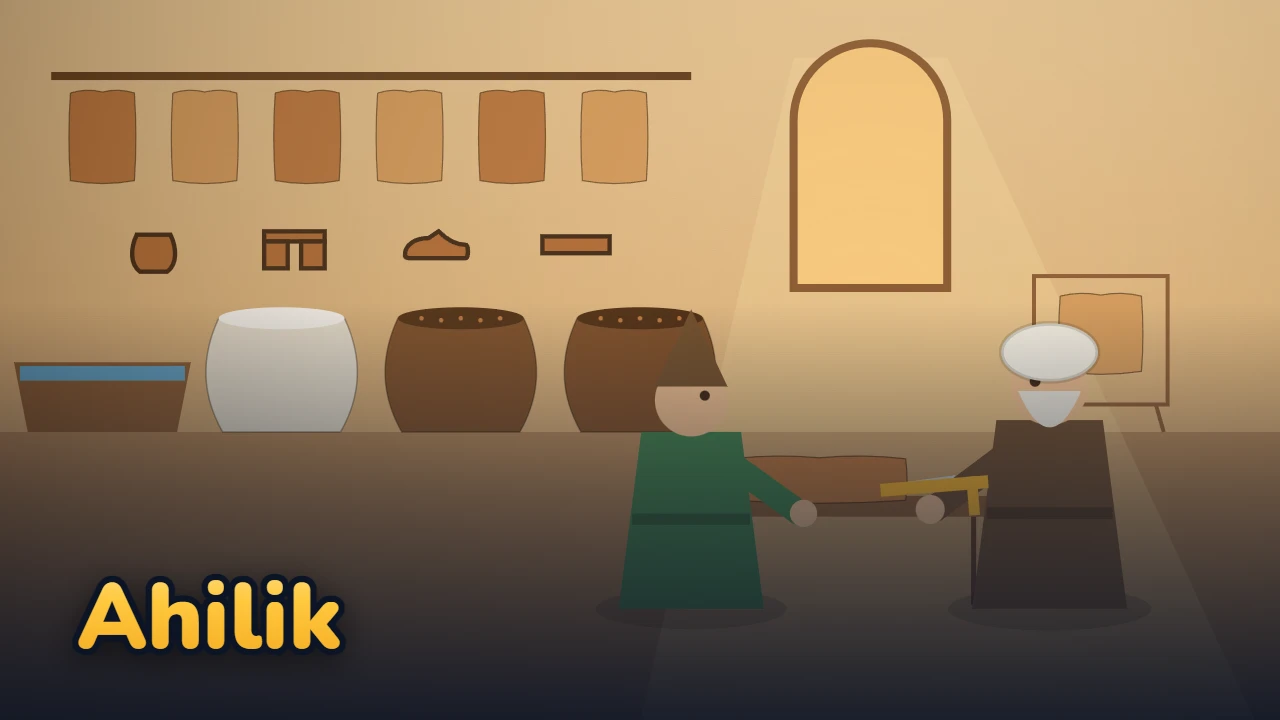
Ahilik
From apprentice to master in a leather workshop in Kırşehir: plan the work, keep your word, earn your reputation.
How to play
Each level is a work day in the workshop. At the top are the day's jobs, below them the timetable: rows are benches, columns are hours. Tap a job card and its next step goes into the first free slot; drag a block to move it to another hour. The steps follow a set order: the hide softens in water, its hair loosens in lime, it is scraped, tanned in the oak gall vat and dried in the shade; then it is cut and sewn. Scraping, cutting and sewing need hands; hide waiting in a vat or on a frame does not, so put your hands to other work meanwhile. When the plan is ready, press Start: the workshop plays your plan and customers collect their goods. Once you are a journeyman, you answer customers at the door with "Promise" or "Tomorrow". Deliver every job on time without a single shortcut for 3 stars.
How to play Ahilik: a full guide from apprentice to master
Ahilik is a planning and reputation game set in a debbağ (tanner's) workshop in 13th-century Kırşehir. You guide Aydın, a village boy, from apprentice to journeyman and then to master under Master Bekir. Every level is one work day: you place the orders on the timetable, press Start, and the workshop plays out your plan. There are 30 levels in 5 chapters, an Order of the Day and a Guild ledger. Shortcuts are always within reach, but the market never forgets.
Goal
Each work day has one Main job plus other orders; you pass the day if the main job is delivered on time. The workshop is on top and the timetable below: rows are workbenches, columns are the hours of the day. The dashed line is the hour a customer arrives. If the job is not done by then, the customer leaves empty-handed and the promise is broken. The Target at the top is the day's akçe goal (akçe was the silver coin of the time), and it can always be reached without shortcuts.
How to play
Tap a job card and its next step drops into the earliest free hour. Drag a placed block left or right to move it. Tap a block for a menu: Remove takes off the block and every step after it; on steps with a shortcut you switch between the shortcut and Do it the right way. Clear wipes the whole plan.
When the plan is ready, press Start: the day plays hour by hour and customers collect their goods. The button in the bottom right sets the speed to 1×, 2× or 4×. If the main job is late, Fix the plan takes you back to the timetable. On a keyboard, 1-5 place the next step of that job, Enter or Space starts the day, and Esc pauses.
Hands and waiting steps
The real puzzle: some steps need a hand, some do not. In any hour you can run only as many active steps as you have hands; the dots at the bottom show how many are busy.
| Step | Bench | Hand |
|---|---|---|
| Soaking | Soaking trough | No, 1 hour |
| Liming | Lime vat | No, 2 hours |
| Scraping | Scraping beam | Yes, 1 hour |
| Tanning | Acorn tanning vat | No, 3 hours |
| Drying | Drying frame | No, 1 hour (2 in rain) |
| Cutting, sewing | Cutting and sewing benches | Yes |
The secret is to keep your hands cutting and sewing while hides wait in a vat. Early on you have 1 or 2 hands; in chapter 4 you take on an apprentice and get 3 hands and two sewing benches.
Stars and akçe
- 1 star: main job on time.
- 2 stars: every promise kept and the day's target reached.
- 3 stars: all of that, without a single shortcut.
A job finished before its customer arrives earns 1 extra akçe for each hour to spare (up to 3).
Shortcuts, reputation and the council
There are four shortcuts: Thin stitching, Cut tanning short (1 hour instead of 3), Cheap hide (skip the tannery, 2 akçe off the fee) and short weighing on market days. The job gets done, but the goods are defective: two work days later the customer returns and your Reputation drops by 10. Choose Make a new one and a free replacement joins the timetable; deliver it on time for +6. Every broken promise costs 8.
Reputation starts at 50; on a replay, gains count only if you beat your star record. After level 12 the Guild council wants 60 for journeyman, after level 30 it wants 75 for master. If you fall short, it opens an Honest work day with no shortcuts: keep every promise and gain 12.
The door and market day
As a journeyman you choose Promise or Tomorrow for each customer on the Door screen. A promised job joins the timetable. Promise everyone and you may be forced into shortcuts; the target hints at what fits honestly.
On market days the saddler buys tanned hide by weight at the end of the day, and you pick weight stones for the scales. An exact weight raises reputation. Weighing over costs you the difference in akçe. Short weighing pays extra but counts as a shortcut, and at the end of the chapter the Guild warden's check takes 6 reputation for each one.
Chapters, modes and helpers
Chapters: Cutting and Sewing, The Tannery, Door and Market, Your Own Apprentice (saddlebags, rainy days) and Toward Mastery (the saddle set, the şed ceremony). The Order of the Day opens after level 6: everyone gets the same work day, with its own leaderboard. The main board uses your Trade score: the sum of your best akçe per level × reputation / 100. The Guild ledger keeps your reputation history and 8 info cards. Classroom mode opens every level and turns ads off. If you like, a short ad gives you a Hint (the master places the next correct step) or a Candle that keeps the shop open one hour longer.
Tips
- Build the day around the tanning vat: tanning takes 3 hours and needs no hand, so keep your hands cutting and sewing meanwhile.
- Place the job with the earliest dashed line first, then fit the main job around it.
- You cannot add an active step to an hour whose hand dots are full; sliding a block one hour is often enough.
- At the door, check the target: the shortest list of promises that reaches it is usually the one that fits honestly.
- Heading to the council with low reputation? Play an Honest work day or two; each successful day brings 12.
- Saying Make a new one to a returning customer is the cheapest way to win reputation back.
Ahilik: the Anatolian craft tradition from apprentice to master
Ahilik was a guild organization of craftsmen and tradesmen that emerged in Anatolia in the 13th century. Ahi Evran is regarded as its founder in Anatolia; his zaviye, a lodge, was in Kırşehir, and according to tradition he is the patron, or pir, of tanners. A newcomer entered the trade as an apprentice and rose to journeyman and then master; the ceremony for a journeyman becoming a master is called şed kuşanma, the girding of the şed, a waist sash. Honesty in measure and weight was a core principle of Ahilik. Today Ahilik Week is celebrated every September in Turkey. The characters in the game are fictional.
- What
- An organization of tradesmen and craftsmen
- Emerged
- 13th century, Anatolia
- Founder in Anatolia
- Ahi Evran (d. 1261/62); his lodge is in Kırşehir
- Ranks
- Apprentice, journeyman, master
- Mastery ceremony
- Şed kuşanma, girding with the waist sash
- Today
- Ahilik Week every September, centered in Kırşehir
What is Ahilik?
Ahilik is an organization of tradesmen and craftsmen that emerged in Anatolia in the 13th century. Its founder in Anatolia is regarded as Ahi Evran, known as Şeyh Nasîrüddin Mahmûd, who is held to have died in 1261/62. His zaviye, a lodge, is in Kırşehir. According to tradition, Ahi Evran is the pir, the patron, of the tanners (debbağ); this tradition is not historically certain. Even so, his lodge in Kırşehir was long regarded as a center of tanners and craftsmen, which is why the game is set in a Kırşehir leather workshop.
Apprentice, journeyman, master and the şed
A trade began with apprenticeship (çırak), was refined as a journeyman (kalfa) and completed as a master (usta). Nobody could open a shop before becoming a master; the new master could open a workplace of his own. The ceremony of becoming a master is called şed kuşanma or şed bağlama; the şed is a waist sash. The council included the ahi baba, the master who had taught the craft and the guild's officials. It was customary for the master to show the journeyman the last finesse of the craft just before.
The Turkish saying "pabucu dama atılmak" (to have one's shoe thrown on the roof) is said to come from throwing an apprentice's shoe onto the roof when he became a journeyman; this explanation is not certain.
The guild, the yiğitbaşı and honest weight
The guild checked the quality of goods and set prices; the number of shops and looms was limited. The yiğitbaşı was the officer who kept order and discipline in the guild. Honesty in measure and weight, never short-weighing, is among the most cited principles of Ahilik. Reputation, returning defective goods and the end-of-chapter check are the game's way of showing these ideas.
Leather making and the game
A raw hide is soaked to soften it, limed to loosen the hair, scraped of hair and flesh, tanned with plant materials such as palamut (valonia acorn) and dried. In reality this takes days or weeks; the game squeezes it into hours. Aydın, Master Bekir and Turgut the journeyman are fictional; Ahi Evran, the şed ceremony, the yiğitbaşı and the leather steps come from real history.
Today
Every September, Türkiye celebrates Ahilik Week, with Kırşehir at the center of the events. Teachers can use the game's Classroom mode in Ahilik Week lessons or at vocational schools: all levels are open and no ads appear.
How Ahilik was made
Ahilik is a tradition of craftsmen and tradesmen that is remembered every September during Ahilik Week, in schools too. The starting point was a game about doing work right, without lecturing. So Ahilik is told through the work itself rather than through speeches: a tannery in 13th-century Kırşehir, an apprentice from the village and a master of few words. Each level is a work day; by working on time, doing the job fully and keeping promises, the apprentice rises to journeyman and then master.
The real rhythm of leatherwork became the rule of the game. The hide softens in water, waits in lime, is tanned in the oak gall vat and dries in the shade; these steps take hours but keep no one's hands busy. Scraping, cutting and sewing need hands. That made the game a timetable puzzle: steps go onto benches and hours, and while the hide waits in the vat, the hands move on to other work. Press Start and the workshop plays the plan; it takes thinking, not reflexes.
Thin stitching, short tanning, cheap hide and short weight are always visible, but the game never comments on them. On an evening with a shortcut, the screen still smiles. The cost comes later: defective goods return to the door with their customer a few days on, and short weight comes to light when the guild warden inspects.
There is always a way back, so no child gets stuck. Returned goods can be replaced, which wins back part of the lost reputation. If the guild council makes you wait, Honest work days open, each raising reputation by 12 points. A solver checked all thirty levels: every one can be finished with three stars without a single shortcut.
The music was synthesized in code in the Hicaz makam with the sounds of ney, oud and def, and all graphics are drawn in code. Classroom mode opens every level for teachers and shows no ads. The game launched as version 1.0 on 14 October 2026 and can be played in seven languages.
Frequently asked questions
Why are shortcuts bad in Ahilik?
Thin stitching, short tanning, cheap hide and short weighing get the job done but make the goods defective. They come back two work days later and cost 10 reputation. A day with a shortcut earns at most 2 stars.
Why won't the Guild council promote me?
The council looks at your reputation: 60 for journeyman, 75 for master. If you fall short, play an Honest work day; keep every promise on this day without shortcuts and you gain 12 reputation.
What does the dashed line on the timetable mean?
It is the hour the customer arrives. The job's last step must finish before it, or the customer leaves empty-handed and the promise counts as broken.
Why can't I do two jobs in the same hour?
Scraping, cutting and sewing need a hand, and you can only run as many as you have hands; each bench also has limited room. Soaking, liming, tanning and drying need no hand and can share an hour with other work.
What should I do with a customer who comes back?
On the Door screen choose Make a new one or Turn away. Make a new one adds a free replacement; deliver it on time and you regain 6 reputation. Turning the customer away frees your timetable, but the reputation stays lost.
How do I get an exact weight on market day?
The saddler asks for a set weight of tanned hide. Pick the stones that add up to exactly that number. An exact weight raises reputation; short weighing pays extra, but at the end of the chapter the Guild warden takes 6 reputation for each one.
How is the Order of the Day scored?
It opens after level 6 and gives everyone the same work day. The akçe from jobs delivered on time is added up, shortcut jobs count half, and 3 stars add 10 more. If the main job is late, the score is zero.
What is the Trade score?
It is the main leaderboard score: the sum of your best akçe in each level, multiplied by your reputation and divided by 100. A player who earns a lot with low reputation can fall behind an honest one.
What is Classroom mode?
A setting for teachers: every level is open and no ads appear. It helps in Ahilik Week lessons or at vocational schools when you want to jump to a topic without playing through the levels.
Is Ahilik free?
Yes. No download or account needed; it plays right in your browser. Watching an ad for a hint is always your choice.
Will I lose my progress?
Your progress is saved automatically on this device. Sign in and it moves to your account, so you can continue on any device.
Can I play on my phone?
Yes. The game opens full screen on phones; tap the X in the corner to exit. On iPhone use "Add to Home Screen" to play it like an app.
Can I play Ahilik offline?
Yes. A game you have opened once is stored on your phone or computer and opens without internet. Leaderboards and cloud saves need a connection.
Which languages are available?
Turkish, English, Spanish, Portuguese, German, French and Russian.
Comments
Sign in to write a comment.
No comments yet. Be the first.
