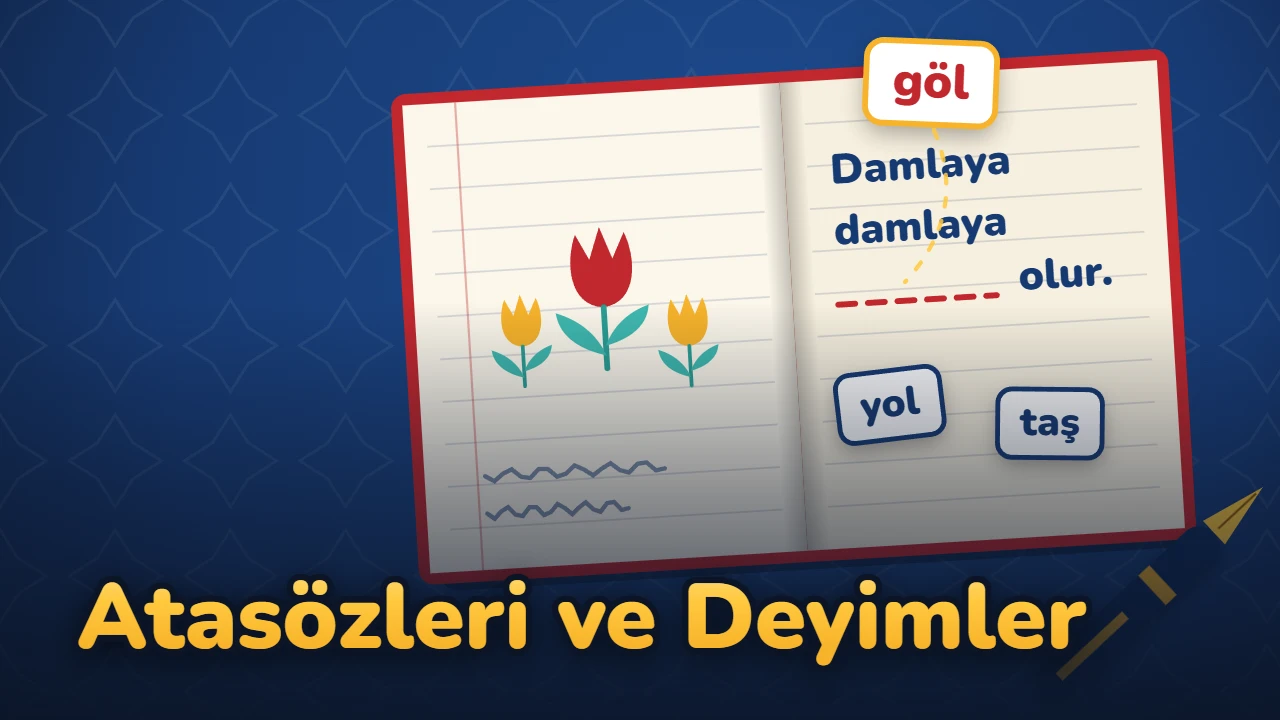
Proverbs & Idioms
We give you half the saying, you finish the rest: a complete-the-proverb game.
How to play
Every round has 10 questions and you do not need a keyboard. You pick the missing word of a proverb from four cards, tap mixed-up words in order to build the saying, find what a saying means from three choices, or pick the saying that matches a given meaning. In the last question you match four sayings to their meanings. After every answer you see the whole saying and what it means, and the sayings you get right are written in your Sayings Notebook. Stuck on a missing-word question? The Remove two wrong hint takes away two wrong cards.
How to play Proverbs & Idioms: a full guide
Proverbs & Idioms is a word game about sayings that needs no keyboard: you learn proverbs and idioms by picking, ordering and matching. The game's motto sums it up: we give you half the saying, you finish the rest. Every round is 10 short questions, and after every answer you see the whole saying and what it means. In English the game has 171 proverbs and 145 idioms; each of the other six languages has its own sayings too.
The goal
The goal is to answer the 10 questions of a round as correctly and as quickly as you can, and to learn what the sayings mean along the way. There are no levels to unlock; your progress is shown by the Sayings Notebook. Every saying you get right is written on its topic page in the notebook, while the ones you have not found yet wait there as "? ? ?". Out of 10 questions, 6 correct answers earn 1 star, 8 earn 2 stars and 10 earn 3 stars.
Five question types
| Question | On screen | What you do |
|---|---|---|
| Pick the missing word | A saying with one word left blank, four word cards | Tap the right word |
| Put the words in order | The words of the saying on mixed-up cards | Tap the cards in order, then press Check |
| Find the meaning | The whole saying, three meanings | Pick the right meaning |
| Find the saying with this meaning | One meaning, three sayings | Pick the saying that has that meaning |
| Match the sayings to their meanings | Four sayings, four meanings | Tap a saying, then its meaning |
In a word-order question, tap a card you placed in the wrong spot and it goes back; Clear takes them all back. Matching is always the last question of the round, and its four pairs count as one question. Within a round the questions go from easier to harder.
Round type and level
In the main menu you choose a Proverbs round, an Idioms round or a Mixed round that brings both. There are three levels:
- Primary: only the best-known, short and concrete sayings.
- Middle school: adds sayings that are common in everyday life.
- General: all of them, including less familiar and old-fashioned ones.
Sayings from your last rounds and sayings already written in your notebook come up later, so each round brings you new ones. You can also choose the language of the sayings separately from the language of the game: that is what the Language of the sayings part of the How to play window is for.
Points and the leaderboard
Every correct answer is worth 100 points. A fast answer adds a speed bonus of up to 50 points: the full bonus within the first 4 seconds, then less and less until it reaches zero at 15 seconds. So that tapping without reading does not pay, an answer given in under 1.2 seconds gets no speed bonus. Three correct answers in a row multiply your points by 1.2, five in a row by 1.5. The level multiplier is 1 for Primary, 1.2 for Middle school and 1.5 for General. In matching, every wrong attempt costs 25 points. The leaderboard records the total score of your 10-question round.
Proverb of the Day
The Proverb of the Day is one saying, the same for everyone, solved in two steps. First you put its mixed-up words in order; a wrong Check costs one try, but the words you placed correctly get locked. Then you pick its meaning from three choices; a wrong pick also costs one try. You have 6 tries in total. Your score starts at 600 and every try you use takes away 100 points. When you finish you can share your result and see on which try everyone else solved it. Your streak counts the days you solved in a row; the days you missed are in the Archive, where points are halved and do not count toward your streak. The weekly ranking is based on these points.
Sayings Notebook and Class Round
The Sayings Notebook is divided into 14 topics: Hard work, Patience, Friends and neighbours, Words and speech, Money and thrift, Family, Knowledge and learning, Honesty, Unity and helping, Caution, Time, Feelings, Behaviour, Experience. Proverbs and idioms are on separate tabs; open a topic page and you will find the sayings you have collected, each with its meaning.
The Class Round is for teachers: you choose the type, the level, the question type (all of them or just one) and the number of questions (5, 10 or 20). There is no timer, no leaderboard and no ads, and the large text can be read from the back of the room on a whiteboard or projector. Every student who opens the link gets the same questions in the same order.
Tips
- In a missing-word question, try saying the proverb out loud first; a familiar saying usually sounds right to your ear.
- In word order, find the first word first: in proverbs it is usually the card that starts with a capital letter.
- In meaning questions, do not get stuck on the literal meaning of the words; sayings are usually figurative.
- Remove two wrong is free once per round; save it for the missing-word question you are least sure about.
- Correct answers in a row raise your multiplier; take your time on a question you are unsure of so your streak does not break.
- Read the Review these list at the end of the round; those sayings may come back in later rounds.
- In the Proverb of the Day, look at the words that got locked after your first Check and build the rest around them.
Proverbs: the shared memory of a language
A proverb is a short, fixed sentence that passes on advice or a general truth taken from long experience: "Many hands make light work." An idiom is a fixed phrase whose meaning is not the sum of its words, used to describe a situation in a vivid way: "spill the beans" means to tell a secret, and there are no beans in it at all. The English sayings in the game are common sayings of the language, checked against dictionaries, and their meanings are written in our own plain words so that a student can follow them.
- English proverbs (in the game)
- 171
- English idioms (in the game)
- 145
- Usual form of a proverb
- A complete sentence: advice or a general truth
- Source of the English sayings
- Common sayings of the language, checked against dictionaries
- Sayings Notebook topics
- 14
- Languages
- 7, each with its own sayings
Where do proverbs come from?
Proverbs pack the lessons that people have learned over many generations into short sentences that are easy to remember. Most of them have no known author; they belong to everyone who speaks the language and have reached us by being said again and again. Many English proverbs take their pictures from farms, kitchens, weather and family life: "Make hay while the sun shines" tells you to use a good chance while it lasts, and "A watched pot never boils" reminds you that waiting makes time feel longer. Because they sound like small stories, they stick in the mind far better than a plain piece of advice.
Proverb and idiom
Both are fixed: you cannot swap their words for others. The difference is in what they do. A proverb gives advice or states something that is true for everyone, and it is a complete sentence on its own ("Strike while the iron is hot."). An idiom describes a situation in a colourful way, gives no advice, and is usually a phrase that fits inside a sentence, very often a verb phrase ("cut corners", "face the music"). In the game, proverbs and idioms are kept apart, so you can play a round of only one kind.
Proverbs at school
Proverbs and idioms come up again and again in language lessons: students explain what a saying means, spot a saying in a text, use one to open or close a piece of writing, or learn them as part of a new language. Linking a saying to a real situation helps it stay in the memory much better than learning it by heart. That is why the game has meaning questions and matching, and why the Class Round lets a teacher give the same questions to the whole class.
How the game handles it
The English sayings in the game are common proverbs and idioms of the language, checked against dictionaries and written in their usual form. Their meanings follow the dictionary sense but are written in our own plain words, so that a student can understand them. Because this is a game for school, sayings that make fun of a person or a group of people were left out. Every language has its own proverbs and idioms, chosen separately and not translated; the Turkish sayings, for example, come from the dictionary of the Turkish Language Association (TDK). The story of Grandma, her grandchild and the old notebook is fiction made for the game.
How Proverbs & Idioms was made
Most of us first meet proverbs and idioms as homework: a list with meanings next to it, to be memorised. The idea behind this game was to turn that list into something you play. The first decision was to remove the keyboard. Typing letter by letter is tiring on a phone and turns the game into word guessing; here you tap cards, put words in order and match sayings to their meanings. That way your attention goes to the saying itself and to what it means, not to spelling.
The five question types show the same saying from different sides: the missing word teaches its fixed form, word order teaches its rhythm, and the meaning questions teach when it is used. After every answer the meaning stays on screen for a few seconds, and sayings you missed appear in a "Review these" list at the end of the round. Most of the work went into the wrong options: if two words fit a gap, the game becomes unfair. So the common alternative wordings of each saying were written down and the wrong options were chosen by hand so they never clash with them.
Each language plays with its own proverbs and idioms rather than translated Turkish ones, because a translated proverb is not a proverb in the new language. The meanings were rewritten in plain words a schoolchild can follow. Since this is also a game for classrooms, old sayings that could be hurtful or demeaning were left out on purpose.
For teachers there is the Class Round: no timer, no leaderboard, no ads, text large enough to read from the back of the room, and everyone who opens the shared link gets the same questions in the same order. The Proverb of the Day gives everyone the same saying each day. The Sayings Notebook and the story of a grandmother and her grandchild come from the same idea: sayings are written down and passed from one generation to the next. The calm background music was generated in code from a scale close to the Turkish Uşşak mode. The game was released as version 1.0 on 18 October 2026 and can be played in seven languages.
Frequently asked questions
How do I tell a proverb from an idiom?
Ask whether the saying gives advice or states something true for everyone. "Patience is a virtue" states a general truth, so it is a proverb; "cut corners" only describes how someone does a job, so it is an idiom.
Where do the sayings in the game come from?
The English sayings are common proverbs and idioms of the language, checked against dictionaries. Every other language has its own common sayings, chosen and checked the same way; none of them are translations.
Why are the meanings not word for word from a dictionary?
The meanings follow the dictionary sense, but they are written in our own plain words so that students can understand them easily. The saying itself keeps its usual form.
Which level should I start with?
Primary school children and anyone new to sayings should start with Primary. Middle school brings more sayings, and General adds the less familiar ones and multiplies your score by 1.5.
How many times can I use Remove two wrong?
It only appears in missing-word questions. It is free once per round; after that, if you choose to, you can watch a short ad to use it up to two more times in the round. A question where you used it gets no speed bonus.
When does the Proverb of the Day change?
Every day at midnight Turkey time. Everyone solves the same saying that day, and in each language the daily saying is one of that language's own proverbs.
How do sayings get into the Sayings Notebook?
When you get a saying right in a round, it is written on its topic page automatically. The four sayings of a matching question go into the notebook once you finish the matching.
Does the Class Round go on the leaderboard?
No. The Class Round has no timer, no leaderboard and no ads; it is made so that the whole class can play the same round on the board.
Will the same saying keep coming back?
Sayings you saw in your last rounds and sayings already in your notebook come later. That way you meet new sayings first, and older ones come back from time to time for review.
Is Proverbs & Idioms free?
Yes. No download or account needed; it plays right in your browser. Watching an ad for a hint is always your choice.
Will I lose my progress?
Your progress is saved automatically on this device. Sign in and it moves to your account, so you can continue on any device.
Can I play on my phone?
Yes. The game opens full screen on phones; tap the X in the corner to exit. On iPhone use "Add to Home Screen" to play it like an app.
Can I play Proverbs & Idioms offline?
Yes. A game you have opened once is stored on your phone or computer and opens without internet. Leaderboards and cloud saves need a connection.
Which languages are available?
Turkish, English, Spanish, Portuguese, German, French and Russian.
Comments
Sign in to write a comment.
No comments yet. Be the first.
