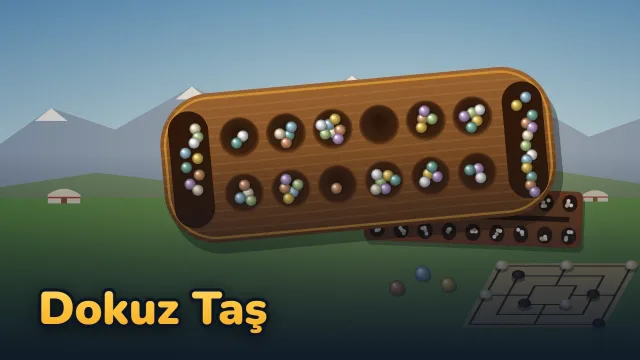
Nine Men's Morris is a two-player alignment game played on a board of three nested squares. In Turkish it is called Dokuz Taş, in German-speaking countries Mühle, and in French-speaking countries jeu du moulin. In Anatolia it is played in coffeehouses, village homes and schoolyards, with the board drawn on paper or even scratched into the ground.
On this page we explain the rules of Nine Men's Morris on CetinsGame exactly as the game applies them. The game is played differently from region to region; we used the most widespread rule set in the world and left the disputed "flying" rule to the settings. Nine Men's Morris is also played inside our Mangala game, together with Mangala and Toguz Korgool.
The board and the stones
The board is made of three nested squares and four lines joining the midpoints of their sides. There are 24 points where the lines meet, and three adjacent points on the same straight line form a mill; the board has 16 mills. Each player has 9 stones. Light stones start.
Phase 1: placing stones
Players take turns putting one stone on an empty point of the board. This phase lasts until both players have placed all nine stones (18 moves in total). You can form a mill while placing too; whoever forms one immediately takes one of the opponent's stones.
Phase 2: moving stones
Once all stones are placed, each move slides one stone along a line to an adjacent empty point. A stone can't jump, can't move diagonally and can't enter an occupied point. Moving is compulsory: the player whose turn it is must move one of their stones.
Mills and taking stones
- Whoever brings three of their own stones into a mill removes one of the opponent's stones from the board.
- Stones not in a mill must be taken first. If all of the opponent's stones are in mills, a stone from a mill can be taken.
- Even if two mills are formed in the same move, only one stone is taken.
- Moving a stone out of a mill and bringing it back on a later move counts as a new mill. That is why opening and closing a mill is such a strong pattern.
- A captured stone leaves the game and never comes back.
Flying with three
A player down to three stones can move their stones not only to an adjacent point but to any empty point on the board. This rule is widespread around the world but not played everywhere. In our game it is on by default; during a game you can turn off "Flying with three" from the menu, and the setting applies from the next game.
Winning and draws
- A player reduced to two stones loses (you can't form a mill with two stones).
- In the moving phase, a player with no legal move on their turn (all stones blocked) loses.
- If the same position comes up three times with the same player to move, the game is a draw.
- If no stone is taken for 50 moves in the moving phase, the game is a draw.
Nine Men's Morris has been solved by computer: if both sides play without mistakes, the result is a draw. That is why good games are usually won by a small mistake made in the placing phase.
The computer opponent
There is no luck in the game; the computer calculates its moves with exactly the same rules engine you play with. Easy forms and blocks mills but makes a mistake now and then, Medium looks a few moves ahead, and Hard calculates much more deeply and doesn't play every game the same way, because it chooses between good moves of similar strength.
Common mistakes
- Trying to take a stone from your opponent's mill: while there are stones outside a mill, a stone in a mill can't be taken.
- Expecting to take two stones after forming two mills at once: only one stone is taken per move.
- Putting all your stones on corners while placing: corners have only two neighbours, so the stones get blocked easily later.
- Seeing two of your opponent's stones on a line and leaving the third point open: they will form a mill on the next move.
- Trying to move a stone diagonally or by jumping: a stone only moves along a line to an adjacent point.
- Assuming flying with three stones is allowed everywhere: some regions play without flying; in our game you choose it in the settings.
Frequently asked questions
How many stones are there in Nine Men's Morris?
Each player has 9 stones; the board has 24 points and 16 mills.
What is a mill?
Bringing three of your own stones onto three adjacent points on the same straight line. Whoever forms a mill takes one of the opponent's stones.
Can a stone in a mill be taken?
Not if your opponent has a stone outside a mill. If all their stones are in mills, a stone from a mill can be taken too.
What happens when you have three stones left?
Once you are down to three stones, your stones can fly to any empty point. In our game this rule is on by default and can be turned off from the menu.
How do you win Nine Men's Morris?
You win if you reduce your opponent to two stones, or leave them with no legal move in the moving phase.
Can Nine Men's Morris end in a draw?
Yes. If the same position comes up three times, or no stone is taken for 50 moves, it is a draw. It is known that the game ends in a draw if both sides play without mistakes.
Are Nine Men's Morris and Dokuz Taş the same game?
Yes. Dokuz Taş is the Turkish name of this game; in German it is known as Mühle, in French as jeu du moulin.
Where can I play Nine Men's Morris?
On CetinsGame you can play against the computer at three levels, or two players on one device. It is inside the same game as Mangala and Toguz Korgool, and your progress is shared.
