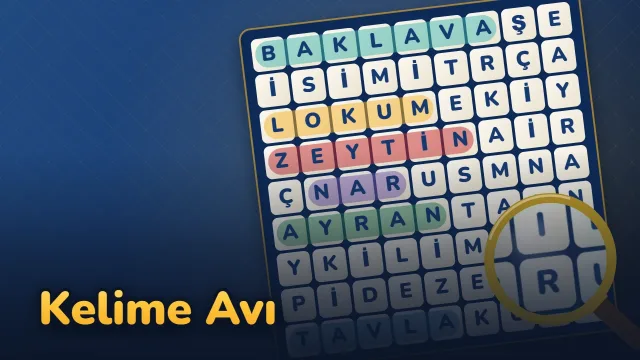
Word Search is the classic puzzle where you find words hidden in a grid full of letters. Every grid has a theme: fruits, Turkish cuisine, instruments, Istanbul neighbourhoods and more. The words to find are listed next to the grid, and each one is hidden exactly once along a straight line. Find every word on the list and the grid is done. You can't lose, and a wrong selection costs you nothing.
On this page we explain how to play, which directions the words can run in, the game's own hidden word, how the levels get harder, the Daily Puzzle, how points and stars are calculated, ways to solve faster, and how the game works for kids and in the classroom.
How do you play Word Search?
Pick a word from the list and look for its first letter in the grid. When you spot the word, mark it in one of two ways:
- Drag: press on the first letter and slide your finger (or the mouse) to the last letter. The selection line snaps to the nearest allowed direction, so it stays straight even if your finger drifts a little.
- Two taps: tap the first letter, then tap the last letter. This is handier with a mouse or on a small screen. Tapping the waiting letter again cancels the selection.
If the letters you picked form a word on the list, the word gets a permanent coloured stripe, it is crossed off the list and its letters give a little bounce. Selecting a word from its last letter back to its first also counts. If the selection isn't a word, the grid gives a small shake and your score stays the same.
The list shows each word with its normal spelling, while the grid holds only the letters: spaces, apostrophes and hyphens are dropped and accents disappear. So Hot Chocolate on the list is HOTCHOCOLATE in the grid, and the Turkish dish Gözleme is GOZLEME. Words on the list are at least 3 letters long.
The timer starts when the grid opens and stops while the menu is open or you switch to another tab. There is no time limit; the clock only matters for the speed bonus and the third star.
Which directions can the words go in?
There are 8 directions in a word search: right, down, the two diagonals (down-right and up-right) and their reverses (left, up, up-left and down-left). A word hidden in a reverse direction reads backwards in the grid. The game doesn't throw all of them at you at once; new directions are added one by one as the grid grows. The Directions row above the list shows which ones the current grid uses.
| Levels | Grid | Words | Directions |
|---|---|---|---|
| 1-10 | 8×8 | 6 | Right and down |
| 11-20 | 9×9 | 7 | + diagonal down-right |
| 21-30 | 10×10 | 8 | + diagonal up-right |
| 31-40 | 11×11 | 9 | + left (backwards across) |
| 41-50 | 12×12 | 10 | + up (backwards down) |
| 51-60 | 13×13 | 12 | All 8 directions |
Words can cross each other and share a letter; in later levels they cross more often and get longer. Every word appears exactly once: when the game builds a grid, it checks all 8 directions to make sure no word on the list turns up a second time by accident. Where you find it is the only right place.
What is the hidden word?
Each grid hides one more word that isn't on the list: the hidden word. It belongs to the theme and has at least 4 letters. At the end of the list you only see one blank per letter (Hidden word _ _ _ _ _). To find it, think about the theme rather than the list: if the theme is Fruits, look for a fruit that isn't listed; if it's Turkish Instruments, look for an instrument that isn't listed.
You select the hidden word like any other. Once found, it gets a gold stripe and the blanks fill in. It's worth 100 points and one star. Finding it is optional. When every word on the list is done but the hidden word is still out there, the grid stays open: keep hunting, or end the grid with the Finish button that replaces the Levels button.
If you press Hint after the list is complete, the hidden word's first letter lights up in the grid and the game tells you which letter it starts with. If you finish without it, the results screen reveals what it was, so you'll know what to look for next time.
Levels, notebooks and Free Hunt
The main path through the game is Levels: 60 themed grids split into 6 notebooks of 10. In the story, Master Nuri, an old bookseller in Istanbul's book bazaar, hands you an unfinished puzzle notebook, and each level is one of its pages. Levels unlock in order. You can replay any finished level with Play again, which gives you the same grid; it's the easy way to collect missing stars. Your best score and most stars are kept for every level.
There are 30 themes and each comes round twice. In the first round (1-30) the grids are small; in the second round (31-60) the same themes return in large grids from 11×11 to 13×13, using words that didn't appear the first time wherever possible. Themes run from everyday topics (Fruits, Animals, Colours) to Turkish culture (Turkish Cuisine, Turkish Instruments, Turkish Crafts, Istanbul Neighbourhoods, Cities of Türkiye).
The first time you finish a theme, its culture card unlocks and goes into your Album; there are 30 cards in all. The theme's card also appears on every results screen under Did you know?
Free Hunt is for unlimited play: choose a difficulty and the game builds a brand-new grid from a random theme each time. Easy is 8×8 with right and down only, Medium is 10×10 with four directions, and Hard is 13×13 with all eight, backwards included. Free Hunt scores don't go on the rankings.
What is the Daily Puzzle?
The Daily Puzzle is one grid that everyone solves on the same day. A new one arrives every day at midnight Turkey time (UTC+3), and they are numbered: 14 October 2026 was #1 and the number goes up by one each day. The grid is 12×12, with 11 words plus the hidden word spread over all 8 directions, so it's close to the last notebooks in difficulty. The theme changes daily, and each of the 30 themes comes up once every 30 days.
- Only your first finish of the day is scored. That score is added to your weekly total, and weekly totals make up the weekly ranking. Weeks start on Monday.
- You can play the same day's grid again, but replays don't count.
- Hints are available here too and cost points, which keeps the ranking fair.
- When you finish, you see the theme's culture card, and it's added to your album if you don't have it yet.
Each language has its own Daily Puzzle built from its own words. Once you've finished the day's grid, the Daily Puzzle button on the home screen shows your time.
How are points and stars calculated?
Your score has four parts:
| Part | How it works |
|---|---|
| Words | 10 points for every letter of the listed words |
| Speed bonus | If you beat the target time, up to half of your word points; the earlier you finish, the bigger it gets |
| Hidden word | +100 points |
| Hint | -30 points per hint (the free one too) |
The minimum score is 10. The target time depends on the grid size and the number of words, and it's shown on the results screen: 2:14 for the 8×8 grids of the first notebook, 5:53 for the 13×13 grids of the last one, and 5:08 for the Daily Puzzle. Finish in half the target time and the speed bonus is a quarter of your word points; the faster you go, the closer it gets to half.
Example: on an 8×8 grid the words have 32 letters in total, which is 320 points. You finish in 1:07, half the target: +80. You find the hidden word: +100. You used one hint: -30. Total: 470 points.
There are three stars: one for finishing the grid, one for finding the hidden word and one for beating the target time. Hints never cost a star, only points. The sum of your best scores across all levels is your total score, shown in the game; finish a level again with a higher score and your total goes up. Each grid you finish (a level or the Daily Puzzle) counts separately on the main leaderboard; its Today, Week, Season and All time tabs show your best single-grid score.
Tips for solving a word search faster
- Hunt for the rare letter. Pick the least common letter in the word (in English, J, Q, X, Z or K) and scan for that. Common letters are everywhere; a rare one leads you straight to the word.
- Scan for the first letter, confirm with the second. When you find the first letter, check its 8 neighbours. If the second letter isn't next to it, move on to the next candidate right away.
- Use double letters. Words like Strawberry, Rabbit or Sheep have two identical letters side by side, and pairs like RR or BB stand out in a grid. Look for the pair first.
- Start with long words, save short ones for last. A long word covers a lot of the grid and is easier to spot. Three- and four-letter words look like letter clusters you see in every corner; they get easier once the grid fills up with stripes.
- Scan row by row. Instead of looking around at random, sweep the grid from top to bottom one row at a time, then column by column.
- Check the Directions row. If the grid has no reverse directions, you only need to read left to right and top to bottom, which cuts the search in half.
- Keep the hidden word in mind. If you notice a word that fits the theme but isn't on the list while scanning, grab it straight away; it's easier than coming back for it later.
- Replay for the third star. Play again opens the same grid, and since you remember where the words are, beating the target time gets much easier.
Word search for kids and the classroom
Word search suits everyone from early readers to grandparents: it works letter recognition, spelling and focus all at once. Word Search makes that easy in a few ways:
- No losing and no penalties. Wrong selections don't cost points and there's no time limit, so children play at their own pace.
- A gentle start. The first 10 levels use an 8×8 grid with words running only right and down. Free Hunt on Easy gives unlimited grids with the same settings.
- Everyday themes. Themes like Fruits, Animals, Colours, Vegetables, The Body and School use words children already know, and the culture cards add a short fact to each theme.
- Clean grids. Words are chosen with their dictionary spelling, and the filler letters are checked too: if they accidentally spell a rude word, the grid is rebuilt.
- The same grid for the whole class. The Daily Puzzle is identical for everyone that day, so a class can solve it together and compare times and the hidden word.
- Language practice. The game plays in 7 languages, and each language has its own word lists rather than translations. Switching languages keeps your progress; only the words change.
For younger children, two taps (first letter, then last letter) is often easier than dragging.
Common mistakes
- Working through the list strictly in order: you lose time on the word you're stuck on. Grab whatever word catches your eye and leave the hard ones for last.
- Forgetting the directions: from level 31 words can also run backwards. If a word won't show up, check the Directions row and read the grid in reverse too.
- Stopping one letter short or one too far: the selection must run exactly from the first letter to the last. One extra letter and the word doesn't count.
- Searching for the list spelling: the grid has no spaces, apostrophes or accents. Hot Chocolate is HOTCHOCOLATE and Gözleme is GOZLEME.
- Pressing Finish too soon: if you end the grid without the hidden word, you miss 100 points and a star. When the list is done, give the theme a little more thought.
- Thinking the first hint is free of charge: the first hint on each grid needs no ad, but it still takes 30 points off.
Frequently asked questions
Is a word search the same as a word find or word seek puzzle?
Yes, they are different names for the same puzzle: words hidden in a grid of letters. Unlike a crossword there are no clues; the words you need are given in a list.
Can one letter be used in two words?
Yes. Words can cross in the grid and share a letter. A found word's stripe doesn't block the letter, so you can select it again for another word.
Does it count if I select a word starting from its last letter?
Yes. A selection is read in both directions, so it makes no difference whether you go from first letter to last or the other way round.
Can the same word appear twice in a grid?
No. Every time it builds a grid, the game checks all 8 directions to make sure each listed word and the hidden word appear only once.
Can I finish a level without finding the hidden word?
Yes. Once the list is done, a Finish button appears; the level counts as complete and the next one unlocks. You can come back later with Play again for the hidden word's 100 points and star.
Will I lose my progress if I change the game language?
No. Levels, stars and cards are kept independently of the language; level 37 is level 37 in every language. Only the words change, coming from that language's own word lists.
Does my score change if I play the Daily Puzzle twice?
No. Only your first finish of the day counts towards your weekly score and the ranking; later plays are just practice.
