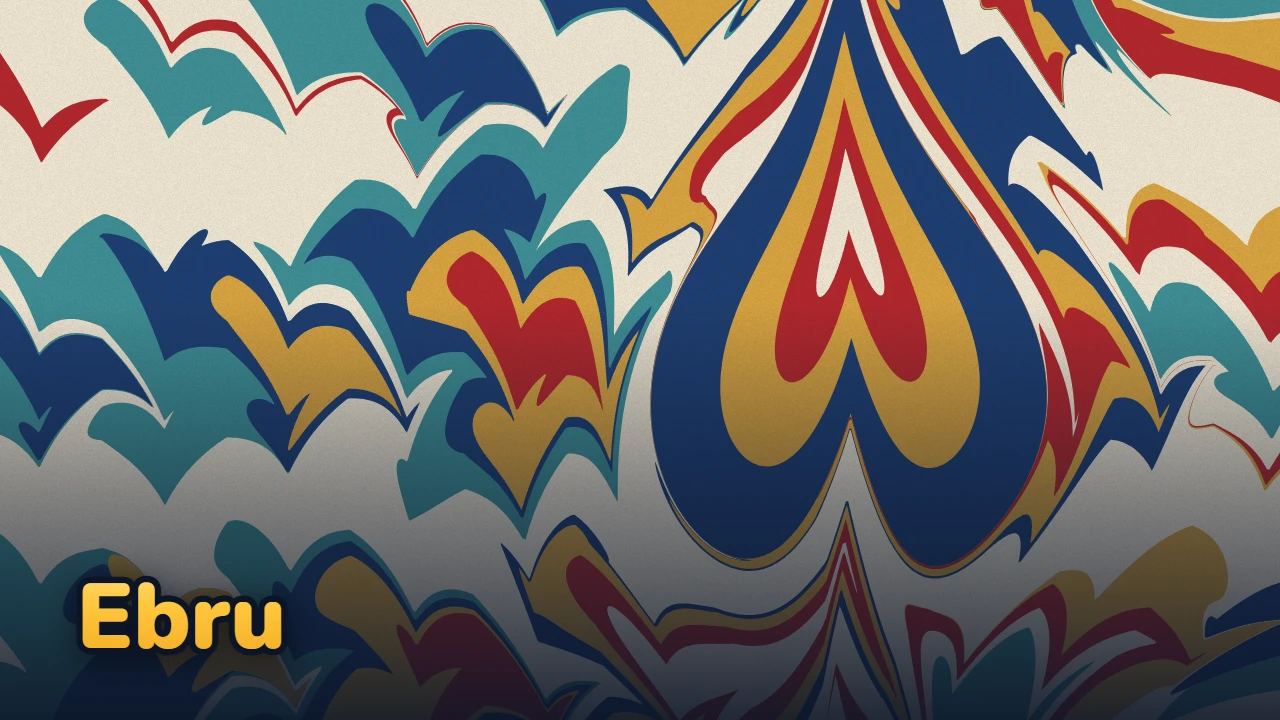
Ebru: Paint on Water
Drop paint on water, solve the pattern.
How to play
Drop paint on the water, pull it with the stylus, comb and swirl tools, then press the paper. The same drops in a different order make a different pattern; the puzzle is finding the right order.
How to play Ebru: Paint on Water - a complete guide
Ebru: Paint on Water is an order puzzle inspired by ebru, the traditional Turkish art of paper marbling. You drop paint onto the water in a tray, pull it with tools, and finally lay down the paper. The catch: the same drops and the same strokes, done in a different order, produce a completely different pattern. Every level shows you a target pattern, and your job is to find the order that recreates it. The game has 60 levels spread across 6 regions, a Daily Tray that changes every day, a Free Tray with no target, and a Book that collects your patterns.
Goal
The small picture in the corner is the Target. Every move you make in your tray changes the paint floating on the water. When you are done, tap Print: the game compares your print with the target and gives you a similarity score as a percentage. The closer you get, the more stars you earn.
Each level has a fixed number of moves. The small dots next to the tray show how many moves you have, and every move fills one dot. Once all dots are filled the Print button lights up and no extra moves are allowed. So the puzzle is as much about "in which order" as about "which paint, which tool".
Controls: paints and tools
The bottom row holds the paints and any tools unlocked for that level. Depending on what you select, guides appear in the tray.
| Selection | How to use it | What it does |
|---|---|---|
| Paint (Crimson, Navy, Yellow, Green, Turquoise, Dusty rose) | Tap a point marked with a dashed ring | The drop lands and pushes earlier paint outward as a ring. The last drop stays innermost. |
| Stylus | Drag your finger along a dashed line | Pulls only the paint around that line in the direction you drag. |
| Comb | Drag anywhere in the tray | Pulls the whole tray at once in evenly spaced bands. |
| Swirl | Tap a marked point | The water turns clockwise around that point and the paint becomes a spiral. |
The stylus and comb work in four directions: right, left, up and down. While you drag, a red arrow appears in the tray; when you lift your finger the stroke follows that arrow. For the stylus, the game picks the dashed line closest to where you dragged.
Each paint button also carries a small shape mark that does not depend on colour, so you can tell the paints apart even if colours are hard for you to distinguish.
Score and stars
When you print, two prints open side by side: Your print and Target. The result depends on the similarity:
- 97% or more: 3 stars, Masterful
- 90% or more: 2 stars, Beautiful
- 80% or more: 1 star, Good
- Below 80%: no stars, Try again
The first time you finish a level with 3 stars, you get 1 hint as a reward. Stars only go up; a weaker result never erases your best.
Regions and progress
The 60 levels are split into 6 regions of 10 levels, each named after a classic style of ebru:
- Battal (Stone marbling): drops only.
- Gelgit (Come and go): the stylus arrives. Needs 12 stars in total.
- Taraklı (Combed): the comb arrives. 30 stars.
- Bülbül Yuvası (Nightingale's nest): the swirl arrives. 50 stars.
- Şal (Shawl): all three tools together. 75 stars.
- Hatip (The master's order): all tools and the longest sequences in the game, 6 to 8 moves. 100 stars.
To open the next level you must finish the previous one with at least 1 star, and to enter a new region your total star count has to be high enough. When a new tool appears for the first time, a short intro card explains it.
Helpers: hint, undo, target
Undo removes your last move; you get 3 undos per level. Restart empties the tray and costs nothing. Hint shows the next correct move: it highlights the paint or tool to pick, then a hand and an arrow in the tray show where to tap or which way to pull. If one of your earlier moves is wrong, the hint is not spent; the Undo button blinks instead.
When you run out of hints or undos, you can watch a short ad to get 1 hint or 2 undos; that is always your choice. Press and hold the target picture to see the target pattern large over your tray, which is great for comparing details.
Daily Tray, Free Tray, Book and story
The Daily Tray is an extra puzzle that changes every day, with the same pattern for everyone that day. All tools are available, it is solved in 5 moves, and your best star result for the day is kept. Solve it with at least one star on consecutive days to build a streak; from two days on, the level map shows how many days in a row you have kept it going.
The Free Tray has no target: all six paints, the stylus, the comb and the swirl are open. A drop lands wherever you touch the tray and grows the longer you hold your finger down, and the stylus can pass anywhere. You get up to 24 moves, unlimited undos and no stars. Tap Print and your work is saved to the Book.
The Book has two parts: My works keeps your last 30 Free Tray works, each of which you can share as an image or delete, and Level patterns collects every level you have finished with at least one star; tap one to play it again. Your score is the total of all stars from levels and Daily Trays, and it goes to the game's leaderboard.
As you move through the regions, you also follow a story as the apprentice of Master Nakşe in a small workshop in Üsküdar. The six chapters (The Apprentice, The Stylus, The Comb, Nightingale's Nest, Mastery, The New Apprentice) open at the start and end of regions and can be reread in the Story tab.
Tips
- Count the move dots: you know from the start how many moves the level needs.
- The innermost colour is the last one dropped; read the target from the inside out.
- If every ring bends the same way, the stroke came after the drops.
- Press and hold the target picture to see the pattern large over your tray.
- Before asking for a hint, check whether Undo is blinking; if it is, an earlier move is wrong.
- Restart is free; after many mistakes, use it instead of spending undos.
The art of ebru: painting on water
Ebru is the traditional Turkish art of marbling: paints are sprinkled on thickened water and transferred onto paper. It was added to UNESCO's Intangible Cultural Heritage list in 2014.
- What it is
- A paper decoration art made with paint sprinkled on the surface of water
- Origin
- Commonly traced to Central Asia and Iran; flourished in the Ottoman world
- Basic materials
- Tray, water thickened with gum tragacanth, earth pigments, ox gall, horsehair brush, stylus, comb
- Classic styles
- Battal, gelgit, taraklı, bülbül yuvası, şal, hatip, flower ebru
- Name in Europe
- Turkish paper
- UNESCO
- On the Intangible Cultural Heritage list since 2014
History
Ebru is the art of sprinkling paint onto thickened water, shaping a pattern on its surface and transferring that pattern to paper. The name is thought to come from the Persian ebri, "cloud-like", or ab-ru, "face of the water". Its exact origin is unknown; the common view is that it began in Central Asia, reached the Ottoman lands through Iran and flourished in Istanbul. The oldest Ottoman examples we have date back to the 16th century.
These papers travelled from the Ottoman world to Europe, where they became known as "Turkish paper" and played an important role in the development of European paper marbling.
Materials and method
The marbler works with a wide, shallow tray (tekne). The water is thickened with gum tragacanth (kitre), taken from the milkvetch plant, so the paint floats instead of sinking. The paints are mostly earth pigments mixed with a few drops of ox gall, which helps them spread over the water. Traditionally the paint is sprinkled with brushes made of horsehair.
The pattern is pulled with a pointed rod called a biz (stylus) or with a comb. Finally a sheet of paper is laid gently on the surface, the pattern passes onto it, and the sheet is lifted and dried. Each pattern can be printed only once, so no two ebru sheets are ever identical.
Classic patterns and the game
The region names in the game are real ebru styles. Battal is the basic ebru made only of sprinkled paint. Gelgit (come and go) is made by drawing the stylus back and forth over a battal ground. Taraklı (combed) is made by passing a comb over a gelgit. Bülbül yuvası (nightingale's nest) is made of small spirals, each curled by hand with the stylus; the game simplifies this with the Swirl tool. Şal (shawl) is a wavy pattern reminiscent of woven shawls. Hatip ebru is traditionally named after Hatip Mehmed Efendi, an 18th-century preacher (hatip) at Hagia Sophia: drops placed in a set arrangement on a battal ground are pulled with the stylus into symmetrical motifs such as hearts, leaves and flowers. The Hatip region of the game does not ask you to draw motifs; it reflects that mastery through the longest and most exacting sequences. Flower ebru, which became known in the 20th century through Necmeddin Okyay, is another well-known style.
Tradition and today
Ebru papers were used in bookbinding, as endpapers and as decorative borders for calligraphy panels. The craft lived on as an art passed from master to apprentice by hand. It is still taught today in workshops and courses, and in 2014 the Turkish art of ebru was added to the UNESCO Representative List of the Intangible Cultural Heritage of Humanity.
Master Nakşe, the Üsküdar workshop and the customers who bring orders are fiction. The ebru styles, the materials and the name "Turkish paper" are real.
How Ebru was made
Ebru is the art of painting on water: paint is dropped onto thickened water, pulled with a stylus and a comb, and then a sheet of paper is laid on the surface to lift the pattern. The game grew out of the most surprising side of this art: the same drops, placed in a different order, give a completely different pattern. Every level has a target pattern, and the puzzle is to make the drops and strokes in the right order.
Levels are built backwards from their solutions. Drops land on fixed points and strokes follow fixed lanes, so every pattern truly has a solution. The levels are split into regions named after classic ebru styles: Battal, Gelgit, Taraklı, Bülbül Yuvası, Şal and Hatip. There is also a Daily Tray, where everyone solves the same pattern, and a Book that collects the patterns you finish. In the story, the player is an apprentice to Master Nakşe in a small workshop in Üsküdar.
The key question for an order puzzle is whether a wrong order can still earn full marks. To find out, other orders of the solution moves were tried one by one in all of the first fifty levels. No wrong order earned three stars; the closest one matches the target by 93 percent. In a single level another order produces exactly the same pattern, and it was kept as a valid second solution.
Version 1.4 brought a sixth region, Hatip, and a sixth story chapter; in these ten levels, too, no wrong order earns three stars. In the Free Tray, with no target, you can make your own ebru, save it to the Book and share it as an image; the Daily Tray gained a streak and the game a leaderboard.
The patterns are drawn in code by the game's own water and paint model; even the cover image was made with the same engine, with a tulip pulled by the stylus. The sounds and music are original and synthesized. The game is playable in seven languages, and with every version all levels are checked again to be solvable.
Frequently asked questions
Why is the water thickened in ebru?
Paint dropped on plain water sinks or scatters. Water thickened with gum tragacanth keeps the paint on the surface and holds the shape of the lines you draw. The tray in the game stands for that thick water.
How many levels are there?
There are 60 levels: ten in each of the 6 regions, Battal, Gelgit, Taraklı, Bülbül Yuvası, Şal and Hatip. On top of that you can play the Daily Tray, which changes every day, and the Free Tray, which has no target.
Why won't the next region open?
Regions open with your total stars: Gelgit needs 12, Taraklı 30, Bülbül Yuvası 50, Şal 75 and Hatip 100. You also need at least 1 star on the previous level. Going back for 3 stars on old levels is the quickest way.
I used the right colours but got few stars. Why?
In ebru, order changes the pattern. If the same drops fall in another order, the rings line up differently, and a stroke before or after a drop also changes the result. Find the innermost colour in the target and work out the order from there.
How is the similarity score calculated?
The game turns your print and the target into a small grid and compares the colour at each point. Very small shifts count as half a point. 80% gives one star, 90% two stars and 97% three stars.
How do I get more hints?
You start the game with 3 hints. Finishing a level with 3 stars for the first time gives you 1 more. When you run out, you can choose to watch a short ad for 1 hint.
Can I keep the ebru I make in the Free Tray?
Yes. When you tap Print, the work is saved under My works in the Book, and your last 30 works are kept. From there you can share it as an image or delete it. The Free Tray has no target and no stars, and allows up to 24 moves.
When does the Daily Tray change?
The Daily Tray brings a new pattern every day, and everyone solves the same pattern that day. Your best stars for the day are saved; they do not open regions but they do add to your score. Solve it on consecutive days to grow your streak.
Is Ebru: Paint on Water free?
Yes. No download or account needed; it plays right in your browser. Watching an ad for a hint is always your choice.
Will I lose my progress?
Your progress is saved automatically on this device. Sign in and it moves to your account, so you can continue on any device.
Can I play on my phone?
Yes. The game opens full screen on phones; tap the X in the corner to exit. On iPhone use "Add to Home Screen" to play it like an app.
Can I play Ebru: Paint on Water offline?
Yes. A game you have opened once is stored on your phone or computer and opens without internet. Leaderboards and cloud saves need a connection.
Which languages are available?
Turkish, English, Spanish, Portuguese, German, French and Russian.
Comments
Sign in to write a comment.
No comments yet. Be the first.
