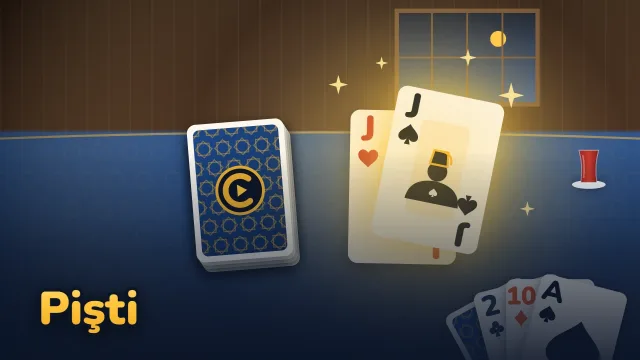
Pişti (often written pishti) is a card game played with a standard 52-card deck and much loved in Turkish homes and on long evenings with friends and family. The rules take a few minutes to learn: you collect all the cards on the table by playing a card that matches the top card, or by playing a jack. The moment that gives the game its name is taking a single card with its match; that capture is called a pişti. On this page we explain the rules of Pişti on CetinsGame from start to finish: the deal, capturing, pişti, scoring, partner play and tips that will help you win. Pişti rules vary a little from table to table; where other tables play differently, we say so.
The deck and the deal
The game uses 52 cards without jokers: spades, hearts, diamonds and clubs, each with an ace, the numbers 2 to 10, a jack (J), a queen (Q) and a king (K). In Pişti a card's rank does not make it stronger; a king does not beat a two. Ranks only matter for matching, and for counting points at the end of the hand.
At the start of each hand the deck is shuffled and 4 cards are placed on the table: the bottom 3 face down and the top, fourth card face up. Then each player is dealt 4 cards. When everyone has played their 4 cards, another 4 cards each are dealt from the deck. The hand ends when the deck is empty and the last card has been played.
- Two players: after the 4 table cards, 48 cards remain; that makes 6 deals, and each player plays 24 cards in a hand.
- Four players (partners): the 48 cards make 3 deals, and each player plays 12 cards.
The dealer changes every hand. The player to the dealer's left plays first (with two players, the non-dealer), and the dealer always plays the last card of the hand. If the face-up opening card is a jack, in our game it simply stays there, and whoever takes the pile first takes it too. At some tables that jack is pushed back into the deck and a new card is turned up.
Playing and capturing cards
On your turn you play one card from your hand to the table. There is no passing, and any card in your hand can always be played. What happens next depends on the card:
- Same rank: if your card has the same rank as the top face-up card on the table (for example, a 7 on a 7), you take every card on the table, including the 3 face-down opening cards.
- Jack: a jack always captures. Whatever the top card is, playing a jack wins you the whole pile.
- Any other card: if there is no match, your card stays face up on top of the pile and the turn passes to the next player.
A card played onto an empty table, even a jack, simply stays there; there is nothing to capture. Only the top card counts: cards lower in the pile are never matched. The cards you capture go face down in a pile in front of you and are not counted until the end of the hand.
Pişti and jack pişti
A pişti means taking a single card on the table with a card of the same rank, and it scores 10 points. It usually happens like this: one player clears the table, the next player has to play a card onto the empty table, and if you hold the matching rank, you make a pişti.
A jack pişti means taking a single jack on the table with another jack, and it is worth 20 points. With only 4 jacks in the deck, it is a rare and very valuable moment.
- Taking a single card (other than a jack) with a jack is not a pişti; you take the cards, but no pişti points are scored.
- The opening four-card pile can never be a pişti, because there is more than one card on the table.
- A pişti made with the very last card of the hand counts in our game. At some tables a pişti with the last card does not count.
End of the hand: the cards left on the table
When the deck is empty and everyone has played their last card, any cards still on the table go to the player who made the last capture of the hand (in partner play, to that player's team). Those cards count for points and for the card total, but this final sweep is never a pişti.
Because the dealer plays the last card of the hand, the dealer has a slightly better chance of collecting what is left; this is called the dealer's advantage. As the deal changes every hand, the advantage goes to each side in turn.
When the hand is over, the captured piles are turned over and the points are counted. The 3 face-down opening cards belong to whichever pile they ended up in; if they include an ace, a jack, the two of clubs or the ten of diamonds, those points go to that side. Nobody sees these cards during the hand, not even the player who took them.
Scoring
At the end of every hand, both sides score according to this table:
| What | Points |
|---|---|
| Each ace | 1 (4 in total) |
| Each jack | 1 (4 in total) |
| Two of clubs | 2 |
| Ten of diamonds | 3 |
| Most cards | 3 (nobody if tied) |
| Each pişti | 10 |
| Each jack pişti | 20 |
The cards themselves are worth 16 points per hand in total: 4 from aces, 4 from jacks, 2 from the two of clubs, 3 from the ten of diamonds and 3 for most cards. Pişti points come on top. Example: a player who captured 28 cards, including 2 aces, 3 jacks and the ten of diamonds, and also made one pişti, scores 2 + 3 + 3 + 3 + 10 = 21 points. In a two-player game, if both sides took 26 cards, nobody gets the points for most cards.
Some tables give a different value for most cards or award points for other cards; what we describe here is how our game counts.
End of the game: 51 or 101
Points add up from hand to hand. The side that reaches the target at the end of a hand wins the game. In Quick Game you choose a target of 51 (the default) or 101. Even if the target is passed in the middle of a hand, the hand is played to the end, because points are only counted when the hand is over.
If both sides pass the target in the same hand, the higher score wins; if the scores are level, one more hand is played. Because a pişti is worth so much, a single good hand can turn a game around. A game to 101 lasts roughly twice as long as a game to 51.
Two-player and partner (2 vs 2) play
Pişti is most often played by two people: you and your opponent, with the deal changing every hand. With four players it is played in partners, and the players sitting opposite each other form a team. In our game's Partners mode the computer across from you is your partner, and the two computers at the sides are your opponents. Play goes clockwise on the screen: you, the opponent on your left, your partner, the opponent on your right.
- Captured cards go to the team's shared pile; points and most cards are counted per team (at 26-26 nobody gets the points for most cards).
- A pişti is credited to the team of the player who made it.
- The player after you is always an opponent, so leaving a single card on the table is just as risky in partner play.
- Your partner's computer sees only its own hand; it does not know your cards, and there is no signalling.
Pişti on CetinsGame
Our game follows the rules above, with these additions to make it fair and comfortable:
- Three levels: Easy plays its cards at random and is ideal for learning. Medium takes what it can and saves its jacks, but does not count cards. Hard counts the cards played and works out the odds.
- Fair deck: the deck is shuffled securely every hand. The computer never sees your hand, the deck or the face-down cards; it decides using only information you can see too, and it never cheats.
- Played-cards counter: shows how many cards of each rank have been seen face up. It only counts cards that were shown openly; it is optional and switched on from the start on Easy.
- Four-colour deck: a colour-blind friendly setting: spades black, hearts red, diamonds blue, clubs green.
- Mansion Evenings: a story mode with opponents who each have their own style, starting with Aunt Hayriye and leading to Mürüvvet Hanım. Aunt Hayriye gives a short lesson before your first game.
- Hints: in your first games, when it is your turn, a short note points out a pişti chance, a jack worth saving or a risky card.
- Daily tasks and the Weekly challenge: 3 tasks every day (for example, making a pişti or winning a partner game) and one challenge every week; the reward is added to your Pişti score on the leaderboard.
Counting cards and strategy tips
Luck plays a big part in Pişti, but a careful player wins clearly in the long run. The most useful tips:
- Count the jacks. There are 4 jacks in the deck. If you know how many are out, you can judge whether your opponent might take the pile with one.
- Save your jack for a big pile. Do not waste a jack on a two-card pile; use it when scoring cards or many cards have built up, or in the last deal.
- Play a safe card onto an empty table. A card played onto an empty table sits alone and gives your opponent a pişti chance. If three cards of that rank are already out, the chance of a pişti against you drops sharply.
- Do not leave scoring cards on the pile. Use aces, the two of clubs and the ten of diamonds to capture; drop them on the pile and they will most likely go to your opponent.
- Plan for the last deal. The cards left at the end go to the last player to capture. If you are the dealer, you play the last card, so keeping a jack for the end pays off.
- Keep an eye on most cards. When the card totals are close, even a small pile can decide those 3 points.
Common mistakes
- Thinking a higher card takes a lower one: in Pişti only a card of the same rank or a jack captures.
- Counting a single card taken with a jack as a pişti: a pişti needs the same rank, and a jack pişti is only a jack on a jack.
- Spending a jack at the first chance on a small two-card pile.
- Playing a card onto an empty table when its matching cards are still unseen, handing your opponent a pişti.
- Forgetting the cards left on the table: at the end of the hand they go to the last player to capture.
- Ignoring the 3 face-down opening cards: they may include scoring cards, and they add to your card total.
- Splitting the 3 points when the card totals are tied: in our game nobody gets them.
Frequently asked questions
How many points is a pişti?
A normal pişti is worth 10 points, and a jack pişti (a jack on a single jack) is worth 20. The card points are added at the end of the hand: each ace and jack 1, the two of clubs 2, the ten of diamonds 3 and most cards 3.
Can you make a pişti with a jack?
Only if the single card on the table is also a jack; that is a jack pişti and it scores 20. Taking any other single card with a jack is not a pişti: you take the cards, but no pişti points are scored.
How many players can play pişti?
Two players, or four players in partners (2 vs 2). In partner play the players opposite each other are a team, and cards and points are counted per team. In our game you can play both modes against the computer.
How many cards are dealt in pişti?
4 cards go on the table (3 face down, the top one face up) and each player gets 4 cards. When the hands run out, 4 more each are dealt until the deck is empty: 6 deals with two players, 3 with four.
How many points do you play pişti to?
Usually 51 or 101 points. The side that reaches the target at the end of a hand wins; if both pass it in the same hand, the higher score wins, and if they are level, one more hand is played.
Does a pişti with the last card count?
In our game it does. At some tables a pişti made with the last card of the hand does not count. The cards left on the table at the end go to the last player to capture, but that sweep is not a pişti.
