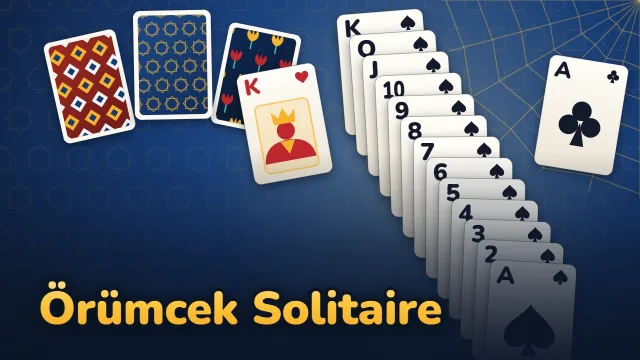
Spider Solitaire is a patience game for one player, played with two decks. The goal is to build eight complete runs from King (K) down to Ace (A) in the same suit; every finished run is removed from the table by itself. You can learn the rules in a few minutes, yet with 4 suits it keeps even experienced players thinking for a long time.
On this page we explain the rules of Spider on CetinsGame exactly as the game applies them. The same game also includes Klondike and FreeCell; we sum up their rules briefly at the end of the page, with the details on their own rules pages.
How to play Spider: the cards and the deal
Spider is played with two decks, 104 cards, no jokers. From low to high the cards are Ace (A), the numbers 2 to 10, Jack (J), Queen (Q) and King (K). The Ace is the lowest card and does not go on a King.
- There are 10 columns. The first 4 columns get 6 cards each, the other 6 columns 5 cards each: 54 cards in all.
- Only the front card of each column is face up; the others are face down.
- The remaining 50 cards form the stock (the pile at the top right). Each time you deal from it, one card goes to every column, 10 cards in all, so there are 5 deals.
Moving cards and runs
A card goes on a card one higher: a 7 on an 8, a Jack on a Queen. When you move a single card, the suit does not matter; you can put the 7 of hearts on the 8 of spades.
To move several cards together, they must form a run in the same suit. For example, if a column ends with the 9 of spades, 8 of hearts and 7 of hearts, you can move the 8 and 7 of hearts together, but not the 9 of spades with them, because the run changes suit there.
When a column has no face-up cards left, its front face-down card turns over by itself. Uncovering face-down cards is what the game is really about.
Empty columns
When every card of a column has been moved away, the column is empty. You can put any card or any same-suit run into an empty column. A King has no higher card, so it can only move to an empty column.
An empty column is the most valuable thing in Spider: it is a temporary parking space for splitting mixed runs, sorting cards and reaching face-down cards. Think carefully before you fill it with a single low card.
Dealing new cards from the stock
When you run out of moves, or whenever you want new cards, tap the stock: one face-up card lands on the end of every column. With 50 cards in the stock you can do this at most 5 times; the number of deals left is shown on the stock.
- You cannot deal while a column is empty. This is the traditional Spider rule: first put a card or a run into every empty column.
- Dealt cards land on top of your runs and break them up, so make every useful move before you deal.
- In our game, turning on Relaxed rule (Spider) in Settings lets you deal even with an empty column. It applies from the next new game and multiplies the points of a win by 0.8.
Complete runs and winning
The moment a 13-card run from King to Ace in one suit is complete at the end of a column, it is removed by itself and does not come back. If there is a face-down card under it, that card turns over.
When you have removed eight complete runs, so all 104 cards are off the table, you win. If there are no moves left and the stock is empty, the game cannot be won; undo a few moves and try another way.
1, 2 or 4 suits: what is the difference?
Spider comes in three levels. The number of cards and the rules never change; only the number of suits does:
| Choice | Suits | Difficulty |
|---|---|---|
| 1 suit | All 104 cards are spades (8 runs of spades) | Easiest |
| 2 suits | 52 spades and 52 hearts (4 runs each) | Medium |
| 4 suits | Two full decks: spades, hearts, diamonds, clubs (2 runs of each suit) | Hardest |
With 1 suit every card is the same suit, so every ordered run moves together; it is ideal for learning. With more suits there are more mixed runs, the runs you can move get shorter and empty columns matter far more. With 4 suits some completely random deals cannot be solved at all.
Spider Solitaire strategy
- Uncover face-down cards first. If two moves look equal, pick the one that turns a card over, and favour the columns with the most face-down cards.
- Prefer the same suit. If a card can go to two places, put it on the card of its own suit; that builds long runs you can move together.
- Win an empty column and use it well. Try to clear short columns. Treat an empty column as a temporary workspace for rearranging runs, not as a permanent home.
- Do not rush a King into an empty column. If there is no face-down card behind the King to uncover, moving it usually wastes the empty column.
- Get ready before you deal. Make every useful move and tidy the columns as much as you can, then deal.
- Use Undo to explore. Undo is unlimited in our game; if a plan does not work out, you can go back.
Klondike rules in brief
Klondike is classic solitaire with one deck. The goal is to move all 52 cards to the four foundations, each suit from Ace up to King.
- 7 columns get 1 to 7 cards from left to right (28 cards); the front card of each column is face up. The other 24 cards form the stock.
- In the columns, cards go down in order with alternating red and black. A face-up run can be moved as a whole.
- Only a King, or a run starting with a King, can go into an empty column.
- You draw 1 or 3 cards from the stock and only the top one is playable. When the stock runs out, the drawn cards are turned over and used again; our game has no limit on passes.
FreeCell rules in brief
In FreeCell all cards are face up from the start; planning wins, not luck. Again the goal is to build all 52 cards on the four foundations from Ace up to King.
- There are 8 columns; the first 4 have 7 cards each, the other 4 have 6 each.
- At the top left there are 4 free cells; each holds one card.
- In the columns, cards go down in order with alternating red and black. Any card can go into an empty column.
- How many cards you can move at once depends on the empty cells and columns: (empty cells + 1) × 2^(empty columns). The game works this out for you.
It is widely known that almost every FreeCell deal can be solved.
Spider Solitaire on CetinsGame
The rules are exactly as described above, plus a few things that make the game comfortable:
- Tap or drag: Tap a card and it goes to the best place it can; tap the same card again to try the next possible place. You can also drag a card or a run and drop it where you want.
- Unlimited Undo and Hint: Hint highlights a good next move.
- Rescue: When you are stuck, it looks for a way out of the current position. If it finds one and you choose to watch a short ad, the next 5 moves are played for you. If there is no way out, no ad is shown and you are advised to undo a few moves.
- Solvable deals only: When this is on (the default), a solution to every deal has been found by computer and checked by playing it through from start to finish under the rules. Turn it off for fully random deals; some cannot be solved, but a win scores ×1.2.
- Deal number: Every deal has a number from 1 to 999999. The same number gives everyone the same deal, so you can play the same game as a friend.
- Daily Deal: The same three deals for everyone every day: Spider (2 suits), Klondike (draw 1) and FreeCell. When you finish, you see how long other players took that day, and you can build a streak over consecutive days.
- Relaxed rule (Spider): lets you deal even with an empty column. It applies from the next new game; a win then scores ×0.8.
- Auto-move to foundations (Klondike and FreeCell): when on (the default), Aces, 2s and other cards that cannot hurt your game go to the foundations by themselves.
- Finish: In Spider, once the stock is used up and every card is face up, the game checks with its solver whether the rest can be solved; if so, the Finish button appears and plays the remaining moves for you. In Klondike it appears when the stock and waste are empty and every card is face up, in FreeCell when every column is in order; one tap sends the remaining cards to the foundations.
- Points and badges: A win scores points based on time and number of moves; harder choices score more. There are separate leaderboards for Spider, Klondike, FreeCell and the Daily Deal, and 15 badges.
Common mistakes
- Trying to move a mixed-suit run as a whole: several cards move together only if they are in order and in the same suit.
- Tapping the stock while a column is empty: under the traditional rule you must first put a card or run into it.
- Filling an empty column with a low card at the first chance: it is your most valuable space, keep it for rearranging runs.
- Dealing before the useful moves are done: the new cards land on your runs and break them up.
- Putting a card on a different suit when the same suit is available: the same suit means a long run you can move.
- Working on columns with no face-down cards and forgetting to uncover cards: new moves come mostly from face-down cards.
Frequently asked questions
How many cards are in Spider Solitaire?
Two decks, 104 cards. At the start 54 cards are dealt to 10 columns (6 to each of the first 4, 5 to each of the other 6) and 50 stay in the stock.
How many times can you deal in Spider?
5 times. Each deal puts one card on every column, 10 cards in all.
Can you deal with an empty column?
Not under the traditional rule; first put a card into the empty column. In our game the Relaxed rule (Spider) setting allows it, but a win then scores ×0.8.
What can go into an empty column?
In Spider, any card or any same-suit run in order. A King can only move to an empty column.
What happens to a complete run?
When 13 cards from King to Ace in one suit are complete at the end of a column, the run is removed by itself. Remove eight runs to win.
Is 1 suit or 4 suits harder?
4 suits is much harder. With 1 suit all cards are spades and every ordered run moves together; 2 suits uses spades and hearts; 4 suits uses all four.
Can every Spider game be won?
No. Some completely random deals cannot be solved, especially with 4 suits. In our game, with Solvable deals only turned on, every deal is checked to have at least one solution.
What is the difference between Spider and Klondike?
Spider uses two decks, has no foundations and builds runs in one suit. Klondike uses one deck, builds in alternating colours and moves cards to four foundations.
Where can I play Spider Solitaire?
On CetinsGame, in your browser, free and without signing up. The same game also has Klondike and FreeCell.
