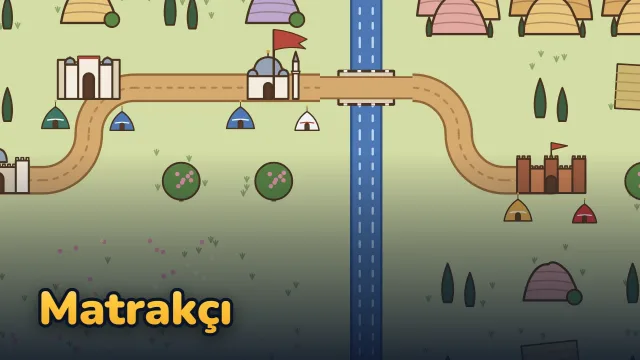
Matrakçı is a road puzzle born from the bird's-eye city paintings of Matrakçı Nasuh. Every level is a miniature page: you place square pieces from the tray and draw the road from the city gate to the fortress. Exact distance doesn't matter; what matters is what connects to what and in which order the stops are passed.
You can't lose, and every page has exactly one solution. Here you'll find the rules, how to read the notebook, the stars and some useful tips.
How to play Matrakçı?
The page is a square grid (from 4×4 up to 7×7). The city gate (start) and the fortress (goal) are already in place; some pages also have squares the Master drew in advance, and mountains. The tray sits below the page (to the right on a wide screen).
A page is complete when all of these hold at once:
- Edges fit: road joins road, water joins water, empty edge meets empty edge. No road leaves the page.
- One road: a single unbroken road with no loops runs from the gate to the fortress.
- The notebook matches: the stops, bridges and the bazaar's crossroads come along the road in the notebook's order, and the written distances are right.
- Every piece is used. Empty squares count as meadow.
Controls
- Drag: drop a piece from the tray onto an empty square. It turns by itself to fit its neighbours best.
- Tap: tap a placed piece to rotate it.
- Move: drag a placed piece to another square; drop it on a filled square and the two swap. Drop it off the page and it goes back to the tray.
- Tap and place: tap a piece in the tray, then tap an empty square.
- Gather the pieces: the button at the top returns every piece to the tray.
- Break: the menu button or the Esc key.
A red dot marks an edge that doesn't fit. When a notebook icon joins the road in the right order, it gets a green tick.
How to read the notebook
The notebook at the top lists the stops of the road in order, like Matrakçı's menzilname: the city gate, the stops (caravanserai, village, mosque, fountain, tower), bridges, the bazaar and the fortress. Read left to right, the icons give the order along the road.
- Number in a circle: how many road squares lie between two icons (the squares of the two icons don't count). 0 means the two stops are next to each other.
- Bridge: the road crosses a river only on a bridge, and every bridge is written in the notebook.
- Bazaar: the bazaar isn't on the main road but at the end of a side road leaving a crossroads. Its place in the notebook shows where the crossroads is.
Pages and stars
There are 36 pages in 6 chapters: Istanbul, Konya (rivers and bridges), Bitlis (mountains), Tabriz and Soltaniyeh (crossroads and bazaar), Baghdad (two rivers) and Aleppo and the return (everything together, the biggest pages). Pages open in order; 108 stars in total.
| Stars | Requirement |
|---|---|
| 3 | No hint without an ad, and no more removals than pieces in the tray |
| 2 | At most 1 hint without an ad |
| 1 | You finished the page |
A removal means taking a placed piece back to the tray or moving it to another square. Rotating and the Gather the pieces button don't count.
Ask the Master (hints)
Ask the Master puts one piece in its right place and direction, and locks it. You can take it by watching an ad (no star lost, 2 per page) or without an ad (counts as a hint, may cost a star). Ads are always your choice.
Long March
Unlocks after 6 pages. You go page after page against the clock: you start with 150 seconds, and each finished page adds 20 seconds plus 2.5 seconds per piece (300 seconds at most). Each page scores 10 points per square of the main road, and pages grow as you go. When time runs out you can watch an ad once for 45 more seconds. In the Long March a hint costs an ad or 20 seconds. The leaderboard uses this mode.
Tips for Matrakçı
- Start with the fixed pieces: which way do the gate's and the fortress's roads open?
- Use the numbers in the notebook: a distance of 0 means two stops sit side by side.
- Rivers decide where the bridges go; start from where a river enters and leaves the page.
- The number of bends limits the road's shape; count the straight and bend pieces in the tray.
- Build roads around mountains starting from the edges.
- When stuck, gather the pieces and put back only the ones you're sure of.
Common mistakes
- Leaving pieces in the tray: the page isn't done until every piece is used.
- Counting a distance wrong: the squares of the two stops themselves don't count.
- Putting the bazaar on the main road: it belongs only at the end of a side road from a crossroads.
- Running a river through the road: road and river cross only at a bridge.
- Closing the road on itself: a road with a loop is not valid.
Frequently asked questions
Does every page have only one solution?
Yes. Each page was built from a solution, and the computer checked every possibility to confirm there is no other.
What happens to empty squares?
Squares left empty count as meadow. When the page is finished, trees, fields and flowers appear on them.
Why did a piece turn by itself?
A piece turns to the direction that best fits its neighbours where you drop it. If it's wrong, tap it to rotate.
Are the pages real maps?
No. The chapters are named after places on the campaign Matrakçı Nasuh painted, but the page layouts are made for the game.
What is matrak?
A sword-and-shield style training game played with sticks, invented by Matrakçı Nasuh; his nickname comes from it. It appears in one scene of the story.
Can I improve my stars later?
Yes. Replay a page from the Campaign Notebook and your best star count is kept.
