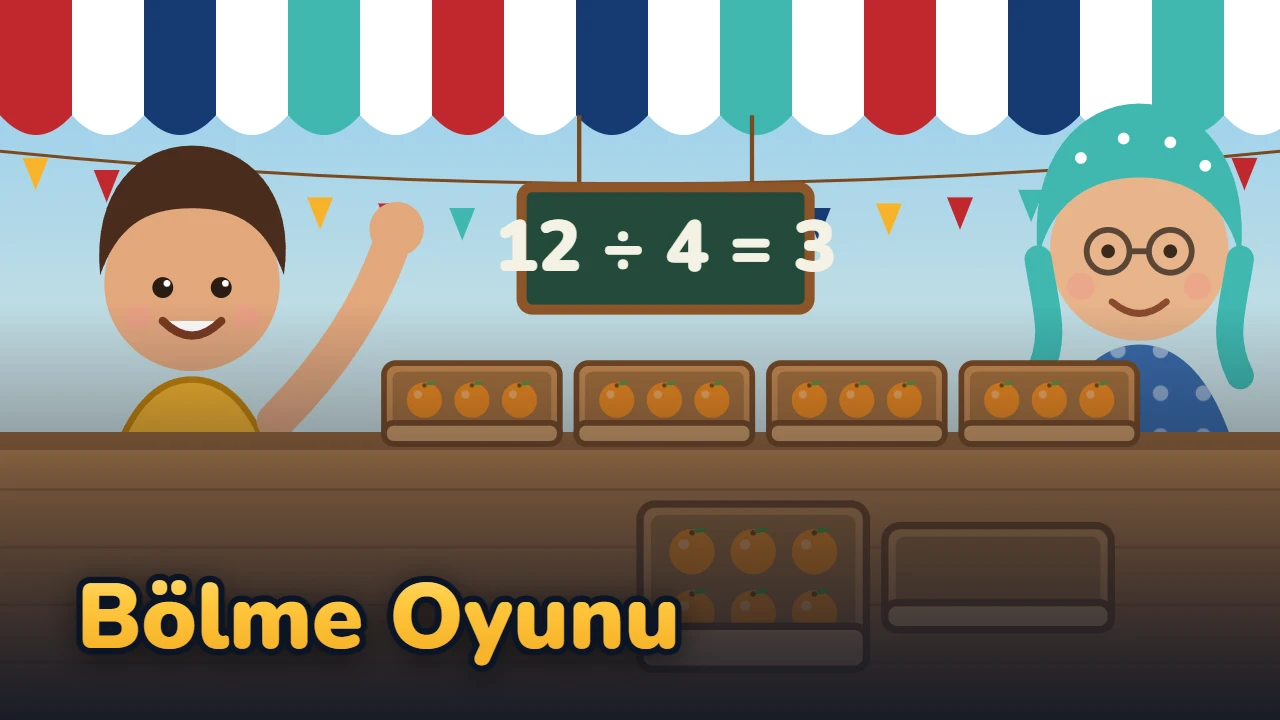
Division Game
Share the fruit equally into crates and learn division by playing.
How to play
You are at Grandma Saniye's market stall, sharing fruit equally into crates. The question "42 ÷ 7 = ?" asks: if 42 pieces of fruit are shared equally into 7 crates, how many go in each crate? Before you start, choose which tables the divisions come from (for example the 6s and 7s), then type the answer with the number keys. If you get stuck, the Share out button shares the fruit into the crates for you. Each round has 10 questions; there is no penalty for a wrong answer, the right answer is shown with the crates, and the same division comes back a few questions later.
How to play the Division Game? A guide to dividing with crates
The Division Game teaches the divisions from the times tables through equal sharing. You are at Grandma Saniye's stall in the neighbourhood market; the question "42 ÷ 7 = ?" asks how many pieces of fruit go in each crate if 42 are shared equally into 7 crates. Division is the Sharing mode of the Times Tables game: your progress, your Market notebook and your score are shared with the main game.
This guide covers choosing tables, the Share out hint, stars, what happens after a wrong answer, spaced repetition and the quickest way to work out a division.
Choosing tables and the round
When the game opens, you choose which tables the divisions come from: each number from 2 to 10 is a button (up to 12 if Tables up to 12 is switched on in Settings); All selects every table and Clear empties your choice. The numbers you pick are the divisors: pick 7 and you get the divisions 7, 14, 21 ... 70 ÷ 7. Your choice is remembered the next time you play.
A round has 10 questions. 6 right first time earns 1 star, 8 right earns 2 stars and 10 right earns 3 stars. Time does not affect the stars; a fast, correct answer brings extra money into the till and a golden sparkle.
The Share out hint
When a question appears, there are as many empty crates on screen as the divisor: 7 empty crates for 42 ÷ 7. You type the answer with the number keys; it is checked automatically once enough digits are typed, or you can press the confirm key.
If you get stuck, press the Share out button: the fruit is shared equally into the crates, and the crates light up one by one as they are counted. The number of pieces of fruit in each crate is the answer. The hint is free and part of learning, but an answer given with the hint does not count as fast.
What happens after a wrong answer?
A wrong answer does not cost a life, and there is no penalty. The right answer is written, the fruit is shown being shared into the crates, then the game says "Now you type it" and you enter the right answer yourself. The same division comes back once more two or three questions later. At the end of the round, you see the divisions you have just learned and the tricky ones that will come back soon.
Spaced repetition and the Market notebook
The game tracks every division separately. A division you get right and fast moves up a box and is asked again days later; one you get wrong goes back to the first box and comes back soon. The waiting times are the same day, the next day, 3 days, 7 days and 21 days. A division counts as known once it has been answered correctly on two different days, and fast at least once.
The Sharing tab of the Market notebook shows the divisions in colours: grey Not yet, red Tricky, yellow Learning, green Known, gold Known and fast. Underneath are the five divisions you find hardest and a Practise these round.
The quickest way to work out a division
Division is the inverse of multiplication. For 42 ÷ 7, ask yourself "7 times what makes 42?"; since 7 × 6 = 42, the answer is 6. That is why knowing the times tables well first makes division faster.
- Start with dividing by 2, 5 and 10: dividing by 10 means taking the zero off the end (70 ÷ 10 = 7).
- Dividing a number by itself gives 1 (8 ÷ 8 = 1); dividing by 1 does not change the number.
- If you get stuck, skip count: 7, 14, 21, 28, 35, 42; the sixth number is 42, so the answer is 6.
- The Missing number mode in the main game (? × 7 = 42) is the best preparation for division.
Whiteboard mode for teachers
In the main game's Whiteboard mode, Sharing can be chosen as the question type. The teacher picks the tables and an optional time limit; the calculation fills most of the screen. The class says the answer and the teacher presses Show; the Crates button shows the fruit shared into the crates. The space bar shows the answer and moves on. Sound is off by default, no ads appear, and the children's own progress does not change.
Tips
- Practise the times tables first: if you know 7 × 6 = 42, you also know 42 ÷ 7.
- Ask yourself: the divisor times what makes the dividend?
- Start with dividing by 2, 5 and 10, then add the other tables.
- If you get stuck, press Share out and count how many pieces of fruit go in each crate.
- Check your answer: multiply the quotient by the divisor, and you should get the dividend.
- Use the Practise these round for the red cells in the Sharing tab of the Market notebook.
A short history of division: from sharing to signs
The first meaning of division is sharing equally: if 12 apples are shared equally into 3 crates, each crate gets 4 apples, so 12 ÷ 3 = 4. Division is the inverse of multiplication; if you know 3 × 4 = 12, you also know 12 ÷ 3 = 4 and 12 ÷ 4 = 3. That is why the game asks division from inside the times tables and shows it with crates. Every division is tracked separately: the hard ones come up more often, the well known ones less often. Division is the Sharing mode of the Times Tables game; progress and score are shared with the main game.
- What division means
- Sharing equally, or splitting into equal groups
- The ÷ sign
- First printed in 1659 in Johann Rahn's algebra book
- The : sign
- Usually attributed to Leibniz
- The ancient Egyptian method
- Doubling the divisor (Rhind Papyrus)
- Divisions in the game
- Exact divisions from the times tables; from the 2s to the 10s, optionally up to 12
Division in ancient Egypt
In ancient Egyptian mathematics, division was done as the inverse of multiplication. In the Rhind Mathematical Papyrus, dated to about 3,500 years ago, the scribe keeps doubling the divisor (1, 2, 4, 8 times ...) until reaching the dividend, then adds up the right multiples. In other words, the question "the divisor times what makes the dividend?" is a method thousands of years old.
The ÷ and : signs
The ÷ sign used today (the obelus) was first printed with the meaning of division in 1659, in an algebra book by the Swiss mathematician Johann Rahn. The habit of writing division with a colon (:) is usually attributed to the German mathematician Leibniz. The sign used at school still differs from country to country: ÷ is common in Turkey, while countries such as Germany, France and Russia use the colon. The game always shows the school sign of the language you play in; in English it uses ÷.
Sharing at the market
In Turkey, neighbourhood markets are set up on a particular day of the week and are often named after that day, such as the Tuesday Market or the Wednesday Market. Fruit arrives at the market in crates; sharing a crate of apples equally onto plates, into bags or among neighbours is the most familiar form of division.
In the game
In the game, division is shown as fruit being shared equally into crates; the number of crates is the divisor, and the number of pieces of fruit in each crate is the quotient. Grandma Saniye and Deniz are fictional characters. The money that builds up in the till is just a number: it decorates the market with flags, lanterns and flowers, and nothing can be bought with it.
Frequently asked questions
Is the Division Game separate from the Times Tables game?
No. Division is the Sharing mode of the Times Tables game: the same market, the same Market notebook and the same save. This page simply opens the game straight on division questions.
Which divisions are asked?
Exact divisions that come from the times tables: for every table you choose, quotients from 1 to 10 (up to 12 if Tables up to 12 is switched on). There is no division with remainders.
What does the Share out button do?
It shares the fruit equally into the crates and shows the result; the number of pieces of fruit in each crate is the answer. It is free, but an answer given with the hint does not count as fast.
What happens after a wrong answer?
There is no penalty. The right answer is shown with the crates, you type it in yourself, and the same division comes back a few questions later.
When does a division count as known?
Once it has been answered correctly on two different days, and fast at least once. The fast limit adapts to the child's own typing speed.
What age is the division game for?
For children who have started learning the times tables, usually 8 to 10 years old. You can start gently by choosing only the 2s, 5s and 10s.
Is there a leaderboard for division?
In division rounds you earn stars and money for the till. The leaderboard belongs to the main game's Beat the clock mode, which is played with multiplication questions.
Can a teacher ask division questions in class?
Yes. In the main game's Whiteboard mode, Sharing is chosen as the question type; the calculation appears in large print, sound is off and no ads appear.
When do ads appear in the game?
Only after a round has ended, and at most once every three rounds. There are no ads in exchange for rewards inside the game.
Is Division Game free?
Yes. No download or account needed; it plays right in your browser. Watching an ad for a hint is always your choice.
Will I lose my progress?
Your progress is saved automatically on this device. Sign in and it moves to your account, so you can continue on any device.
Can I play on my phone?
Yes. The game opens full screen on phones; tap the X in the corner to exit. On iPhone use "Add to Home Screen" to play it like an app.
Can I play Division Game offline?
Yes. A game you have opened once is stored on your phone or computer and opens without internet. Leaderboards and cloud saves need a connection.
Which languages are available?
Turkish, English, Spanish, Portuguese, German, French and Russian.
Comments
Sign in to write a comment.
No comments yet. Be the first.
