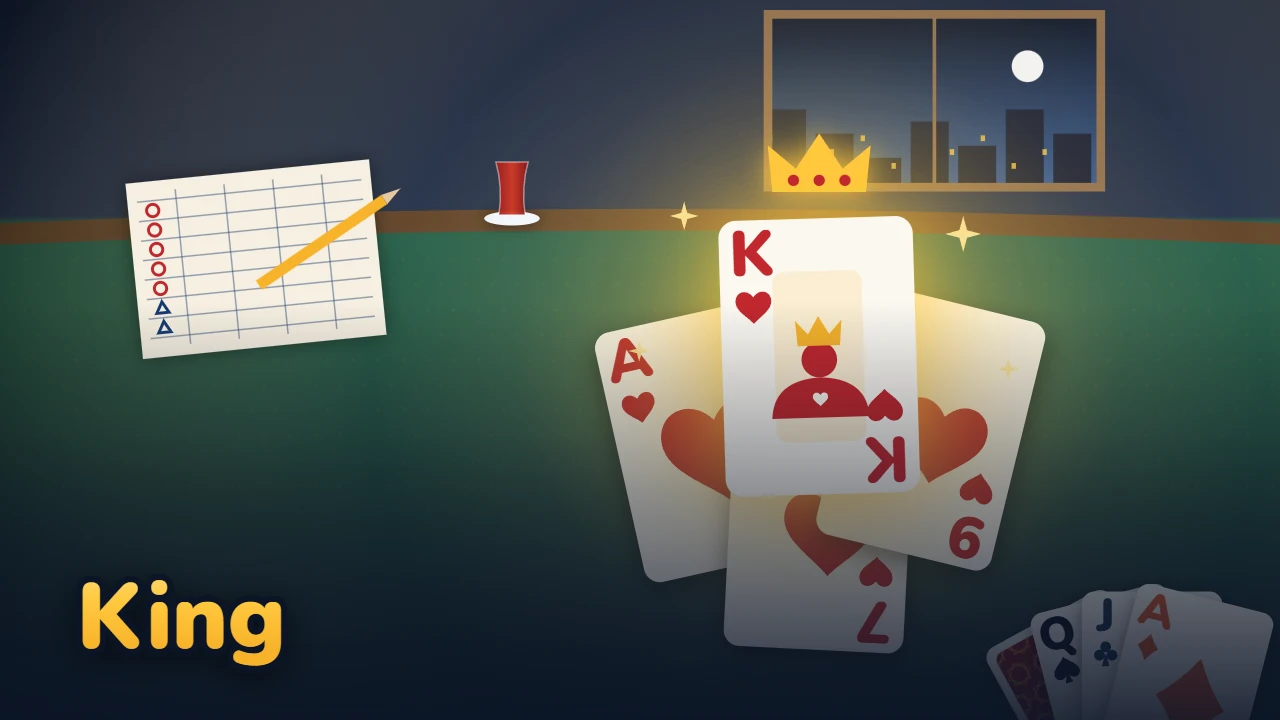
King: Turkish Card Game
20 deals, 6 penalties, 8 trumps. Don't get stuck with the Rıfkı!
How to play
Four players, 52 cards, 20 deals. In each deal the chooser names the game: one of the six penalty games (El Almaz - no tricks, Kupa Almaz - no hearts, Erkek Almaz - no kings or jacks, Kız Almaz - no queens, Rıfkı - king of hearts, Son İki - last two) or trumps. On your turn, tap a card and then tap the table, or drag the card onto the table. You must follow suit; if you're void, you discard your penalty card in the penalty games and play a trump in the trump game. Take as little as you can in the penalty games and as many tricks as you can in trumps. After 20 deals, the player with the highest score wins.
How to play King: a detailed guide
King is a classic trick-taking game for four players with a 52-card deck; on CetinsGame you play against three computer opponents. A game has 20 deals, and each deal is a different game: in the six penalty games you dodge penalties, and in the trump game you collect tricks. When it's your turn to choose, you look at your cards and decide which game to name. There are three modes: Dorm Table, the story mode where you move from table to table in a student dorm in Eskişehir; Quick King, where you pick a level and play 20 deals; and Practice, where you try any game you like for a single deal.
The goal and taking tricks
Each player is dealt 13 cards and play goes counterclockwise. The suit of the card led is the suit of that trick; the highest card of the suit led wins the trick, or in the trump game the highest trump. Whoever wins the trick leads the next. On your turn you play a card by tapping it and then tapping the table, by tapping the card a second time, or by dragging it onto the table.
- If you have a card of the suit led, you must follow suit.
- In the penalty games, if you're void you must discard your penalty card; in trumps, if you're void you must play a trump.
- If you tap a card you can't play, the game briefly tells you why, naming the rule.
The goal is to reach the highest total after 20 deals. The scores of the 20 deals add up to zero: one player's gain is the others' loss.
Choosing order and the games
Whoever holds the two of diamonds chooses the first game; after that the right to choose passes to the player on the right every deal. Everyone chooses 5 times: 3 penalties and 2 trumps under the default rule. The chooser looks at their cards, names the game and leads the first card. If they choose trumps, they also set the trump suit.
| Game | What to avoid / what to take | Points |
|---|---|---|
| El Almaz | Any trick | −50 per trick |
| Kupa Almaz | Hearts | −30 per heart |
| Erkek Almaz | Kings and jacks | −60 each |
| Kız Almaz | Queens | −100 per queen |
| Rıfkı | King of hearts | −320 |
| Son İki | Last two tricks | −180 each |
| Trumps | Take the most tricks | +50 per trick |
Each penalty is played at most twice in the whole game, and trumps eight times in total. The choosing panel shows your remaining picks and the games that are closed.
Obligations and table rules
In the penalty games, if a higher card has fallen and you hold a lower penalty card in that suit, you must play it (Erkek Almaz - no kings or jacks, Kız Almaz - no queens, Rıfkı - king of hearts). In Kupa Almaz (no hearts) and Rıfkı you can't lead a heart until a heart has been played, unless you have only hearts left. The games where cards carry the penalty end early once all the penalty cards are out.
Since King is played differently from region to region, you can change these settings on the Table rules screen: Choice limit (3 penalties + 2 trumps or Free), Must play higher (None, Trumps only, Every game), No trump lead until trumps are broken (Off or On), No heart leads (In Kupa Almaz and Rıfkı or In all penalty games) and In Rıfkı, if you're void (Discard the Rıfkı or Discard any heart). The first option of each setting is the default and the most common rule. Dorm Table is always played with the default rules.
Dorm Table, Quick King and Practice
Dorm Table is set in a student dorm in Eskişehir. Your roommate Mert sits you down at the first table and gives a short lesson if you want one. Five tables open in order:
- Room 214: your first game with Mert, Pelin and Ilgın.
- Study Hall: careful Pelin and card-counting Ilgın.
- Canteen: the table of trump-loving Nurettin Abi.
- Card Club: tougher opponents with Tuncay Hoca and Ilgın.
- Alumni Night: the final; the table of Feride Abla, a former resident of the dorm.
At the first four tables you need to finish in the top two to move on; at the final you have to finish first. Each table you clear brings a new title: starting from Newcomer, then Room Player, Study Hall Master, Canteen Champion, Club Captain and finally King of the Dorm. In Quick King you play 20 deals against three opponents and choose the level yourself (Easy, Medium, Hard). In Practice you see your hand, choose any game you like and play a single deal; it is for learning the rules and doesn't count toward the leaderboard.
Levels and on-screen helpers
Easy opponents play loosely and the card counter is on from the start. Medium opponents know how to dodge penalties and take tricks in trumps. Hard opponents count cards, track who has run out of which suit and decide by trying out possible layouts of the remaining cards. No level cheats: the computer can't see your cards or the other players' cards, it only knows the cards played to the table.
The screen always shows: the current deal's game and the remaining penalties in the top bar (tap the bar to open the Choices table and see who chose what in which deal), the Scoresheet for all 20 deals and Last trick, showing the most recently closed trick. The game settings include Card counter, a colorblind-friendly 4-color deck and Speed (Normal, Fast).
King points and rematch
The raw game score on screen can be negative; for the leaderboard a separate, cumulative King points total is kept, and it never goes down. Points are added at the end of every game you complete, based on the level (in Dorm Table, the table's level counts):
| What | Easy | Medium | Hard |
|---|---|---|---|
| First place | 20 | 50 | 100 |
| Second place | 8 | 20 | 40 |
| Finishing above zero | 5 | 10 | 20 |
| Each King | 5 | 10 | 20 |
At the end of a game where you didn't finish first, a Rematch option appears: you play again at the same table, and if you finish first, that game's King points are doubled. Rematch is unlocked with an optional ad and is always your choice. A game you quit earns no points. There is no money, chips or betting in the game; interstitial ads only appear at the end of a game.
Tips
- When it's your turn to choose, first look at the weak spots in your hand: if you have unprotected queens, naming Kız Almaz early can be a good idea.
- Save trumps for a hand with plenty of aces and kings and a long suit.
- Check the Choices table: knowing the remaining penalties and who has which picks left helps you predict the last deals.
- In the penalty games, run out of a short suit early; then, when that suit is led, you can safely discard your penalty cards.
- In the Rıfkı game, if you hold the ace of hearts, play while keeping an eye on where the Rıfkı is; once the ace falls, the Rıfkı holder has to give it up.
- In Son İki, keep your low cards for the last tricks and get rid of your high cards early.
- Turn on the card counter: knowing which cards are out is your biggest help against Hard opponents.
King: the much-loved four-player card game of Turkey
King is a four-player trick-taking game that friends love to play around the table in Turkey; in some places it is also known as Rıfkı. Each deal is a different game: in the penalty games you try not to take tricks or penalty cards, and in trumps you try to take the most tricks. King belongs to the Barbu / King family of games, where each deal is played as a separate contract.
- Type
- Compendium trick-taking game (Barbu / King family)
- Deck
- 52 cards, no jokers
- Players
- 4, everyone for themselves
- Length
- 20 deals: 12 penalty, 8 trump
- Games
- 6 penalty games and trumps
- Most expensive card
- Rıfkı (king of hearts): −320
The Barbu / King family
King belongs to a family that card game researchers call compendium games. In these games each deal is a different contract: in one deal you must avoid taking tricks, in another you dodge certain cards, and in yet another you collect as many tricks as you can. A well-known member of the family is Barbu; similar games are played in different countries under different names and with small rule differences.
What all these games share is that they fit several small games inside one trick-taking game. Players are tested not only on playing their cards well, but also on choosing which hand to play as which game. The Turkish form of King has six penalties and trumps, and over the whole game the penalty and trump points balance each other.
Tradition and everyday life
King is a much-loved table game in Turkey. Because it needs four players and a game lasts 20 deals, it is a game for long evenings and get-togethers with friends. The choosing order and the remaining penalties are tracked deal by deal, at most tables the scores are written on a sheet of paper, and the four columns are totaled again after every deal.
The fun of the game comes as much from the conversation at the table as from the rules. The player who takes the Rıfkı is not easily forgotten; neither is the one who collects every trick in a trump deal and makes a King. At some tables the whole game is also called Rıfkı, after its most expensive card.
Rules that change from table to table
Because King lives on through table tradition rather than a written rulebook, the details vary from place to place. At some tables everyone picks 3 penalties and 2 trumps; at others the choice is free. At some tables you must play higher if you have a card that can beat the trick; at others this applies only in trumps. At some tables you can't lead trumps until they are broken, and at others the ban on leading hearts applies to every penalty game. Whether a player who is void in the Rıfkı game discards the Rıfkı or any heart also differs from table to table.
That is why agreeing on the rules before sitting down to play is a well-established habit. In our game you can choose these differences on the Table rules screen; the defaults are the most common rules.
In our game: Dorm Table
Our game's story mode is inspired by King's place at tables among friends. The student dorm in Eskişehir, Room 214, the Study Hall, the Canteen, the Card Club and Alumni Night were created for the game; Mert, Pelin, Nurettin Abi, Ilgın, Tuncay Hoca and Feride Abla are fictional characters too. Each character's playing style reflects familiar player types you meet at real tables: the careful one, the one who loves trumps, the one who counts every card.
How was King made?
King is a game that four people in Turkey play around a table for hours, and its rules are usually learned from family or in a dorm room. So the first job was to check the rules against reliable sources: 20 hands, six penalty games plus trumps, a choosing order that starts with the two of diamonds, and every player choosing 3 penalty games and 2 trump games. The points are balanced so that the 20 hands always add up to zero; the game's tests check this again for every game.
What people forget most in King is who chose what and which penalties are still left. At a real table someone writes it on paper; in the game a strip at the top always shows how many times each of the seven games has been played, and the choice table and the 20-hand score sheet are one tap away. When you tap a card you cannot play, the game does not just say no, it names the rule: follow suit, hearts cannot be led, a higher card has fallen, you must give up your penalty card.
Rules change from place to place, so instead of picking one right answer the game has table rules: whether you must play higher, when trumps can be led, in which games hearts cannot be led and more. The defaults are the most common ones, so everyone can play the way their own table does.
The computer opponents never cheat: they do not see your cards or each other's, only the cards played on the table. Hard opponents count cards, keep track of who has run out of which suit and try out possible deals in their heads before they play. The story takes place in a student dormitory in Eskişehir: five tables from a dorm room to the canteen, the card club and Alumni Night. There are no chips, no money and no bets at the table, only points and titles.
Frequently asked questions
What games are there in King?
Six penalty games and trumps: El Almaz (no tricks, −50 per trick), Kupa Almaz (no hearts, −30 per heart), Erkek Almaz (no kings or jacks, −60 for each king and jack), Kız Almaz (no queens, −100 per queen), Rıfkı (king of hearts, −320) and Son İki (last two, −180 for each of the last two tricks). In trumps, each trick is +50.
What is Rıfkı?
The Rıfkı is the king of hearts, and whoever takes it scores −320. The same name is also the name of the penalty game built on not taking this card. In the Rıfkı game, if you are void in the suit led you must discard the Rıfkı; once it is played, the deal ends.
When can hearts be led?
In Kupa Almaz (no hearts) and Rıfkı (king of hearts), you can't lead a heart until someone has discarded one. If you have only hearts left, you can lead one. In the table rules you can also apply this ban to every penalty game.
Who picks how many penalties and trumps?
Whoever holds the two of diamonds chooses for the first deal, then the right passes to the right every deal. Over 20 deals everyone chooses 5 times: 3 penalties and 2 trumps under the default rule. Each penalty is played at most twice, and trumps eight times in total.
What does making a King mean?
It means taking all 13 tricks in a trump deal. The table score is still 13 × 50 = 650; in our game, though, it is celebrated on screen, recorded in your statistics and adds a bonus of 5, 10 or 20 to your King points, depending on the level.
Why won't the next table open in Dorm Table?
At the first four tables you need to finish in the top two to move on to the next one. At the final table, Alumni Night, you have to finish first. Dorm Table is always played with the default rules.
Can the Hard computer see my cards?
No. Hard opponents only count the cards played to the table, track who has run out of which suit and try out possible layouts of the remaining cards. They can't see your hand or the other players' hands.
What is Practice mode for?
In Practice you see your hand, choose any of the six penalties or trumps and play a single deal. It is for trying out the rules and the finer points of a game; it doesn't count toward King points or the leaderboard.
How do King points go up?
They are added after every game you complete, based on the level: first place 20, 50 or 100; second place 8, 20 or 40; finishing above zero and each King 5, 10 or 20. If you finish first in a rematch, that game's points are doubled.
Is King: Turkish Card Game free?
Yes. No download or account needed; it plays right in your browser. Watching an ad for a hint is always your choice.
Will I lose my progress?
Your progress is saved automatically on this device. Sign in and it moves to your account, so you can continue on any device.
Can I play on my phone?
Yes. The game opens full screen on phones; tap the X in the corner to exit. On iPhone use "Add to Home Screen" to play it like an app.
Can I play King: Turkish Card Game offline?
Yes. A game you have opened once is stored on your phone or computer and opens without internet. Leaderboards and cloud saves need a connection.
Which languages are available?
Turkish, English, Spanish, Portuguese, German, French and Russian.
Comments
Sign in to write a comment.
No comments yet. Be the first.
