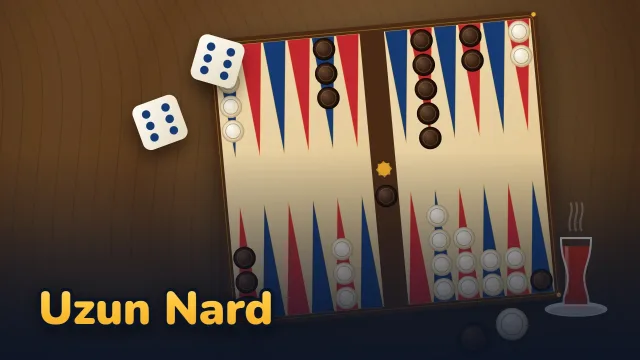
Long Nard is a no-hitting backgammon variant for two players. It is much loved in Azerbaijan, Russia and Central Asia; in English it is often called long nardy, in Russian длинные нарды, and in Turkish Uzun Nard. Both sides move in the same direction, checkers are never hit and even a single checker holds a point. Two more rules set it apart from classic tavla: the head rule and the ban on a six-point prime.
On this page we explain the rules of Long Nard on CetinsGame exactly as the game applies them. Long Nard is played inside our Tavla game, together with classic tavla, Gülbahar and Mahbusa.
Board and setup
The board is the same as in classic tavla: 24 points and a 6-point home for each player. Each player has 15 checkers, all starting in a single stack on their own 24-point, called the head. The two heads sit in diagonally opposite corners of the board. In our game your home is at the bottom right and your head in the top right corner; your opponent's head is in the bottom left corner and their home at the top left.
Direction and starting
Both sides move in the same direction: your checkers move left along the top row and right along the bottom row; your opponent's move right along the bottom row and left along the top row. To start, each side rolls one die; the higher roller rolls both dice again and makes the first move. Later games are started by the winner of the previous game.
Moving and holding points
- For each die, one checker moves that many points; a double is four moves.
- There is no hitting. Even a single opposing checker holds a point: you cannot land there.
- When you play both dice with one checker, the intermediate point must also be open.
- If both dice can be played, both must be played; if only one can be played, the larger one is played.
- If there is no legal move, the turn passes to the opponent.
The head rule
Only one checker may leave the head each turn; rolling a double does not change this. The only exception is a player's first roll: on the first roll two checkers may leave the head. With 3-3, 4-4 or 6-6 a single checker cannot play the roll, so two checkers leave.
No six-point prime
Six points held in a row form a prime that the checkers behind it cannot pass. In Long Nard it is forbidden to build such a prime in front of all of your opponent's checkers. If at least one opposing checker is already ahead of it, a six-point prime is allowed. Primes of five points or fewer are always allowed.
Bearing off, winning and scoring
Once all 15 of your checkers are home, you start bearing off. The checker on the point shown by the die comes off; if that point is empty, a checker on a higher point is moved, and if there are none higher, the highest one comes off.
- The first to bear off all 15 checkers wins the game: 1 point.
- If the opponent has not borne off a single checker by then, it is a mars: 2 points.
- There is no doubling cube; the match is played to a number of points chosen in advance (1, 3 or 5).
The computer opponent
The dice are fair; the computer cannot see its roll before you or change it. The Easy level sometimes plays at random, Medium plays by rules that weigh holding points, points in a row and the race, and Hard uses the same evaluation while looking one step ahead at the opponent's possible rolls.
Common mistakes
- Trying to take two checkers off the head in one turn: apart from the first roll, only one checker leaves the head per turn.
- Trying to hit a single opposing checker: there is no hitting in Long Nard, a single checker holds a point.
- Trying to build a six-point prime in front of all opposing checkers: it is forbidden unless an opposing checker is ahead of it.
- Taking checkers off the head too late: since only one leaves per turn, late checkers get stuck at the end of the game.
- Stacking checkers on a few points: there is no room left for big rolls.
- Bearing off nothing while losing the race: if your opponent bears off all 15, it is a mars and you lose 2 points.
Frequently asked questions
How many checkers are there in Long Nard?
Each player has 15 checkers. They all start in a single stack on their own head, in diagonally opposite corners.
Which way do the checkers move in Long Nard?
Both sides move in the same direction. They do not move towards each other as in classic tavla.
Is there hitting in Long Nard?
No. Even a single checker holds a point, and the opponent cannot land there.
What is the head rule?
Only one checker may leave the head each turn. On the first roll two may leave; with 3-3, 4-4 or 6-6 there is no other way to play.
Can you build a six-point prime?
Only if at least one opposing checker is ahead of it. Building a six-point prime in front of all opposing checkers is forbidden; a five-point prime is always allowed.
How many points is a mars in Long Nard?
2 points. If you bear off all 15 checkers before your opponent bears off any, it is a mars; a normal game is 1 point.
Are long nardy and Long Nard the same game?
Yes. Long nardy is a common English name for the game; in Russian it is длинные нарды, and in Turkish Uzun Nard.
Where can I play Long Nard?
In CetinsGame Tavla you can play it against the computer at three levels, with two players on one device or online with a friend. It is free, with no download and no sign-up.
