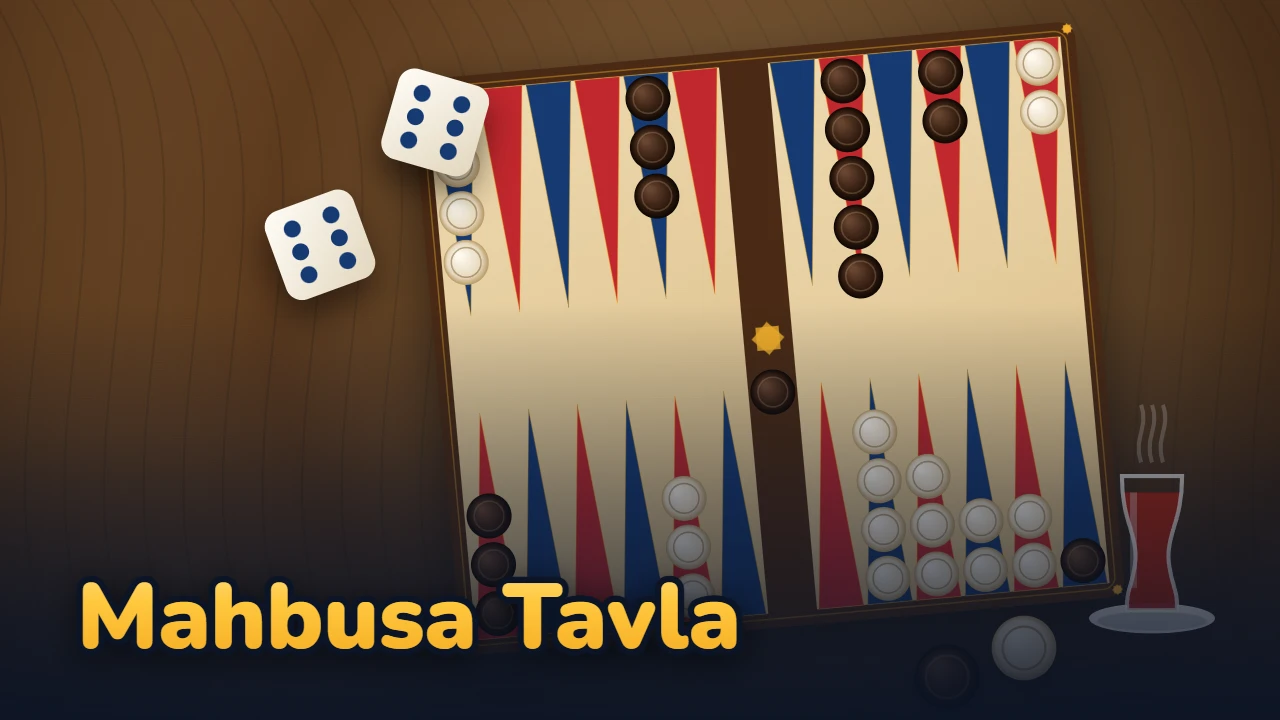
Mahbusa (Plakoto)
No hitting: land on a lone opposing checker and trap it.
How to play
Roll the dice and move one checker the number of points shown on each die. Each player's 15 checkers start on their own 24-point and the sides move towards each other, as in classic tavla. There is no hitting: if you land on a lone opposing checker it is trapped and cannot move until your checker leaves. You cannot land on a point with two or more opposing checkers. When all your checkers are home you bear them off; the first to bear off all 15 wins. If the last checker on the starting point (the mother) is trapped before it ever leaves, that side loses 2 points.
How to play Mahbusa: a guide to Mahbusa (Plakoto) against the computer
Mahbusa (Tapa, Plakoto) is a tavla (Turkish backgammon) variant in which trapping takes the place of hitting. When a checker lands on a lone opposing checker, the lone checker does not leave the board: it stays under yours and cannot move until you leave. The checkers move towards each other as in classic tavla, but everything starts from the corner: all 15 checkers set off from a single stack. On CetinsGame you can play Mahbusa against the computer at three levels, with a friend on the same device or with a friend online. This page opens the game straight on the Quick Game screen with Mahbusa selected.
Goal and setup
The goal is to bring your 15 checkers into your home (the 6 points at the bottom right) and bear them all off before your opponent. At the start your 15 checkers sit at the far end of your opponent's home, on your 24-point in the top right corner; your opponent's 15 checkers sit at the far end of your home, in the bottom right corner. The sides move towards each other as in classic tavla: you go left along the top row and right along the bottom row; your opponent goes left along the bottom row and right along the top row. The roads meet in the middle of the board.
Trapping
- There is no hitting. If you land on a lone opposing checker, it is trapped: it cannot move until your checker leaves that point.
- The trapping checker also holds the point; your opponent cannot land there.
- You cannot land on a point with 2 or more opposing checkers.
- You cannot start bearing off while one of your trapped checkers is outside your home.
On the board a trapped checker appears under the top checker with a lock icon. When you trap a checker the message "Trapped!" appears, and when yours is trapped you see "Your checker is trapped!".
The mother checker
The last checker left on your starting point is the mother. If the mother is trapped before it ever leaves, that side loses the game by 2 points, and the game ends at once. There are two exceptions:
- If the trapping side still has checkers on its own starting point, the rule does not apply and the game goes on.
- If both sides' mothers are trapped at the same time, the game is a draw.
Your opponent's checkers arrive at your starting corner at the end of their journey. That is why your mother is in most danger in the middle and the end of the game.
Dice, bearing off and scoring
Who starts: each side rolls one die, the higher roller rolls both dice again and begins; the next game is started by the winner of the previous one. If both dice can be played, both are played; if only one can, the larger one is played; a double is four moves. Bearing off is as in classic tavla: the checker on the point shown by the die comes off; if that point is empty, a checker on a higher point is moved, and if there are none higher, the highest checker comes off. A game is 1 point, or a mars, 2 points, if the opponent has borne off none.
Modes, levels and points
- Quick Game: choose the Easy, Medium or Hard level and a 1, 3 or 5-point match. Each point of the match is worth 10 Tavla points on Easy, 25 on Medium and 50 on Hard; a mars brings bonus points.
- Two players: you play face to face on one device; no points are recorded.
- With a friend (online): set up a table, choose Mahbusa as the game type and send the code or link. No account is needed; friend matches do not count towards points or rankings.
Coffeehouse Road, Position of the Day and Tavla School are played with classic tavla. Before ending your turn you can take back your moves with Undo, and three times per match Master's move? shows you the Hard level's move.
Strategy
Move in pairs. In Mahbusa a lone checker within your opponent's reach is an invitation. Play your checkers two at a time whenever you can; a point with two checkers is both safe and a block on your opponent's road. Points held in a row keep your opponent's checkers waiting behind a wall.
A trap in your home is worth most. Trapping an opposing checker in or just in front of your home is very strong: your checker is already home, while your opponent's checker is far from its own home, and your opponent cannot start bearing off until it is free.
Do not leave your mother too late. Move the last checker of your starting stack out before your opponent's checkers approach that corner, or keep two checkers there. When your opponent's mother is left alone, look for the same chance yourself: trapping that checker at the far end of your home brings 2 points.
Tips
- Play your checkers in pairs; a lone checker can be trapped.
- Trapping an opposing checker in your own home is the strongest play; your opponent cannot bear off until it is free.
- Move the last checker in your starting corner out before your opponent's checkers come near.
- When your opponent's mother is left alone, work out how to land on that point at the far end of your home: it is worth 2 points.
- Do not release a trapped checker without need; once your checker leaves, your opponent's checker is free.
- Hold points in a row; your opponent's checkers will have to wait behind the wall.
- When you are stuck, use Master's move? to see the Hard level's move and think about why.
Mahbusa: the tavla where you trap instead of hit
Mahbusa is a no-hitting tavla variant named after the word mahbus, meaning imprisoned. It is also known as Tapa, and in Greece it is played as Plakoto alongside classic backgammon. Instead of hitting your opponent's checker, you land on top of it and pin it in place. Our game uses the common rule set, including the mother checker rule.
- Other names
- Tapa, Plakoto
- Checkers
- 15 per player, on their own 24-point
- Direction
- Towards each other, as in classic tavla
- Hitting
- None; landing on a lone checker traps it
- Special rule
- Mother checker: trapped before it leaves, 2 points
- Scoring
- Game 1 point, mars 2; both mothers trapped is a draw
The name and other names
Mahbusa takes its name from the word mahbus, meaning imprisoned or captive, which sums up the spirit of the game in one word. The game is also known as Tapa; foreign sources give this as its name in the Middle East. In Greece the same game is played under the name Plakoto. The names change, but the core idea stays the same: a checker that lands on a lone checker pins it in place.
Three games at one table
In many places where backgammon is played, the table is not limited to a single game. In Greece, tavli means three games played in turn: Portes with hitting, Plakoto with trapping and Fevga in which both sides move the same way. In Turkey too, variants such as Mahbusa and Gülbahar are the choice of players who want to change the game at the table alongside classic tavla. With the same board and the same checkers, they call for a completely different way of thinking.
Why the mother matters
One of the rules that sets Mahbusa apart from other tavla variants is the mother checker. If the last checker of the starting stack is trapped before it ever leaves, the game ends in a single move with 2 points. This rule ties the first and last phases of the game together: a player must work out both when to empty their own stack and when to catch the opponent's. Sources show small differences on the mother rule; in our game, both mothers being trapped at once counts as a draw.
Its place in the game
Mahbusa is one of the four game types in CetinsGame Tavla: Classic, Gülbahar, Mahbusa and Long Nard. It is played on the same board, with the same checkers and the same themes. You can choose it in Quick Game, in Two players mode and at With a friend (online) tables. The masters of Coffeehouse Road, Position of the Day and Tavla School stay with classic Turkish tavla.
Frequently asked questions
Can checkers be hit in Mahbusa?
No. Instead of hitting there is trapping: if you land on a lone opposing checker, it cannot move until your checker leaves.
When is a trapped checker set free?
When the opposing checker on top of it leaves the point. The trapping side decides for itself when to lift its checker.
Can I bear off while a checker of mine is trapped?
If the trapped checker is inside your home, yes; if it is outside your home, you cannot start bearing off until it is free.
What is the mother checker?
It is the last checker left on your starting point. If it is trapped before it ever leaves, that side loses 2 points; the rule does not apply if the trapping side also still has checkers on its start.
Can Mahbusa end in a draw?
Yes, in one case only: if both sides' mothers are trapped at the same time, the game is a draw.
Are Mahbusa and Plakoto the same game?
Yes. Plakoto is the game's name in Greece, and it is also known as Tapa. The basic rules are the same.
How do I choose Mahbusa?
The game on this page opens on the Quick Game screen with Mahbusa selected. If you opened Tavla elsewhere, choose Mahbusa as the Game type on the Quick Game or Two players screen.
Can I play Mahbusa online with a friend?
Yes. In With a friend (online) mode, set up a table, choose Mahbusa as the game type and send the code or link. No account is needed; friend matches do not count towards points.
Is Mahbusa (Plakoto) free?
Yes. No download or account needed; it plays right in your browser. Watching an ad for a hint is always your choice.
Will I lose my progress?
Your progress is saved automatically on this device. Sign in and it moves to your account, so you can continue on any device.
Can I play on my phone?
Yes. The game opens full screen on phones; tap the X in the corner to exit. On iPhone use "Add to Home Screen" to play it like an app.
Can I play Mahbusa (Plakoto) offline?
Yes. A game you have opened once is stored on your phone or computer and opens without internet. Leaderboards and cloud saves need a connection.
Which languages are available?
Turkish, English, Spanish, Portuguese, German, French and Russian.
Comments
Sign in to write a comment.
No comments yet. Be the first.
