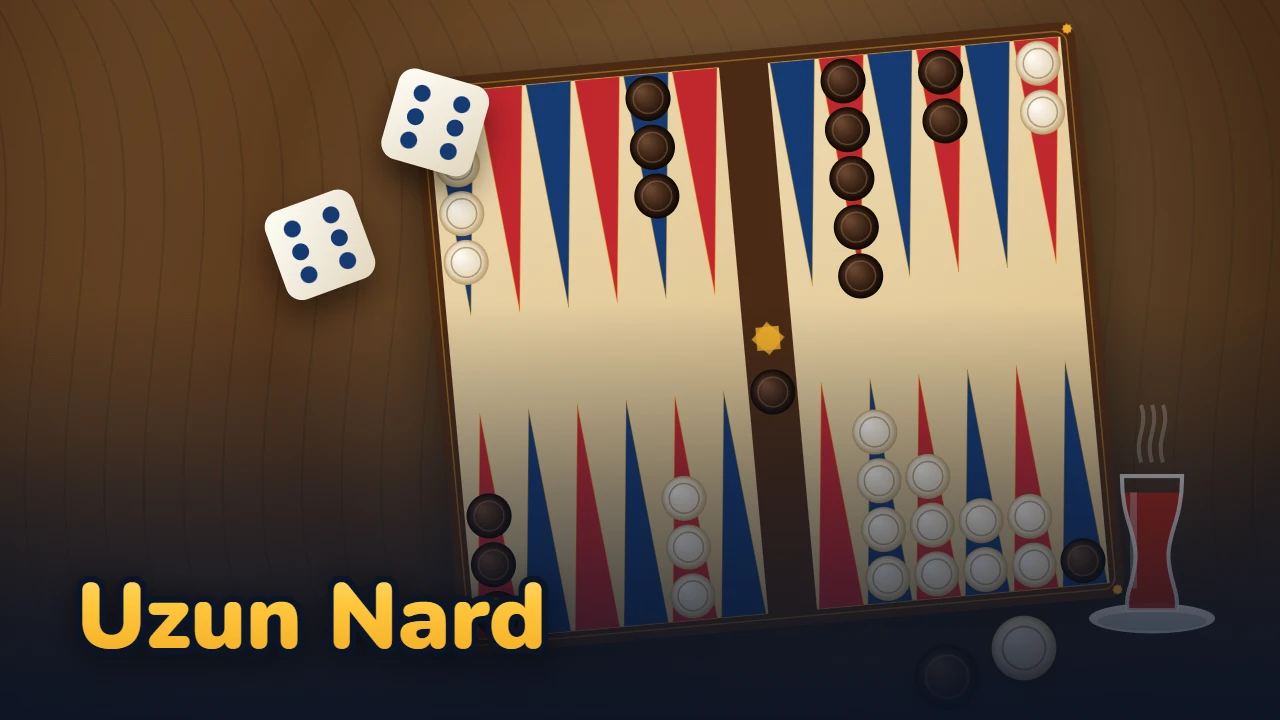
Long Nard
No hitting, a race in the same direction; one checker leaves the head per turn.
How to play
Roll the dice and move one checker the number of points shown on each die. Both sides start with 15 checkers on the head point in diagonally opposite corners and move in the same direction. There is no hitting: even a single opposing checker holds a point. Only one checker may leave the head each turn; two on your first roll. You may not close six points in a row in front of all your opponent's checkers. When all your checkers are home you bear them off; the first to bear off all 15 wins, and if your opponent has borne off none it is a mars worth 2 points.
How to play Long Nard: a guide to long nardy against the computer
Long Nard is a backgammon variant with no hitting, in which both sides move in the same direction. The checkers start on the head point in diagonally opposite corners, and only one checker may leave the head each turn, so the game opens slowly and with a plan. Because even a single checker holds a point, the real fight is about closing your opponent's road while keeping your own open. On CetinsGame you can play Long Nard against the computer at three levels, with a friend on the same device or with a friend online. This page opens the game straight on the Quick Game screen with Long Nard selected.
Goal and setup
The goal is to take your 15 checkers round the board into your home (the 6 points at the bottom right) and bear them all off before your opponent. At the start, each side's 15 checkers sit in a single stack on the head, in diagonally opposite corners. Your head is in the top right corner; your checkers move left along the top row and right along the bottom row. Your opponent's head is in the bottom left corner and their home at the top left. Because both sides move the same way, your roads cross all over the board.
Holding points: no hitting
- There is no hitting; no checker is ever taken off the board.
- A single checker holds a point: you cannot land on a point with an opposing checker.
- When you play both dice with one checker, the intermediate point must also be open.
- If you can play both dice you must play both; if you can play only one, you play the larger. A double is four moves.
The game applies the rules itself: when you touch a checker, only the points it can reach light up.
The head rule and the six-point prime
Head rule: only one checker may leave the head each turn. You play your other dice with checkers that are already on their way. Only on your first roll may two checkers leave the head; with 3-3, 4-4 or 6-6 there is no other way to play, so two checkers leave.
No six-point prime: you may not close six points in a row in front of all of your opponent's checkers. If at least one opposing checker is already ahead of it, a six-point prime is allowed. A five-point prime is always allowed.
Bearing off and scoring
Once all your checkers are home, you start bearing off. The checker on the point shown by the die comes off; if that point is empty you must move a checker from a higher point, and if there are no checkers higher up, the checker on the highest point comes off. The first to bear off all 15 wins the game: a game is 1 point, or a mars, 2 points, if the opponent has not borne off a single checker. Who starts: each side rolls one die, the higher roller rolls both dice again and begins; the next game is started by the winner of the previous one.
Modes, levels and points
- Quick Game: choose the Easy, Medium or Hard level and a 1, 3 or 5-point match. Each point of the match is worth 10 Tavla points on Easy, 25 on Medium and 50 on Hard; a mars brings bonus points.
- Two players: you play face to face on one device; no points are recorded.
- With a friend (online): set up a table, choose Long Nard as the game type and send the code or link. No account is needed; friend matches do not count towards points or rankings.
Coffeehouse Road, Position of the Day and Tavla School are played with classic tavla. Before ending your turn you can take back your moves with Undo, and three times per match Master's move? shows you the Hard level's move.
Strategy
Make every turn count. Since only one checker leaves the head each turn, getting all 15 checkers on their way takes at least fourteen turns. Using one die almost every turn to take a checker off the head and the other to advance checkers already on the road keeps the head from jamming later.
Close your opponent's road. Because a single checker holds a point, points held in a row become a wall in front of your opponent. A five-point prime on the points your opponent's checkers need on their way can keep them waiting for turns. A six-point prime is only allowed when an opposing checker is already ahead of it.
Keep your own road open. If you stack your checkers on a few points, you will find no room for big rolls. If you get stuck behind your opponent's wall, advance the checkers on the roads that are still open first. If you are behind in the race at the end, try to bear off at least one checker: a mars means 2 points.
Tips
- Take a checker off the head almost every turn; head checkers left too late get stuck at the end.
- If your first roll is 3-3, 4-4 or 6-6, two checkers leave the head.
- A single checker holds a point; you can close points on your opponent's road with just one checker.
- A five-point prime is always allowed; a six-point prime only when an opposing checker is ahead of it.
- Do not stack your checkers on a few points; leave open points for big rolls.
- If you are behind in the race, bring everything home and focus on bearing off at least one checker.
- When you are stuck, use Master's move? to see the Hard level's move and think about why.
Long Nard: the backgammon loved from the Caucasus to Central Asia
Long Nard is a no-hitting backgammon variant much loved in Azerbaijan, Russia and Central Asia; in Russian it is called длинные нарды, and in English it is often known as long nardy. Checkers are never hit, points are held by single checkers and the game turns into a patient race. The head rule and the ban on a six-point prime are the rules that set it most clearly apart from classic tavla.
- Other names
- Uzun Nard, long nardy, narde, длинные нарды
- Checkers
- 15 per player, on the head in diagonally opposite corners
- Direction
- Both sides move the same way
- Hitting
- None; a single checker holds a point
- Special rules
- One checker off the head per turn; no six-point prime
- Scoring
- Game 1 point, mars 2 points
The name nard
Nard is the old name of the backgammon family, coming from Persian, and it still lives on in many languages: nərd in Azerbaijani, нарды (nardy) in Russian. In Turkey the family is called tavla; the name Long Nard comes from what the game is called where it is played most. English sources also call it long nardy or narde.
Long and short nardy
In Russian the two big games of the backgammon family have different names. The game with hitting, in which the sides move towards each other and which resembles our classic tavla, is called short nardy (короткие нарды). The game with no hitting, in which both sides move the same way and the head rule applies, is called long nardy (длинные нарды). In these regions Long Nard is often seen as the "real" nardy and is the first one people learn.
Where it is played
Long Nard is widespread in Azerbaijan, Russia and Central Asia. People spend hours over the board in teahouses, courtyards, summer houses and homes. Like classic tavla, it is both a pastime and the subject of serious tournaments. With no hitting, the game flows more calmly; luck plays its part, but the player who plans ahead comes out on top in the long run. Those who know the game recognise a good Long Nard player by their patience and by when they take checkers off the head.
Its place in the game
Long Nard is one of the four game types in CetinsGame Tavla: Classic, Gülbahar, Mahbusa and Long Nard. It is played on the same board, with the same checkers and the same themes. You can choose it in Quick Game, in Two players mode and at With a friend (online) tables. The masters of Coffeehouse Road, Position of the Day and Tavla School stay with classic Turkish tavla.
Frequently asked questions
Can checkers be hit in Long Nard?
No. There is no hitting in Long Nard. Even a single opposing checker holds a point; you cannot land there.
What is the head?
It is the point where the checkers start: each side's 15 checkers stand in a single stack on their own head, in diagonally opposite corners.
Why can only one checker leave the head?
Because of the head rule: only one checker may leave the head each turn. On your first roll two may leave; with 3-3, 4-4 or 6-6 there is no other way to play.
What is the six-point prime ban?
You may not close six points in a row in front of all of your opponent's checkers. If at least one opposing checker is ahead of it, a six-point prime is allowed.
Is there a mars in Long Nard?
Yes. If you bear off all 15 checkers before your opponent has borne off any, it is a mars and you score 2 points. A normal game is worth 1 point.
What is the difference between long and short nardy?
Short nardy is the game with hitting, in which the sides move towards each other, much like classic tavla. In Long Nard there is no hitting, both sides move the same way and the head rule applies.
How do I choose Long Nard?
The game on this page opens on the Quick Game screen with Long Nard selected. If you opened Tavla elsewhere, choose Long Nard as the Game type on the Quick Game or Two players screen.
Can I play Long Nard online with a friend?
Yes. In With a friend (online) mode, set up a table, choose Long Nard as the game type and send the code or link. No account is needed; friend matches do not count towards points.
Is Long Nard free?
Yes. No download or account needed; it plays right in your browser. Watching an ad for a hint is always your choice.
Will I lose my progress?
Your progress is saved automatically on this device. Sign in and it moves to your account, so you can continue on any device.
Can I play on my phone?
Yes. The game opens full screen on phones; tap the X in the corner to exit. On iPhone use "Add to Home Screen" to play it like an app.
Can I play Long Nard offline?
Yes. A game you have opened once is stored on your phone or computer and opens without internet. Leaderboards and cloud saves need a connection.
Which languages are available?
Turkish, English, Spanish, Portuguese, German, French and Russian.
Comments
Sign in to write a comment.
No comments yet. Be the first.
