Kilim: a language woven flat
A kilim is a pileless rug woven in Anatolia for centuries. Unlike a carpet, it has no knots: coloured wefts pass between tight warps and are beaten down, so both faces are flat and the pattern is the cloth itself. Kilims were usually woven at home by women and often went into the dowry chest. Its motifs form a language of signs carrying the weaver's wishes.
Common motifs and their traditional meanings
Meanings can change from region to region. Take the list below as the general tendency of the tradition, not a strict dictionary.
- Elibelinde ("hands on hips"): a female figure, traditionally interpreted as motherhood and fertility.
- Ram's horn: known as a symbol of strength, heroism and abundance.
- Eye: believed to be woven as protection against the evil eye.
- Scorpion: read as protection against scorpions and against harm.
- Star: associated with happiness and good fortune.
- Tree of life: the idea of immortality and the continuity of the family line.
- Hair band: said to express a young woman's wish to marry.
Why always steps and diagonals?
The angular, stepped look of kilim motifs is not just a matter of taste. In flat weaving each colour travels back and forth within its own area, and where two colours meet, a small slit opens in the cloth. If that boundary stays in exactly the same place for many rows, the slit grows and the cloth weakens. So weavers avoid long vertical lines: they shift the boundary every few rows and build motifs from diamonds, zigzags and steps.
The Kilim game turns this rule into a puzzle
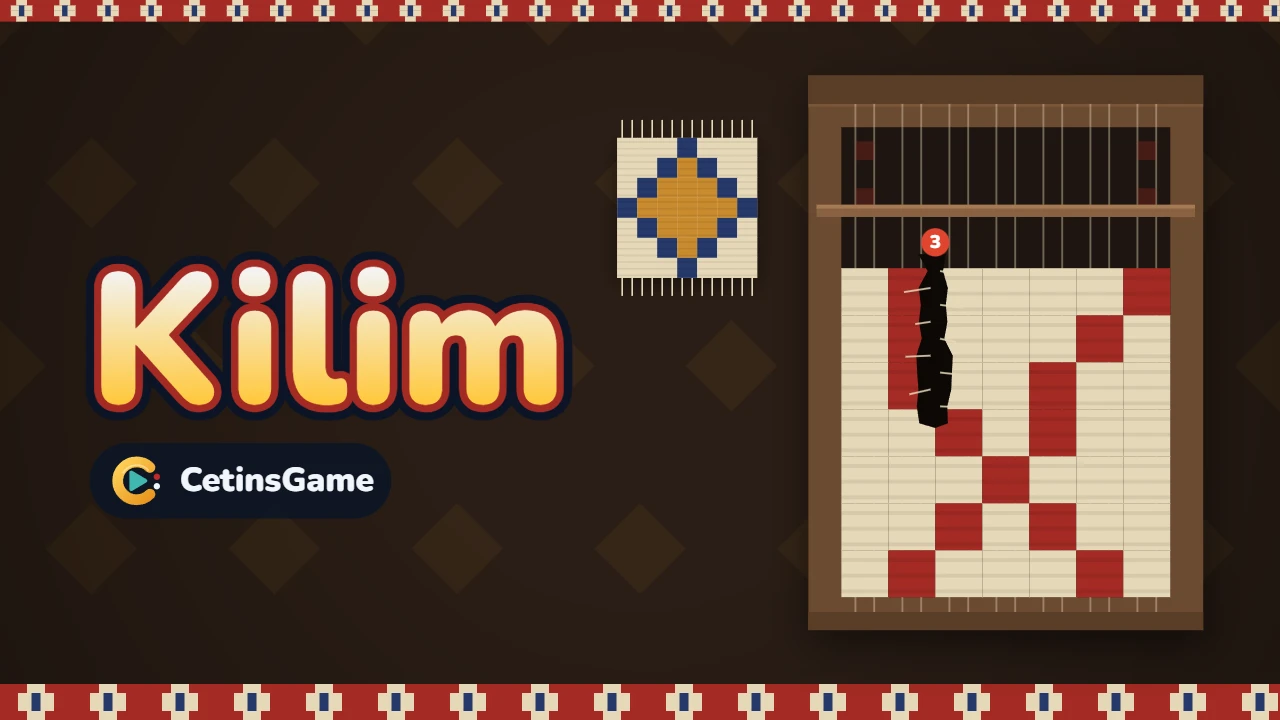
The Kilim game on CetinsGame is built on exactly this idea. You weave row by row from the bottom up: paint the cells of the current row by looking at the target pattern, then press Beat the weft. If the boundary between two colours stays in the same place for three rows, the cloth splits. A yellow counter says "break this boundary on the next row", a red one says "beat now and it tears". The target often cannot be woven exactly; the skill is to weave the closest kilim without tearing it.
In the story, your older sister's wedding is coming, and Grandma, who was going to weave the dowry kilim, can no longer see well. The 40 kilims are split into five chapters: The Courtyard, The Plateau, The Repair, Fine Wool and The Dowry. In The Repair you continue on the ready rows of Grandma's own torn dowry kilim; in Fine Wool a boundary cannot stay put even for two rows; the final chapter puts all four colours on the loom. You also get 24 real Anatolian motifs with their meanings, hints when you are stuck, and a home where your finished kilims are laid out.
The best way to understand stepped motifs is to weave one yourself. Play Kilim in your browser: free, no download.

Comments
No comments yet. Be the first.